
12 Volt Wire Connectors: 3 Kits Compared by Fit

Kuject 320-Piece Heat-Shrink Kit is the best starting point for most 12-volt wiring because its 320-piece assortment includes ring, fork, spade and heat-shrink butt terminals. Choose another kit if a 22-to-10 AWG range or a smaller assortment better matches your wire and repair needs; these connectors join wire ends or attach them to terminals.
We earn a commission if you buy through links on this page. As an Amazon Associate I earn from qualifying purchases. Products are compared on manufacturer specifications, not hands-on testing.
- Best overall: Kuject 320-Piece Heat-Shrink Kit – The 320-piece kit combines several common terminal styles with adhesive-lined heat-shrink butt connectors.
- Best for a large assortment: Oiojuct 600-Piece Heat-Shrink Kit – The 600-piece assortment includes butt, ring, spade and fork terminals.
- Best for a stated wire range: TICONN 120-Piece Heat-Shrink Kit – The assortment is identified for wire from 22 to 10 AWG.
| Product | Best for | Connector types | Kit count | Shop |
|---|---|---|---|---|
| Kuject 320-Piece Heat-Shrink Kit | Mixed terminal repairs | Ring, fork, spade, butt | 320 pieces | Check Price on Amazon |
| Oiojuct 600-Piece Heat-Shrink Kit | Larger assortment | Butt, ring, spade, fork | 600 pieces | Check Price on Amazon |
| TICONN 120-Piece Heat-Shrink Kit | Known wire range | Ring terminals | 120 pieces | Check Price on Amazon |
12 Volt Wire Connectors Compared
Match the terminal style and wire gauge to the connection before choosing an assortment.
Kuject 320-Piece Heat-Shrink Kit
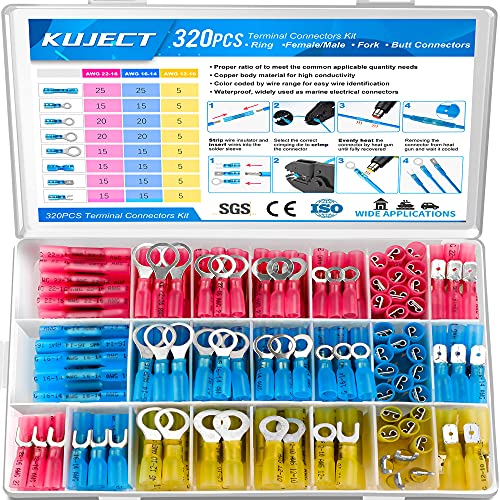
The 320-piece Kuject kit combines ring, fork, spade and heat-shrink butt terminals, making it a useful choice when a repair may need more than one connection style. Its copper cores provide conductivity, and the maker says the adhesive-lined tubing seals around the wire when heated. The translucent tubing also allows visual inspection of the connection. This assortment suits mixed automotive or marine wiring tasks. Its wire-gauge range is not identified here, so confirm the connector size matches the wire before crimping.
Bottom line: Choose this assortment for repairs that call for several common terminal styles.
Oiojuct 600-Piece Heat-Shrink Kit

The 600-piece Oiojuct kit has the largest assortment count among these kits and includes butt, ring, spade and fork terminals. The maker says the heat-shrink connectors provide waterproof insulation for automotive and marine wiring. Its range of terminal styles is useful when a project needs both wire-to-wire splices and ring or fork ends for attachment points. The specifications do not establish a wire-gauge range, so buyers should match each terminal to the actual wire gauge rather than assuming the assortment spans every common size.
Bottom line: Pick this kit when a larger assortment count is the priority.
TICONN 120-Piece Heat-Shrink Kit

The TICONN kit is the only assortment here with a wire range: 22 to 10 AWG. It contains red, blue and yellow ring terminals, with tinned copper barrels and dual-wall heat-shrink insulation. The maker says its 3:1 shrink tubing and heat-activated adhesive form a waterproof seal and resist corrosion. This kit suits buyers who need ring ends and can verify that their wire falls within the marked range. It is less suited to repairs requiring butt, fork or spade terminals, since the assortment is identified as a ring-terminal kit.
Bottom line: Choose this option when ring terminals and a defined 22–10 AWG range fit the job.
How to Choose 12 Volt Wire Connectors
Choose a connector by terminal style, wire gauge and exposure to moisture, in that order. Butt connectors join two wire ends; ring terminals fasten under a screw or stud; fork terminals can fit a loosened screw; and spade terminals make a disconnectable blade connection. A connector must match the conductor size: a terminal that is too large can pull off, while one that is too small may not accept the wire cleanly. For mixed repairs, an assortment with several terminal styles can reduce the need to combine unrelated connector types. For a single job, prioritize the exact style and gauge range instead of the total piece count.
Wire Gauge, Current and Voltage Drop
Wire gauge and circuit length both affect a 12-volt connection: longer runs and higher current increase voltage drop and heating risk. As a practical design target, keep voltage drop near 3% on critical circuits and no more than about 10% on less critical loads; at 12 volts, those figures equal 0.36 and 1.2 volts. A connector does not make undersized wire safe, so size the whole circuit for its current and one-way run length before selecting terminals. Use a terminal marked for the conductor gauge, and do not rely on color alone because color-to-gauge conventions can vary between assortments.
Sealing and Crimping Outdoor Connections
Heat-shrink terminals with adhesive lining help seal a crimp against moisture, but correct crimping still matters. Strip only enough insulation for the conductor to reach the barrel, use a crimping tool matched to the terminal, and pull-test the joint before shrinking the tubing. Apply heat evenly until the tubing conforms and adhesive appears at the edges; avoid an open flame near vehicle wiring or fuel vapors. For marine or exposed wiring, route connections above bilge water where possible and support the cable so vibration does not load the crimp. Heat-shrink tubing cannot compensate for loose strands, corrosion at the mating point or a poorly sized connector.
12 Volt Wiring Mistakes to Avoid
The most consequential mistake is leaving an unfused wire connected directly to a battery: protect the circuit with a fuse near its power source and size that fuse to protect the wire. Disconnect the negative battery terminal before working on vehicle wiring, and keep tools from bridging battery posts. Avoid mixing solid and stranded conductors in a terminal intended for stranded wire, and do not reuse a connector after a failed or overheated crimp. Keep high-current battery cable terminations separate from small-gauge accessory splices; they need appropriately sized lugs and tooling, not a small insulated crimp terminal. After installation, check that insulation is intact and the wire is secured against abrasion.
Frequently Asked Questions
Can I use heat-shrink connectors on 12-volt wiring?
Yes, if the connector is sized for the wire and the circuit current. Adhesive-lined heat-shrink tubing can help keep moisture out of a properly made crimp, but it does not replace a correctly sized fuse.
What do red, blue and yellow connectors mean?
Those colors commonly indicate different wire-gauge ranges, but the exact mapping can vary by manufacturer and kit. Check the package or terminal marking and match the size to the wire rather than relying on color alone.
How do I choose between a ring and fork terminal?
Use a ring terminal when the fastener can be removed and the connection should stay captured around the stud. A fork terminal can be convenient where a screw can be loosened without fully removed, but verify that its opening and tongue fit the hardware.
How much voltage drop is acceptable on a 12-volt circuit?
A common design target is about 3% for critical circuits and up to 10% for less critical loads. At 12 volts, that is 0.36 to 1.2 volts; longer wire runs and higher current make drop more likely.
Should I fuse a 12-volt wire near the battery?
Yes, place circuit overcurrent protection close to the power source so a short in the wire is protected. Select the fuse to protect the wire gauge and circuit, not just to match the connected device.