
24-Inch Lawn Mowers: 5 Models Compared by Fit

PACE 24-Inch 201cc RWD Mower is the closest match to a 24-inch lawn mower because its 24-inch deck is wider than the 21- and 22-inch alternatives. Choose a narrower mower if your yard has tight gates or many obstacles; a smaller deck is easier to maneuver through confined spaces.
We earn a commission if you buy through links on this page. As an Amazon Associate I earn from qualifying purchases. Products are compared on manufacturer specifications, not hands-on testing.
- Best overall: PACE 24-Inch 201cc RWD Mower – Its 24-inch cutting width is the only exact match for the requested size.
- Best for rear-wheel drive: SENIX 22-Inch 201cc Self-Propelled Mower – This 22-inch self-propelled mower pairs a 201cc engine with rear-wheel drive.
- Best for push mowing: SENIX 21-Inch 144cc Push Mower – Its 21-inch deck and push design are the lightest-weight option at 54.2 pounds.
| Product | Best for | Cutting width | Engine | Drive | Shop |
|---|---|---|---|---|---|
| PACE 24-Inch 201cc RWD Mower | Wide lawn passes | 24 in. | 201cc | RWD | Check Price on Amazon |
| YARDMAX 22-Inch 201cc FWD Mower | Front-wheel drive | 22 in. | 201cc | FWD | Check Price on Amazon |
| SENIX 21-Inch 144cc Push Mower | Push mowing | 21 in. | 144cc | Push | Check Price on Amazon |
| SENIX 22-Inch 201cc Self-Propelled Mower | Rear-wheel drive | 22 in. | 201cc | RWD | Check Price on Amazon |
| SENIX 22-Inch 201cc RWD Mower | Height adjustment | 22 in. | 201cc | RWD | Check Price on Amazon |
24-Inch Lawn Mowers and Close Alternatives
Compare the deck size and drive type first, then weigh engine and mowing-feature differences against your yard layout.
PACE 24-Inch 201cc RWD Mower

PACE 24-Inch 201cc RWD Mower is the only exact 24-inch match here, and its rear-wheel drive differs from the front-wheel-drive alternative. It has a 201cc engine, electric start, a 6-speed CVT, and high wheels; the maker says the CVT lets you match mower pace to your walking speed. A blower is rated at 150 CFM and up to 130 mph by the maker. This model suits open lawns where a wider pass can reduce the number of rows. Its 120.55-pound weight can make lifting or maneuvering in tight spaces more demanding.
Bottom line: Choose this for a 24-inch deck, electric start and self-propelled rear-wheel drive.
YARDMAX 22-Inch 201cc FWD Mower

YARDMAX 22-Inch 201cc FWD Mower is the front-wheel-drive alternative, with a 22-inch deck rather than the requested 24-inch width. Its 201cc engine is paired with a 6-speed CVT, automatic choke and aggressive spiked-tread rubber tires; the maker says the transmission lets you set pace using the shift lever. A deck-cleanout port and single-lever height adjustment add practical setup and cleanup features. This mower may suit a buyer who prefers front-wheel drive and accepts a narrower cut. The 95.7-pound weight and self-propelled format still require room to turn and store it.
Bottom line: Pick this when front-wheel drive and its deck-cleanout port matter more than a 24-inch cut.
SENIX 21-Inch 144cc Push Mower
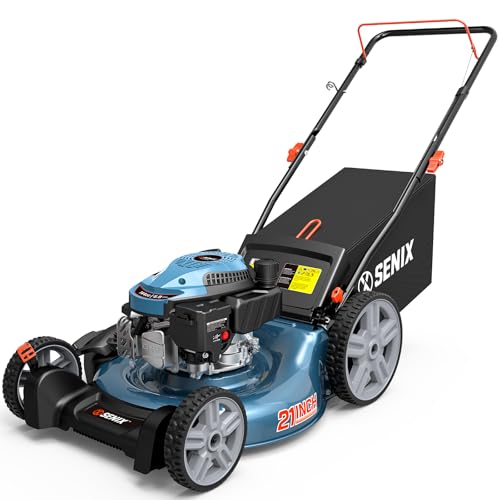
SENIX 21-Inch 144cc Push Mower is the push mower option and the narrowest deck in this group at 21 inches. Its 144cc four-stroke engine and steel deck support rear bagging, side discharge or mulching, with a 1.7-bushel catcher included. The maker says the engine comes pre-filled with oil and describes startup as quick. At 54.2 pounds, it is lighter than the other models, which can help when moving or storing a mower. The tradeoff is manual pushing rather than self-propulsion, so it is less suited to buyers who want the mower to drive itself across slopes or larger lawns.
Bottom line: Choose this if you want a lighter push mower and do not require a 24-inch deck.
SENIX 22-Inch 201cc Self-Propelled Mower

SENIX 22-Inch 201cc Self-Propelled Mower combines a 22-inch deck with a 201cc OHV engine and self-propelled rear-wheel drive, rather than the target 24-inch width. Its 11-inch rear wheels are a distinct feature for buyers comparing wheel size, and the maker describes the model as suited to medium and large lawns. The wider-than-21-inch deck can cover more ground per pass than SENIX 21-Inch 144cc Push Mower, while keeping a narrower cut than PACE 24-Inch 201cc RWD Mower. This option fits buyers prioritizing rear-wheel propulsion and a larger engine. The 79-pound weight is heavier than the push mower and may be a consideration for lifting into storage.
Bottom line: Pick this for a 201cc rear-wheel-drive mower if 22 inches is wide enough.
SENIX 22-Inch 201cc RWD Mower

SENIX 22-Inch 201cc RWD Mower offers a 22-inch cut and 201cc four-stroke OHV engine, with rear-wheel self-propulsion instead of a 24-inch deck. Its single-handle synchronized height control has six positions and a 1.25- to 4-inch range. The 3-in-1 setup supports bagging, mulching and side discharge. This mower suits buyers who want a defined mowing-height range and multiple clipping options without stepping up to the 24-inch model. Its 64-pound stated weight is lower than the other self-propelled options here, but the cut remains two inches narrower than the requested size.
Bottom line: Choose this for six-position height adjustment and a 22-inch rear-wheel-drive cut.
How to Choose a Lawn Mower Deck Width
Choose deck width by balancing mowing time against clearance and maneuverability. A 24-inch deck cuts a wider strip per pass than a 21- or 22-inch deck, but the full mower width also needs room to pass through gates and between obstacles. Measure the narrowest gate and compare it with the mower’s overall width, not just the cutting width. A practical rule: if the mower cannot pass through a gate with at least a couple of inches of clearance, choose a narrower model or plan another route. Turning space matters too; trees, beds and tight corners reduce the benefit of a wider deck because extra edging and repositioning can offset fewer straight passes.
Self-Propelled Versus Push Mowers
Self-propelled mowers drive their wheels, while a push mower moves only when the operator pushes it. Front-wheel drive can be easier to pivot when the front wheels are lifted, while rear-wheel drive tends to maintain traction when weight shifts toward the rear on inclines; wheel traction and lawn conditions affect both. For flat, compact yards, a push mower avoids a drive system and its added complexity. For longer routes or slopes, consider self-propulsion and whether the drive wheels match the terrain. Mow across a slope rather than directly up and down when practical, and avoid mowing wet grass, which reduces footing and traction.
Mulching, Bagging and Side Discharge
Three-in-one mowers can mulch clippings, collect them in a bag or discharge them to the side, but the right mode depends on grass length and conditions. Mulching works best when no more than about one-third of the grass blade is removed in a mowing; cutting more at once can leave clumps and stress turf. Bagging is useful for collecting clippings or leaves, but a full catcher adds weight and needs regular emptying. Side discharge is practical when clippings can lie on the lawn without covering plants or paths. Avoid mowing wet grass in any mode because damp clippings tend to clump and can obstruct the deck.
Safe Setup and Mowing Practices
Clear sticks, stones and toys before mowing because a rotating blade can throw debris. Keep children and pets away from the mowing area, and stop the engine before clearing clippings, checking beneath the deck or handling the blade; never reach under a running mower. Wear sturdy, closed-toe shoes and eye protection, and use hearing protection around gas-powered equipment. For a gas mower, use fresh fuel appropriate to the engine and check the oil before operation; a low-oil engine can be damaged quickly. Keep hands and feet clear of the blade, and disconnect the spark-plug wire before blade maintenance so the engine cannot start unexpectedly.
Frequently Asked Questions
How much faster does a 24-inch mower cut?
A 24-inch deck covers 2 more inches per pass than a 22-inch deck, about 9% more nominal width. Actual mowing time also depends on turning, overlap, terrain and obstacles.
Will a 24-inch mower fit through a 24-inch gate?
A mower with a 24-inch cutting deck may be wider than its deck measurement, so a 24-inch gate may not provide clearance. Measure the mower’s full outside width and the narrowest part of the gate before choosing.
How often should I sharpen a mower blade?
A common rule is to sharpen a mower blade after about 20 to 25 hours of mowing, sooner if it hits rocks or roots. A dull blade tears grass rather than making clean cuts.
What is the one-third rule for mowing grass?
The one-third rule means removing no more than one-third of the grass height in a single mow. If the lawn is too tall, raise the cut and mow again later rather than scalping it.
Is rear-wheel drive better on hills?
Rear-wheel drive can maintain traction on inclines when the mower’s weight shifts rearward, but slope, moisture, tire tread and operator control also matter. Avoid mowing steep or wet slopes, where traction can be unreliable.