
303 RV Wash and Seal: 4 RV Washes Compared

303 RV Wash & Seal, 1 Gallon is the closest match for a routine RV wash because its pH-neutral formula is designed to clean without stripping existing wax or coatings. Choose Liquishine RV Wash & Wax, 20 fl oz instead if you need a waterless option for quick cleanups; Poli Glow Poli Wash, 16 oz or Meguiar’s M43 Marine/RV Boat Wash, 64 oz suit buyers wanting a broadly usable foaming soap.
We earn a commission if you buy through links on this page. As an Amazon Associate I earn from qualifying purchases. Products are compared on manufacturer specifications, not hands-on testing.
- Best overall: 303 RV Wash & Seal, 1 Gallon – pH-neutral wash intended to leave existing waxes and coatings intact.
- Best for waterless washing: Liquishine RV Wash & Wax, 20 fl oz – Can be used with water or for waterless spot cleaning.
- Best for multi-surface use: Poli Glow Poli Wash, 16 oz – Made for boats, RVs, cars, and trucks across several surface types.
| Product | Best for | Size | Wash method | Finish or protection | Shop |
|---|---|---|---|---|---|
| 303 RV Wash & Seal, 1 Gallon | Routine RV washing | 128 fl oz | Bucket wash | Gloss and UV protection | Check Price on Amazon |
| Poli Glow Poli Wash, 16 oz | Multi-vehicle washing | 16 fl oz | Bucket wash | Free-rinsing foam | Check Price on Amazon |
| Liquishine RV Wash & Wax, 20 fl oz | Waterless spot cleaning | 20 fl oz | Wet or waterless | Waxed, slick finish | Check Price on Amazon |
| Meguiar’s M43 Marine/RV Boat Wash, 64 oz | Marine surfaces | 64 fl oz | Traditional wash | Wax-safe suds | Check Price on Amazon |
303 RV Wash and Seal and Similar RV Washes
Compare each formula by its washing method and the finish it is designed to leave behind.
303 RV Wash & Seal, 1 Gallon
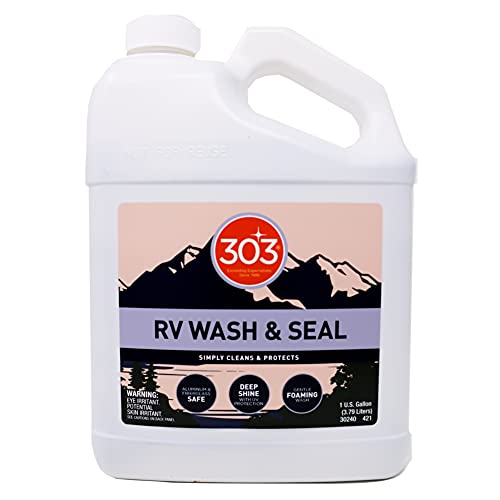
303 RV Wash & Seal, 1 Gallon is the only product here named specifically for RV washing, and its pH-neutral formula is intended to preserve existing waxes or coatings while cleaning. The gallon container holds 128 fluid ounces, and the maker’s directions call for 1 ounce of wash per 5 gallons of water. The formula is also described as high-foaming and as leaving a deep gloss with UV protection. It suits regular RV exterior washes where water and a bucket are available. Buyers who need a waterless cleanup should choose another formula, since this wash is presented as a traditional wash.
Bottom line: Choose this for routine bucket washing when preserving existing coatings is a priority.
Poli Glow Poli Wash, 16 oz

Poli Glow Poli Wash, 16 oz stands out for its broad use across boats, RVs, cars, and trucks, rather than an RV-only focus. Its concentrated soap calls for 1 to 2 ounces in a 5-gallon bucket, followed by washing with a soft cloth or applicator and a thorough fresh-water rinse. The maker says its pH-neutral, biodegradable formula works on fiberglass, gel coat, aluminum, and paint, and is safe for Poli Glow and ceramic finishes. This is a fit for owners who clean multiple vehicle types. The 16-ounce bottle is smaller than 303 RV Wash & Seal, 1 Gallon’s 128-ounce container, so it is less suited to buyers seeking a large-format supply.
Bottom line: Pick this when one soap needs to cover several vehicles and surface types.
Liquishine RV Wash & Wax, 20 fl oz

Liquishine RV Wash & Wax, 20 fl oz differs by offering both a traditional wash and waterless cleanup, making it the option for spot work when a full rinse is impractical. The 2-in-1 formula is designed to remove road film, dirt, and bugs while leaving a glossy, slick finish with water-repellent qualities. Its surface compatibility includes fiberglass and painted surfaces. Choose it for drive-day grime or isolated areas rather than assuming every wash must involve a bucket. The 20-fluid-ounce bottle is a smaller format, and its waterless mode suits quick cleanups better than a full exterior wash across a large RV.
Bottom line: Choose this for small or quick cleanups when a full water wash is inconvenient.
Meguiar’s M43 Marine/RV Boat Wash, 64 oz

Meguiar’s M43 Marine/RV Boat Wash, 64 oz is the marine-focused alternative, with compatibility for RVs alongside fiberglass gel coat and aluminum hulls. The maker describes its pH-balanced soap as producing long-lasting suds and cleaning while preserving existing wax. That makes it a practical choice for owners whose washing also includes a boat or aluminum surfaces. The container holds 64 fluid ounces, a middle size between the gallon format in 303 RV Wash & Seal, 1 Gallon and the smaller bottles in Poli Glow Poli Wash, 16 oz and Liquishine RV Wash & Wax, 20 fl oz. Its focus is marine cleaning, so buyers seeking a product framed specifically around RV gloss and UV protection may prefer 303 RV Wash & Seal, 1 Gallon.
Bottom line: Pick this when RV washing overlaps with routine boat and marine-surface cleaning.
How to choose an RV wash
Choose an RV soap by coating compatibility, water access, and the finish you want after washing. A pH-neutral cleaner is a useful default for waxed or coated surfaces because it is formulated to clean without stripping those layers; verify compatibility before using a new formula on delicate finishes. For a full wash, use a bucket-and-rinse soap and work in manageable sections so suds do not dry on the surface. For spot cleanup without practical rinse access, select a formula specifically designed for waterless use. A simple decision rule: if you cannot rinse the whole area with fresh water, prefer a product that explicitly allows waterless washing rather than improvising with a bucket soap.
RV wash methods and finishes
Traditional RV washing uses diluted soap, a soft applicator, and a fresh-water rinse; waterless products are intended for limited cleanup where water access is constrained. Suds help lubricate the wash surface, but they do not replace a soft cloth or careful technique. Work from the upper surfaces downward, rinse grit from the applicator often, and avoid scrubbing visible dirt dry, which can mar paint or gel coat. Wash in shade when possible and rinse before soap dries, especially on warm or windy days. Product claims such as gloss, water repellency, or UV protection describe the intended finish, not a substitute for checking that the formula suits the RV’s material and existing coating.
How much RV wash to mix
Follow the product’s dilution rather than assuming concentrated soaps share the same ratio. For a 5-gallon bucket, a formula calling for 1 ounce uses half the amount of one calling for 2 ounces, so measuring helps keep the mix consistent and avoids excess residue. Use a marked measuring cup or dedicated dilution bottle; do not estimate concentrate by eye. A soft wash mitt or cloth is preferable to a rough household sponge, and clean rinse water should remove suds before drying marks appear. If a formula’s directions do not give a clear amount for the job, confirm the dilution before mixing instead of applying concentrate undiluted.
Protecting RV paint, gel coat, and aluminum
RV exteriors may combine painted panels, fiberglass or gel coat, and metal trim, so surface compatibility matters more than the label’s broad promise of versatility. Test a new cleaner on a small, inconspicuous area first, particularly on older finishes or near decals and sealants. Use a separate clean applicator for lower panels where road grit accumulates, and rinse it frequently to avoid dragging abrasive particles across upper surfaces. Never use a pressure washer close to seams, vents, or decals; concentrated spray can force water behind seals or lift edges. For routine care, rinse loose grit first, wash gently, and dry with a clean, soft towel if water spotting is a concern.
Frequently Asked Questions
Can RV wash strip existing wax or coatings?
Some formulas are expressly described as safe for existing wax or coatings, while others make no such claim. For a waxed RV, choose a soap labeled pH-neutral or wax-safe and test an inconspicuous spot first.
How much soap goes in a 5-gallon bucket?
The products here call for between 1 and 2 ounces per 5-gallon bucket. Measure the specific formula’s dose, since the more concentrated wash uses a smaller amount.
Can waterless wash clean a whole RV?
Waterless products are useful for quick cleanups and spot work, but a traditional wash is better for an RV covered in heavy road grime. Rinse loose grit before wiping whenever water is available to reduce scratch risk.
What should I use on fiberglass gel coat?
Use a cleaner whose maker identifies fiberglass or gel coat as compatible, and test it on a small area first. Soft cloths and frequent rinsing help keep grit from scratching the surface.