
360 Degree Auto Camera Systems Compared by Coverage

For a vehicle-length limit of 22 feet, Weivision 360° Surround System is the clearest match because it specifies a four-camera 1080p surround system for vehicles within that length. Choose Weivision Universal 360° Bird View System instead if you want a universal bird’s-eye system and can arrange professional installation and mirror drilling; the dash cams record multiple views but are not the same kind of stitched surround system.
We earn a commission if you buy through links on this page. As an Amazon Associate I earn from qualifying purchases. Products are compared on manufacturer specifications, not hands-on testing.
- Best overall: Weivision 360° Surround System – Its four-channel 1080p surround system is specified for vehicles up to 22 feet.
- Best for universal fit: Weivision Universal 360° Bird View System – It is described as a universal surround system, with professional installation and 20 mm mirror holes required.
- Best for five-channel recording: Affver 5-Channel 360° Dash Cam – It records front, rear, left, right and cabin views, with 4K front video.
| Product | Best for | Camera channels | Video resolution | Stated vehicle fit | Shop |
|---|---|---|---|---|---|
| Weivision 360° Surround System | Vehicles up to 22 ft | 4 | 1080p | Up to 22 ft | Check Price on Amazon |
| Weivision Universal 360° Bird View System | Professional installation | 4 | — | Universal; excludes long vehicles | Check Price on Amazon |
| Affver 5-Channel 360° Dash Cam | Five-view recording | 5 | 4K front; 1080p others | — | Check Price on Amazon |
| IIWEY N6 4-Channel 360° Dash Cam | Night recording | 4 | 2K front; other resolutions not stated | — | Check Price on Amazon |
| 360 View 4-Channel Dash Cam | Time-lapse parking | 4 | 1080p | — | Check Price on Amazon |
360 Degree Auto Camera Systems
Choose between a stitched surround-view system for maneuvering and a multi-channel dash cam for recorded footage.
Weivision 360° Surround System
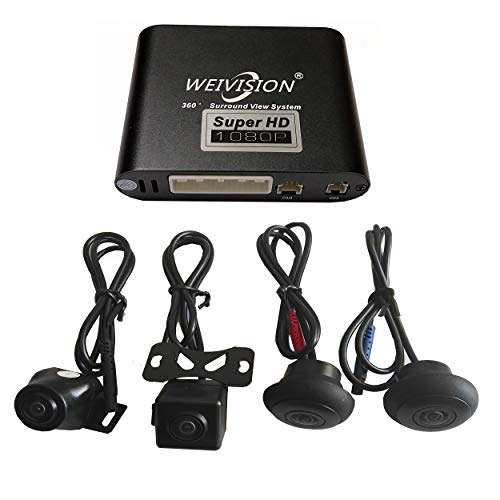
For a specified vehicle-length limit, this four-camera surround system is designed for vehicles within 22 feet. It records four 1080p channels, uses 190° fisheye cameras, and provides a bird’s-eye view intended to help with parking, blind spots and narrow turns. The system supports cycle recording and a maximum 32GB card. It suits drivers who want a surround view rather than separate dash cam perspectives. Its 22-foot fit limit matters for longer vehicles, and the system’s calibration and installation still need to be handled correctly for a useful composite view.
Bottom line: Choose this if your vehicle is within 22 feet and you want a four-camera surround view.
Weivision Universal 360° Bird View System

Unlike a multi-channel dash cam, this system is designed to combine four exterior camera views into a bird’s-eye view around the vehicle. The cameras have viewing angles above 170°, are rated IP69 for water resistance, and support night vision and parking monitoring with a shock sensor. The product calls for professional installation, including drilling a 20 mm hole in each side mirror for a camera. That installation requirement is the main trade-off: drivers who cannot modify their mirrors should consider a different setup.
Bottom line: Choose this if you want an exterior bird’s-eye system and can arrange mirror drilling.
Affver 5-Channel 360° Dash Cam

For recorded views from inside and outside the vehicle, this five-channel dash cam adds a cabin camera to front, rear, left and right recording. Its front channel records 4K, while the other four record 1080p; the included 128GB card and 1.5-inch screen are also specified. This is a better fit for drivers who want separate video footage from multiple directions than for those seeking a stitched, live bird’s-eye parking view. Its multi-camera recording is not a substitute for a dedicated surround-view system.
Bottom line: Choose this for five-channel video recording, including a cabin view.
IIWEY N6 4-Channel 360° Dash Cam

For a four-channel dash cam with adjustable side cameras, this model records front, rear and both sides, with 170° front and rear angles and 150° side angles. Its front camera records STARVIS 2K (1440p), and infrared night vision is included. Unlike a dedicated surround-view system, the N6 is described as a recorder, not as a stitched bird’s-eye display for parking. It must be connected to vehicle power while in use because it has no built-in battery; buyers who need a cable-free camera should choose another type.
Bottom line: Choose this for four-direction recording and infrared night vision.
360 View 4-Channel Dash Cam

For compressed parking footage, this four-channel dash cam offers time-lapse recording that compresses 60 minutes into one minute. It records 1080p video from front, rear, left and right, and includes a 128GB card, GPS, night vision and WDR. Parking mode requires an optional ACC hardwire kit, which is sold separately. This model suits drivers prioritizing recorded coverage and storage-conscious time-lapse, rather than a live stitched surround view; the additional hardwire kit is a meaningful requirement for parked-vehicle monitoring.
Bottom line: Choose this if time-lapse parking recording is a priority and you can add the hardwire kit.
How a 360 degree auto camera works
A surround-view system uses multiple wide-angle cameras and image processing to build a composite view around the vehicle. Camera placement and calibration matter because the system must align overlapping views; a shifted camera can make the stitched perspective misleading. Multi-channel dash cams also record several directions, but their purpose is recorded video, not necessarily a live, stitched overhead image. Choose a surround system for close-quarters maneuvering and a dash cam when the priority is retaining video evidence. Camera count alone does not establish that a product provides a bird’s-eye display.
Choosing by vehicle size and installation
Vehicle fit and mounting needs should decide the system before channel count. One option specifies use only on vehicles within 22 feet, while another requires professional installation and 20 mm holes in the side mirrors; those are concrete constraints to resolve before purchase. Check mirror construction, camera mounting locations, cable routes and available space for the display or recorder. A system described as universal still may not suit a long vehicle. Do not assume a dash cam’s multiple lenses will provide the same live parking perspective as a calibrated surround-view kit.
Surround systems and 360 dash cams compared
A surround camera system and a multi-channel dash cam solve different problems: one supports maneuvering, while the other records views for later review. Use this guide to match the camera type to the job.
| Need | Camera type | What to check |
|---|---|---|
| Live bird’s-eye view | Stitched surround system | Calibration and camera placement |
| Recorded front, sides and rear | Multi-channel dash cam | Channel coverage and resolution |
| Parking footage while off | Dash cam with parking mode | Power connection and hardwire needs |
Resolution figures describe recording detail, not how accurately an overhead image is stitched. For a parking system, setup and camera alignment are central to usefulness.
Installation and safe use
Camera systems can reduce blind spots, but they do not replace direct checks before moving. Wide-angle lenses distort distance near the edges, and a composite view depends on correct camera alignment. With mirror-mounted cameras that require a 20 mm hole, use a professional installer if drilling or wiring is outside your skills. Hardwired parking modes draw power from the vehicle, so confirm the required kit and power setup before relying on monitoring while parked. Keep the lens surfaces clean and verify each view after installation; never treat a camera image as proof that the path is clear.
Frequently Asked Questions
Do 360 dash cams show a bird’s-eye view?
Some systems stitch camera feeds into a bird’s-eye view, but multi-channel dash cams may only record separate perspectives. Confirm that the specific system explicitly offers a live surround display if parking guidance is the goal.
How many cameras does a 360 car system need?
Four cameras are common for front, rear and side coverage in a surround-view setup. Coverage and the finished view still depend on camera placement and calibration, not camera count alone.
Can a 360 camera system fit a long vehicle?
Check the vehicle-length limit before choosing a surround system. One system here specifies vehicles up to 22 feet, while another excludes long vehicles.
Does a dash cam record while the car is parked?
Parking recording may require vehicle power after the ignition is off. One four-channel model requires an optional ACC hardwire kit, so confirm the power arrangement before expecting parked-vehicle recording.
Are 360 camera views enough to park safely?
No camera view replaces checking the area directly before moving. Wide-angle imagery can distort distances, so use the display as an aid and verify the path around the vehicle.