
6-Inch Polish Pads: Five Options Compared by Fit

Meguiar’s Professional 6-Inch Foam Pads is the closest match for 6 inch polish pads because its foam face is 6 inches, while several kits use 6.5-inch faces intended for a 6-inch backing plate. Choose a larger-face kit for broader coverage or a defined cutting/finishing grade; check that the pad face and backing plate are compatible before ordering.
We earn a commission if you buy through links on this page. As an Amazon Associate I earn from qualifying purchases. Products are compared on manufacturer specifications, not hands-on testing.
- Best overall: Meguiar’s Professional 6-Inch Foam Pads – Its 6-inch foam pad size most directly matches the search.
- Best for mixed cutting: SPTA SQMIX65 Mixed-Cut Pads – It offers five foam pads with multiple cutting grades.
- Best for finishing: SPTA Red T10 Ultra-Fine Finishing Pads – Its red T10 foam is intended for ultra-fine finishing.
| Product | Best for | Pad face | Count | Pad type | Shop |
|---|---|---|---|---|---|
| Meguiar’s Professional 6-Inch Foam Pads | Light defect polishing | 6 in | 2 pads | Foam | Check Price on Amazon |
| SPTA SQMIX65 Mixed-Cut Pads | Multiple cutting grades | 6.5 in | 5 pads | Foam | Check Price on Amazon |
| SPTA Red T10 Ultra-Fine Finishing Pads | Fine finishing work | 6.5 in | 3 pads | Foam | Check Price on Amazon |
| ZFE 6-Inch Waffle Foam and Wool Kit | Waffle foam polishing | 6 in (150 mm) | 7 pads | Foam and wool | Check Price on Amazon |
| KUIMIT 6-Inch Buffing Pad Kit | Reusable mixed materials | 6.5 in | 6 pads | Foam and wool | Check Price on Amazon |
6 inch polish pads compared
Compare pad face and intended polishing task against your backing plate and finish goal.
Meguiar’s Professional 6-Inch Foam Pads

For a true 6-inch pad face, this pair is the most direct fit among these choices. Meguiar’s says the foam pads work with polishing compound for light to moderate scratches, swirls and haze, or with a one-step product for cleaning, polishing and protection. They can be used with rotary and dual-action polishers. The pair is suited to a paint-polishing step rather than a kit of multiple cutting grades. Buyers seeking a wool pad or several foam aggressiveness levels should choose a kit instead.
Bottom line: Pick this pair when a 6-inch foam face and light-defect polishing are the priorities.
SPTA SQMIX65 Mixed-Cut Pads

SPTA’s five-pad set stands apart by separating foam into several cutting grades, rather than supplying one general polishing face. The faces measure 6.5 inches for a 6-inch, 150 mm backing plate. This is a fit for buyers matching pad aggressiveness to different paint-correction steps.
Bottom line: Choose this set for several foam cutting grades on a compatible 6-inch plate.
SPTA Red T10 Ultra-Fine Finishing Pads
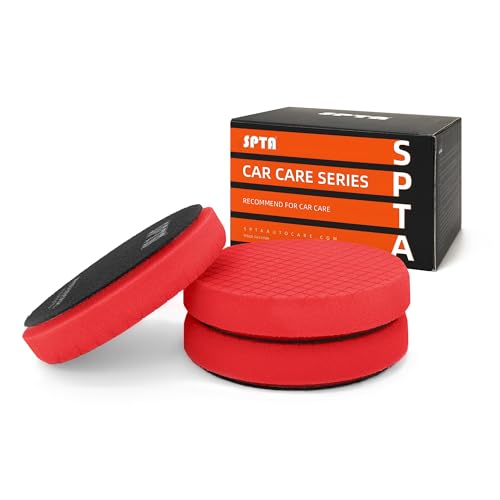
SPTA’s red T10 set focuses on ultra-fine finishing instead of a spread of cutting strengths. The maker says the foam is intended for car-wash scratches and ultra-fine swirl marks, and recommends it with finishing polish on rotary or dual-action polishers. Each face is 6.5 inches for a 6-inch, 150 mm backing plate. The grooved design is intended to hold excess polish and aid airflow. This set suits a final gloss step; choose a heavier-cut pad when the job calls for deeper defect correction rather than fine finishing.
Bottom line: Pick these pads for a finishing step on a matching 6-inch backing plate.
ZFE 6-Inch Waffle Foam and Wool Kit

ZFE combines waffle-pattern foam pads with a wool pad, giving this kit a different pad mix from the foam-only choices. The maker says the waffle texture improves surface contact, holds polish and supports airflow, while the foam is washable and reusable. The set is described for compounding, polishing and waxing with a 6-inch backing plate. Its 6-inch (150 mm) size is closer to the named plate size than a 6.5-inch-face kit. Buyers who need a specifically graded finishing pad should instead look for a set that identifies a fine finishing grade.
Bottom line: Choose this kit if you want waffle foam pads and a wool pad for a 6-inch plate.
KUIMIT 6-Inch Buffing Pad Kit

KUIMIT’s six-pad kit combines sponge and wool pads and uses a honeycomb structure, unlike the waffle-textured foam set. The maker says the pads are washable and reusable, attach with hook-and-loop backing, and suit waxing, polishing and sealing glaze. The 6.5-inch faces are intended for a 6-inch backing plate, and the set is also described for several buffer types. This mix suits buyers wanting both foam and wool materials for general buffing. It does not provide the clearly differentiated cutting grades of a correction-focused foam set.
Bottom line: Pick this kit for a washable foam-and-wool mix with hook-and-loop attachment.
How to choose 6 inch polish pads
Start with the backing plate diameter, then match the pad face and the work stage. A pad face equal to the plate diameter is a straightforward match; some kits intentionally use a slightly larger face, such as 6.5 inches on a 6-inch plate. Foam pads can be made for cutting, polishing or finishing, while wool is commonly used for more aggressive compounding. Match the pad to the polish or compound and the paint defect: fine swirls call for less cut than deeper oxidation or sanding marks. If the product gives a pad grade, use that rather than color alone; color coding differs by maker.
For a 6-inch plate, choose a 6-inch face when exact dimensions are the priority, or a 6.5-inch face when the kit explicitly specifies that plate size. Never use a pad whose attachment does not match the tool’s backing system.
Pad face size and backing plate fit
A 6-inch backing plate measures about 150 mm across, while a pad face can be larger than the plate it attaches to. The face diameter affects how much paint the pad contacts at once; a larger face can cover more area, while a smaller face can be easier to maneuver around tighter contours. Confirm that the pad’s attachment diameter and backing system match the tool, not just the nominal pad size.
Use this quick fit rule: choose a 6-inch face for a direct size match, and consider a 6.5-inch face only when the kit specifies a 6-inch backing plate. Keep the pad centered on its plate; an overhanging edge can catch on trim or concentrate pressure. Avoid polishing sharp edges and raised body lines, where paint is thinner.
Foam, waffle and wool pads compared
Foam is available across a wide range of cutting strengths, so the pad grade matters as much as the material. Waffle texture changes the pad surface pattern, while wool is a different material often selected for compounding. The product mix and intended task are the useful distinctions when choosing a kit.
The table maps common needs to the pad type to consider; actual correction depends on paint hardness, compound and tool speed.
| Need | Pad type to consider | Trade-off |
|---|---|---|
| Fine finishing | Fine-grade foam | Not meant for heavy correction |
| Multiple correction steps | Foam grades with different cut | Requires matching grade to compound |
| Compounding | Wool or heavier-cut foam | May leave a finish that needs follow-up polishing |
| General polish application | Foam, including textured designs | Texture alone does not establish cutting grade |
Safe use and pad care
Keep a polisher moving and use light pressure, especially on edges and body lines; prolonged work in one spot can build heat and damage paint. Start with the least aggressive pad and compound that can address the defect, then step up only if needed. Work a small test area before polishing a full panel so the combination can be checked on that paint.
Clean pads between sections to keep spent compound and removed paint from accumulating in the foam or wool. Washable pads should be rinsed after use and allowed to dry completely before storage. Replace a pad that is torn, permanently misshapen or no longer stays attached securely, and never run a loose pad on a powered polisher.
Frequently Asked Questions
Will a 6.5-inch pad fit a 6-inch backing plate?
A 6.5-inch face can be made for a 6-inch backing plate, as specified for some of these kits. Check the kit’s plate compatibility and attachment style rather than assuming every 6.5-inch pad fits.
What pad should I use for fine swirl marks?
A fine finishing foam pad is the appropriate starting point for fine swirls. Pair it with a compatible finishing polish and test a small area before treating a full panel.
Can I use one pad for compound and wax?
Use separate pads for compound and wax to avoid carrying abrasive residue into the finishing step. Mark each pad by task and wash it after use if its maker allows washing.
How often should I clean car polishing pads?
Clean a pad whenever spent polish or residue builds up, and between products or correction stages. A loaded pad can cut inconsistently and trap abrasive debris against the paint.