
6 Volt Lantern Batteries: Four Types Compared

For a standard spring-terminal lantern battery, Eveready Super Heavy Duty 1209 is the straightforward single-cell choice; NERMAK 6V 6Ah LiFePO4 2-Pack suits buyers who want a rechargeable 6V 6Ah option. Choose another option if your device requires a specific chemistry, terminal arrangement or replacement model.
A lantern battery is a large-format 6-volt cell used in some lanterns and other compatible equipment, but the voltage alone does not establish fit.
We earn a commission if you buy through links on this page. As an Amazon Associate I earn from qualifying purchases. Products are compared on manufacturer specifications, not hands-on testing.
- Best overall: Eveready Super Heavy Duty 1209 – A single 6V spring lantern battery intended for lanterns and other low-drain devices.
- Best rechargeable: NERMAK 6V 6Ah LiFePO4 2-Pack – A 6V 6Ah LiFePO4 battery with a rechargeable design and built-in protection circuitry.
- Best multipack: Interstate DRY1403 6-Pack – A six-count 6V carbon-zinc pack with spring terminals.
- Best alkaline option: Duracell MN908 2-Pack – A two-pack of 6V alkaline batteries for buyers seeking that chemistry.
| Product | Best for | Chemistry | Pack count | Terminal or form | Shop |
|---|---|---|---|---|---|
| Eveready Super Heavy Duty 1209 | Single-cell replacement | Super heavy duty | 1 | Spring lantern | Check Price on Amazon |
| NERMAK 6V 6Ah LiFePO4 2-Pack | Rechargeable use | LiFePO4 | 2 | Spring S2 | Check Price on Amazon |
| Interstate DRY1403 6-Pack | Six-cell supply | Carbon zinc | 6 | Spring terminals | Check Price on Amazon |
| Duracell MN908 2-Pack | Alkaline chemistry | Alkaline | 2 | MN908 | Check Price on Amazon |
6 Volt Lantern Batteries Compared
Start with device compatibility, then compare chemistry, pack count and terminal style.
Eveready Super Heavy Duty 1209

Unlike the multipacks and rechargeable alternative, this is a single spring lantern battery aimed at everyday device replacement. Eveready identifies lanterns, smoke alarms, flashlights and other low-drain devices as intended uses; the battery weighs 1.29 lb and measures 4.5 × 2.6 × 2.6 inches. The maker says it has dependable, long-lasting power and contains zero added mercury and cadmium. It suits someone replacing one compatible battery. The limitation is its one-cell pack, which is less suitable when you need multiple replacements on hand.
Bottom line: Pick this for a single compatible lantern or low-drain device replacement.
NERMAK 6V 6Ah LiFePO4 2-Pack

The rechargeable chemistry sets this pair apart from the single-use options: each battery is a 6V 6Ah LiFePO4 unit with spring S2 terminals. NERMAK says the batteries include a BMS for overcharge, over-discharge, over-current and short-circuit protection, and claims 2,000-plus cycles. Each weighs 1.6 lb and measures 4 × 2.64 × 2.64 inches. This option suits repeat use in compatible 4R25 lanterns or other equipment. Its particular terminal style and dimensions make checking the device’s required battery format essential.
Bottom line: Choose this pair if your device accepts the S2-terminal format and you want rechargeable cells.
Interstate DRY1403 6-Pack
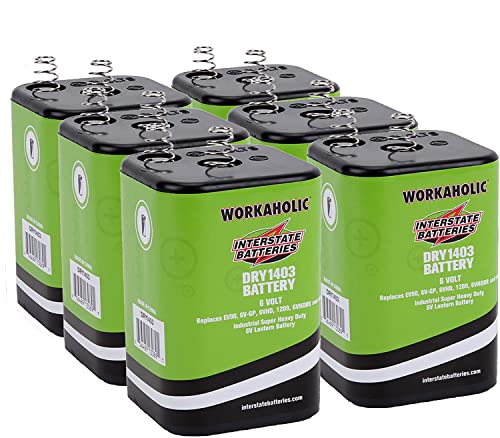
The six-count pack distinguishes this carbon-zinc option from the single battery and two-pack choices. Interstate identifies it as a 6V heavy duty lantern battery with spring terminals and says it can power lanterns, flashlights and other equipment. The maker also cites a 12-month performance warranty. This pack suits households or outdoor users who need several compatible replacements available. Its carbon-zinc chemistry and spring-terminal configuration are specific requirements, so buyers should not assume that every 6V device accepts this battery just because the voltage matches.
Bottom line: Pick this when you need six compatible carbon-zinc lantern batteries.
Duracell MN908 2-Pack

Alkaline chemistry is the key distinction of this two-pack, compared with the carbon-zinc and LiFePO4 alternatives. The product is identified as a 6V Duracell MN908 battery in a pack of two; each weighs 2.84 lb and measures 3.6 × 2.7 × 2.8 inches. It suits buyers whose equipment specifically calls for the MN908 or a compatible 6V alkaline lantern battery. The maker gives no terminal configuration, so that physical fit should be confirmed against the device before choosing it.
Bottom line: Choose this if your device specifies a compatible 6V alkaline MN908.
How to choose a 6 volt lantern battery
Choose by the device’s required battery format, not voltage alone: a 6V rating does not guarantee matching dimensions, terminals or chemistry. Traditional lantern batteries commonly use a rectangular 4R25-style case with spring terminals, while replacements may use different internal chemistries. For recurring use, a rechargeable cell can reduce single-use replacements, but only when the device supports its dimensions and terminals. Compare stated capacity in amp-hours when available; higher amp-hours generally indicate more stored charge at a given voltage, though actual runtime also depends on the device’s current draw. If the manual specifies a model or terminal type, match that before buying.
| Need | Compare |
|---|---|
| One replacement | Pack count and exact battery format |
| Repeated use | Rechargeable chemistry and capacity |
| Several replacements | Pack count and chemistry |
Fit and terminals for lantern batteries
Physical fit depends on both the battery case and its contacts; spring terminals must reach and seat against the device’s contacts without forcing the battery into place. A common 4R25 lantern battery is roughly 4.5 inches tall and about 2.6 inches wide and deep, but replacement formats can differ. Measure the battery compartment and compare the terminal layout with the removed battery or device manual. When less than about 0.1 inch of clearance remains around a replacement, verify the dimensions carefully rather than assuming the case will fit. Never bridge terminals with metal or install a cell backward: a short circuit can cause heat or leakage.
Lantern battery chemistry and capacity
Lantern batteries may use carbon-zinc, alkaline or rechargeable lithium iron phosphate chemistry, and those chemistries are not automatically interchangeable in every device. Capacity in amp-hours (Ah) is a useful comparison when manufacturers provide it; 6Ah means a nominal six amp-hours under specified test conditions, not a guaranteed runtime in any lantern. Current draw, temperature and battery age affect actual operating time. A low-drain device may draw less current than a bright lantern, so the same battery can last for different periods in different equipment. Use the chemistry and model required by the device maker, especially when replacing a disposable cell with a rechargeable one.
Safe storage and replacement
Store spare batteries in a cool, dry place and keep terminals away from loose keys, coins and other conductive objects; contact between terminals can create a short. Remove a leaking or damaged battery with care and avoid contact with its contents. Do not mix old and new cells or different chemistries in multi-cell equipment, since unequal discharge can increase leakage risk. For rechargeable LiFePO4 cells, use a charger designed for that battery chemistry and voltage rather than a charger for a different lithium type. Recycle spent batteries through a local battery collection program where available; do not put damaged or leaking cells loose in household storage.
Frequently Asked Questions
Are all 6 volt lantern batteries interchangeable?
No; the same 6V rating does not ensure matching case size, terminal arrangement or chemistry. Compare the device’s required battery model and compartment dimensions before choosing a replacement.
What does 6Ah mean on a lantern battery?
A 6Ah rating represents nominal charge capacity of six amp-hours under specified conditions. Actual runtime changes with device current draw, temperature and battery condition.
Can I replace a disposable lantern battery with rechargeable lithium?
Only if the device accepts the replacement’s voltage, dimensions and terminals, and its maker permits that chemistry. A rechargeable LiFePO4 battery also needs a charger compatible with its chemistry.
How should I store spare lantern batteries?
Keep them in a cool, dry place with terminals protected from metal objects. Avoid storing loose batteries with keys or coins, since a short circuit can generate heat.