
90 Degree XLR Cable Options Compared by Length and Fit

Cable Matters Right Angle XLR Cable, 6 ft suits most people because its 6-foot cables provide more reach than the short adapter options. Choose Togconn 90-Degree XLR Adapter, 0.6 ft, 6-Pack instead for compact 0.6-foot connections or Devinal Adjustable-Angle XLR Cable, 1 ft, 2-Pack for an adjustable-angle male connector.
A 90-degree XLR cable turns the connector sideways to reduce the space needed behind audio equipment; matching connector gender and available clearance matters as much as cable length.
We earn a commission if you buy through links on this page. As an Amazon Associate I earn from qualifying purchases. Products are compared on manufacturer specifications, not hands-on testing.
- Best overall: Cable Matters Right Angle XLR Cable, 6 ft – Two 6-foot cables provide more reach than the compact adapter options.
- Best for short extensions: Togconn 90-Degree XLR Adapter, 0.6 ft, 6-Pack – Six 0.6-foot adapters provide compact female-to-male connections.
- Best for angle adjustment: Devinal Adjustable-Angle XLR Cable, 1 ft, 2-Pack – The male connector angle can be adjusted to suit the available clearance.
| Product | Best for | Length | Pack size | Connector setup | Shop |
|---|---|---|---|---|---|
| Cable Matters Right Angle XLR Cable, 6 ft | Longer cable reach | 6 ft | 2 cables | XLR to XLR; 90-degree connector | Check Price on Amazon |
| Togconn 90-Degree XLR Adapter, 0.6 ft, 6-Pack | Compact connections | 0.6 ft | 6 adapters | Female to male; 90-degree female | Check Price on Amazon |
| Devinal Adjustable-Angle XLR Cable, 1 ft, 2-Pack | Flexible connector angle | 1 ft | 2 cables | Male adjustable-angle to straight female | Check Price on Amazon |
90 Degree XLR Cables and Adapters
Choose by cable reach, connector gender, and whether the angle is fixed or adjustable.
Cable Matters Right Angle XLR Cable, 6 ft

Unlike the short adapters, this pair gives you 6 feet of cable per connection for more flexible placement of a microphone or audio device. The cables use oxygen-free copper conductors, a soft PVC jacket, heavy-duty metal connectors, and copper-braided shielding. Cable Matters says the shielding helps reduce hum and noise. The 90-degree connector is suited to crowded spaces where a straight plug would stick out farther. The connector gender and which end is angled are not clear from the product name, so check that against your equipment before ordering.
Bottom line: Pick this pair when you need several feet of cable rather than a short port adapter.
Togconn 90-Degree XLR Adapter, 0.6 ft, 6-Pack

This six-pack is the most compact option, with each 0.6-foot adapter changing the connection direction instead of supplying a long microphone cable. It has a 90-degree female connector and a straight male connector, with metal connectors, pure copper wire, and aluminum-foil shielding. The maker says its self-locking design holds the connection securely and its shielding resists interference. This format suits tight gaps between a device and a wall, but 0.6 feet leaves little room to reposition connected equipment.
Bottom line: Choose these when several devices need short, right angle XLR connections.
Devinal Adjustable-Angle XLR Cable, 1 ft, 2-Pack
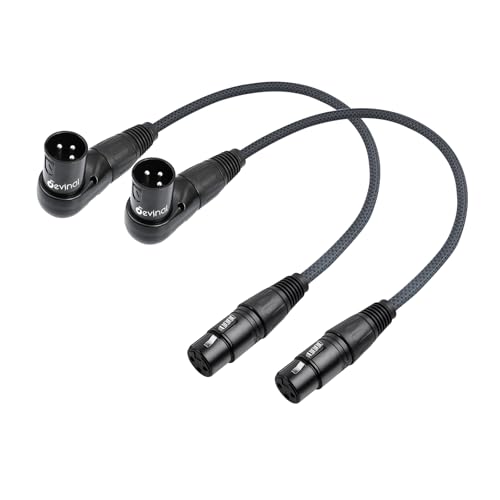
The adjustable male connector distinguishes this pair from the fixed-angle cables and adapters, letting you set the plug direction for a particular port layout. Each cable is 1 foot long and runs from an adjustable-angle male XLR connector to a straight female connector. It has oxygen-free copper conductors, a braided cover, metal connector housing, and copper shielding; Devinal says the shielding helps reject noise. The short length is useful for close connections, but it is not a substitute for a longer microphone run.
Bottom line: Pick this pair when the male plug needs to turn to a specific angle.
How to Choose a 90 Degree XLR Cable
Start with connector gender, then compare the cable length and the direction of the angled end. Standard three-pin XLR connections use pin 1 for shield, pin 2 for the positive signal, and pin 3 for the negative signal; a right angle shell changes the plug’s physical direction, not the pin assignment. Balanced XLR connections carry the signal on pins 2 and 3, which helps reject noise picked up along a cable run. If the connector sits less than about 2 inches from a wall or neighboring gear, measure the clearance and plug orientation before choosing an elbow. A short adapter can clear a tight port, while a longer cable allows equipment to sit farther apart.
Avoid assuming that every right angle XLR has the same gender or angled end. Match the male and female ends to the ports you need to connect, and note whether the angle is fixed or adjustable.
XLR Cable Length and Connector Fit
Choose cable length based on the distance between devices plus enough slack to route the cable without pulling on either connector. A 1-foot lead is intended for close equipment; it cannot replace a 6-foot run when devices are several feet apart. A 0.6-foot adapter changes direction near a port, but contributes little repositioning range. Leave a gentle loop instead of bending a cable sharply at the connector, since repeated tight bends concentrate strain at the plug and cable entry.
Use this fit guide to match the format to the physical connection you need.
| Connection need | Useful format | Measure first |
|---|---|---|
| Device farther away | Longer XLR cable | Route distance plus slack |
| Port close to a wall | Right angle adapter | Port clearance and plug direction |
| Unusual plug orientation | Adjustable-angle connector | Space around the connector |
Balanced XLR Connections and Cable Care
Three-pin XLR is the common balanced audio connector format, but a three-pin plug alone does not establish that a cable will fit: gender and signal direction still matter. Keep cable runs away from power cords where practical, and avoid coiling excess cable tightly around the connector. For stage or studio use, secure loose cable runs so people cannot snag them or trip. Inspect plugs for bent pins, loose shells, and damaged insulation before connecting equipment; disconnect by gripping the connector body rather than pulling the cable. If a cable must cross a walkway, protect or reroute it rather than relying on the connector to withstand a pull.
Frequently Asked Questions
Does a right angle XLR connector change the audio signal?
A right angle shell changes the plug’s direction, not the standard three-pin assignment. Pin 1 is shield, pin 2 carries the positive signal, and pin 3 carries the negative signal.
How much clearance does a 90-degree XLR plug need?
Measure the port area and compare it with the connector’s full profile; a right angle plug still needs room for its shell and cable exit. If the space is under about 2 inches, verify the connector orientation and dimensions before choosing.
Can I connect two XLR cables with a short adapter?
A female-to-male adapter can join compatible XLR connections while changing their direction, but it does not add much reach. Use a longer cable when the devices need to be separated by several feet.
How should I route an XLR cable near power cords?
Keep audio and power cables separated where practical, and cross them at roughly 90 degrees if their paths must intersect. Secure cable runs across walkways to prevent trips and strain on the connectors.