
TRQ Brakes: Five Kits Compared by Vehicle Fit

TRQ brake kits can suit your repair if the kit matches your vehicle’s year, model, trim and brake configuration; the deciding factor is fit, not the brand name alone. Choose a different kit when your vehicle falls outside its applications, and verify the production-date or rotor-size conditions where they apply.
We earn a commission if you buy through links on this page. As an Amazon Associate I earn from qualifying purchases. Products are compared on manufacturer specifications, not hands-on testing.
- For WRX and Legacy/Outback: TRQ Subaru WRX/Legacy Front & Rear Kit – Includes front and rear ceramic pads and rotors for the named Subaru applications.
- For Impreza and related models: TRQ Subaru/Scion Front Ceramic Kit – Includes front ceramic pads and rotors for several Subaru and Scion applications.
- For 2010–2011 F-150: TRQ Ford F-150 Front & Rear G-Coated Kit – Covers front and rear with ceramic pads and premium G-coated rotors.
- For Passat: TRQ VW Passat Front & Rear Kit – Includes front and rear ceramic pads and rotors, with a production-date qualification.
| Product | Best for | Axle coverage | Rotor finish | Shop |
|---|---|---|---|---|
| TRQ Subaru WRX/Legacy Front & Rear Kit | Subaru front and rear | Front and rear | — | Check Price on Amazon |
| TRQ Subaru/Scion Front Ceramic Kit | Subaru front brakes | Front only | — | Check Price on Amazon |
| TRQ Ford F-150 Front & Rear G-Coated Kit | 2010–2011 F-150 | Front and rear | Premium G-coated | Check Price on Amazon |
| TRQ VW Passat Front & Rear Kit | Passat four-wheel brakes | Front and rear | — | Check Price on Amazon |
| TRQ Toyota Tundra/Sequoia Front G-Coated Kit | Toyota front brakes | Front only | Premium G-coated | Check Price on Amazon |
TRQ brake kits by vehicle fit
These kits differ mainly by vehicle application, whether they cover the front axle or both axles, and whether a rotor coating is specified.
TRQ Subaru WRX/Legacy Front & Rear Kit

This kit covers both axles for specified Subaru WRX and Legacy/Outback applications, unlike the front-only kits below. It includes one front and one rear ceramic pad set plus two rotors for each axle. The fit range calls out a 300 mm rear rotor configuration for the WRX and driver- and passenger-side coverage for the Legacy/Outback. TRQ says it has DIY replacement-part videos to help make repairs more accessible. This is a vehicle-specific replacement set, not a universal brake upgrade; confirm the rear rotor configuration and exact model-year fit before ordering.
Bottom line: Choose this kit if your Subaru matches the application and rear-rotor setup.
TRQ Subaru/Scion Front Ceramic Kit

This front-axle kit includes two rotors and one ceramic pad set, making it distinct from the four-wheel kits here. Its applications span Impreza WRX, Crosstrek, Forester 2.5i, Legacy/Outback, BRZ and Scion FR-S model years. That range makes exact year, trim and brake configuration especially important; a shared model name does not establish fit across every version. TRQ says it offers direct-fit replacement parts, but the fit claim does not replace matching the vehicle details. Buyers needing rear brakes as well should select a kit that explicitly includes them.
Bottom line: Choose it for a matching vehicle that needs front-axle pads and rotors only.
TRQ Ford F-150 Front & Rear G-Coated Kit
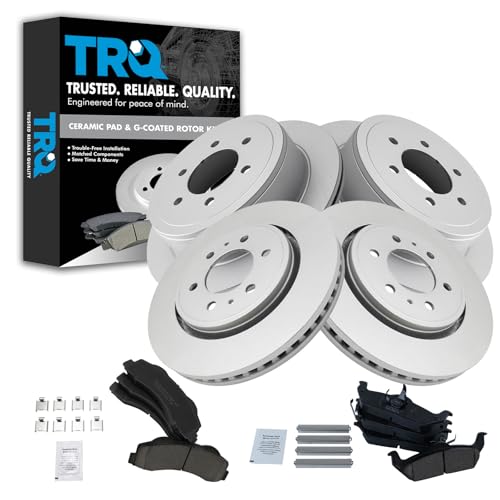
This is the only kit for a Ford F-150, and it pairs front and rear ceramic pads with four premium G-coated rotors. The vehicle application is limited to 2010–2011 F-150 models, so it is not an all-years F-150 replacement set. The coating is a distinguishing feature, but the specifications do not establish a braking-distance or corrosion-performance figure. TRQ says it has made replacement parts for over 25 years. Match the truck’s exact configuration and confirm the full axle coverage meets the repair you are planning.
Bottom line: Choose it for a matching 2010–2011 F-150 needing pads and rotors at both axles.
TRQ VW Passat Front & Rear Kit
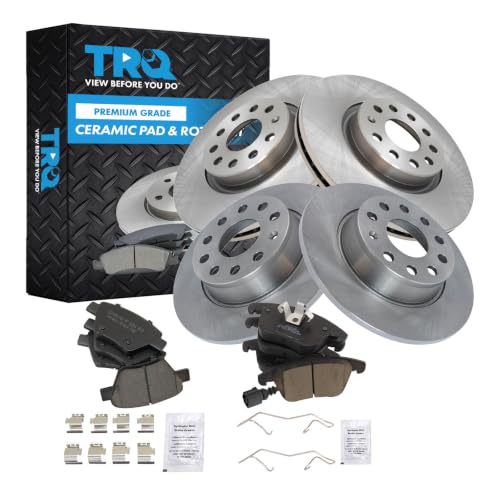
This Passat set includes front and rear ceramic pads and four rotors, but its fit includes a production-date cutoff for certain 2015 TDI SE/SEL Premium applications. That makes it particularly important to match the vehicle’s production date rather than rely on model year alone. The kit distinguishes itself from the front-only options by covering both axles; the rotor coating is not identified in the specifications. TRQ says it offers direct-fit replacement parts. Verify the Passat’s trim and production date before choosing this set.
Bottom line: Choose it for a matching Passat after confirming trim and production date.
TRQ Toyota Tundra/Sequoia Front G-Coated Kit

This front-axle kit is the Toyota option here, with two premium G-coated rotors and one ceramic pad set. Its applications cover select Tundra and Sequoia versions with caliper casting number 13WL. That casting-number condition is more specific than a model-year match alone, so check the caliper before selecting it. TRQ describes its replacement parts as direct-fit, but this kit covers the front only; buyers replacing rear brakes need a separate, compatible rear set.
Bottom line: Choose it for a matching Tundra or Sequoia with the required caliper casting.
How to choose a TRQ brake kit
Start with the vehicle’s exact year, model, trim and brake configuration, then check whether the kit covers the axle you are repairing. Brake pads and rotors are vehicle-specific: two trims from the same year can use different rotor diameters, thicknesses or caliper setups. A front-only kit contains two rotors and one pad set for that axle; a front-and-rear kit includes components for both axles. Use the vehicle identification number or compare the old part numbers when fitment remains uncertain. If the vehicle’s rear rotor is specified as 300 mm, do not assume a kit for another rear size fits. Never install mismatched brake parts to make an application work.
What ceramic pads and coated rotors mean
Ceramic brake pads use a ceramic-based friction material, often with other compounds, and are commonly selected for ordinary street driving. Pad material alone does not establish stopping distance, noise or dust levels; those depend on the full brake system, vehicle and driving conditions. A coated rotor has a surface treatment that differs from an uncoated rotor, but a coating name alone does not quantify corrosion life or braking performance. In these options, only two kits identify premium G-coated rotors. Match rotor type and dimensions to the vehicle’s original setup. Avoid judging a replacement kit solely by pad material or coating; compatibility and axle coverage are the first decision points.
Brake fitment checks before installation
Compare the replacement parts with the vehicle’s original setup before disassembly: rotor diameter, thickness, venting, hat shape and caliper configuration must match. A production-date cutoff can split a model year, and a casting number can distinguish compatible brake hardware within a model line. For any vehicle with a special cutoff or caliper condition, confirm the exact configuration before ordering. Brake work involves safety-critical parts; support the vehicle on correctly rated jack stands, never rely on a jack alone, and tighten wheel fasteners to the vehicle maker’s specified torque. After installation, pump the brake pedal until it firms before moving the vehicle, then bed pads according to the pad maker’s procedure.
When to replace pads and rotors
Brake pad replacement timing depends on driving style, traffic, terrain and vehicle load; there is no reliable single mileage interval for every driver. Inspect pad thickness and rotor condition at routine service, and replace pads before friction material reaches the vehicle maker’s minimum. Rotors must remain above their minimum thickness stamped on the rotor or specified by the service data; measure them rather than judging by appearance alone. Deep scoring, cracks, severe corrosion or thickness variation can mean a rotor needs replacement or professional evaluation. Replace components as axle pairs to preserve balanced braking, and address fluid leaks, a soft pedal or warning lights before driving.
Frequently Asked Questions
Do TRQ brake kits include front and rear brakes?
Some kits include both axles and others cover the front only. Check the kit contents: a four-wheel set should include front and rear pad sets and four rotors.
How do I confirm the right TRQ kit for my car?
Match year, model, trim and brake configuration, then check any special rotor-size, production-date or caliper-casting condition. A model-year match by itself may not identify the correct brake setup.
When should brake rotors be replaced with pads?
Replace a rotor if its measured thickness is at or below the vehicle maker’s minimum, or if it has cracks or severe damage. Pad replacement alone may be appropriate when rotors remain within specification and are in serviceable condition.
Are ceramic brake pads suitable for everyday driving?
Ceramic pads are commonly used for ordinary street driving, but the right pad depends on vehicle compatibility and intended use. Follow the vehicle maker’s requirements, especially for towing or demanding driving.
What should I do after installing new brake pads?
Pump the brake pedal until it feels firm before moving the vehicle, then follow the pad maker’s bedding procedure. A soft pedal, fluid leak or brake warning light calls for inspection before driving.