
12V Air Conditioning for Car: 3 Kits Compared

For a 12V car air-conditioning retrofit, Jiaji 12V Electric Under-Dash AC is the electric-compressor option with the highest cooling capacity, 13,700 BTU. Choose a different kit if you need a belt-driven compressor or a complete component set with hoses and louvers.
These kits add cooling hardware to a vehicle; they are not simple plug-in cabin fans. Installation and refrigerant-system compatibility matter as much as the evaporator’s capacity.
We earn a commission if you buy through links on this page. As an Amazon Associate I earn from qualifying purchases. Products are compared on manufacturer specifications, not hands-on testing.
- Best overall: Jiaji 12V Electric Under-Dash AC – Its electric scroll-compressor system is rated at 13,700 BTU.
- Best for an electric kit: 12V E-404-100 Electric AC Kit – The kit pairs a 12V electric compressor with an under-dash evaporator and condenser.
- Best for a belt-driven setup: 404-000 Sanden-Style 12V AC Kit – It includes a Sanden-style compressor, hoses, condenser, and evaporator.
| Product | Best for | Compressor type | Cooling capacity | Shop |
|---|---|---|---|---|
| Jiaji 12V Electric Under-Dash AC | Electric compressor | Electric scroll | 13,700 BTU | Check Price on Amazon |
| 12V E-404-100 Electric AC Kit | Compact evaporator | Electric scroll | 12,700 BTU | Check Price on Amazon |
| 404-000 Sanden-Style 12V AC Kit | Belt-driven compressor | Sanden-style compressor | 12,700 BTU | Check Price on Amazon |
12V Air Conditioning for Car Kits
Compare compressor styles and stated cooling capacities before choosing a retrofit system.
Jiaji 12V Electric Under-Dash AC

Jiaji 12V Electric Under-Dash AC separates itself with an electric scroll compressor and a 13,700 BTU cooling capacity. The under-dash unit has four vents, and the kit is described as providing both heating and cooling. Its maker also gives an 8-minute cabin-temperature adjustment claim and a 6–8-hour operating estimate, which depend on the vehicle and power setup. This option suits a buyer seeking an electric-compressor retrofit rather than a belt-driven system. The dimensions are 26 by 15 by 16 inches, so check dash clearance before planning the installation.
Bottom line: Choose this if an electric compressor and four vents fit your retrofit plan.
12V E-404-100 Electric AC Kit
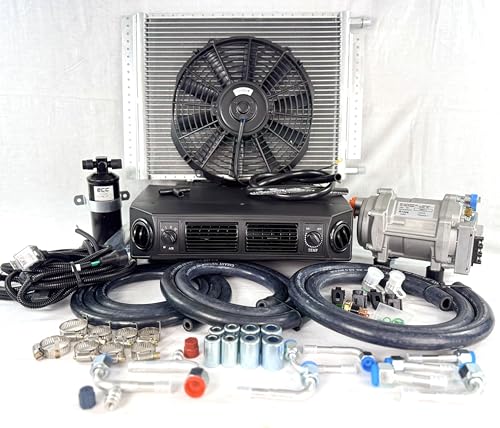
12V E-404-100 Electric AC Kit combines a 12V electric scroll compressor with an E-404-100 under-dash heat-and-cool evaporator rated at 12,700 BTU and 359 CFM. Its evaporator measures 15¾ by 12½ by 6 inches, and the package also names a parallel-flow condenser. The all-aluminum coil and three-speed blower make this a defined component set for a retrofit, rather than just an evaporator assembly. It suits buyers who want listed airflow and compact evaporator dimensions to plan around. Unlike the belt-driven kit, this system uses an electric compressor; confirm the vehicle’s electrical system can support the intended installation.
Bottom line: Pick this when its 359 CFM airflow and evaporator dimensions suit the cabin.
404-000 Sanden-Style 12V AC Kit

404-000 Sanden-Style 12V AC Kit differs from the electric-compressor choices by using a Sanden-style SD508 compressor with a 2A groove pulley. The heat-and-cool evaporator is rated at 12,700 BTU and 359 CFM; the kit also specifies a parallel-flow condenser, 10 feet of flex duct, four louvers, and multiple hose lengths. That component combination suits a vehicle with a compatible engine-driven compressor arrangement and room to route ducts and hoses. It is not the right fit if you specifically need an electric compressor. Plan bracket and pulley compatibility before installation.
Bottom line: Choose this if your retrofit calls for a belt-driven Sanden-style compressor.
How to Choose a 12V Car AC Kit
Start with the compressor type: an electric scroll-compressor kit and an engine-driven Sanden-style kit require different installation plans. Then compare evaporator dimensions, blower airflow, duct routing, and the cooling capacity; BTU capacity alone does not establish cabin comfort because vehicle size, insulation, glass area, and heat load affect results. For scale, 12,700 BTU per hour is about 1.06 refrigeration tons, while 13,700 BTU per hour is about 1.14 tons. Those figures describe cooling output, not electrical power consumption. If you cannot verify the intended power draw and alternator/battery capacity, confirm them before ordering an electric-compressor system.
Electric and Belt-Driven 12V AC Types
Electric-compressor kits do not rely on a belt-driven compressor, while a Sanden-style retrofit needs a compatible drive arrangement and mounting plan. This difference can decide the installation before capacity does. A belt-driven system must align with the engine’s pulley path and have suitable bracket clearance; an electric compressor instead places demand on the vehicle’s electrical supply. Both approaches still need a refrigerant circuit, condenser airflow, condensate drainage, and a suitable evaporator location. A condenser needs unobstructed airflow to reject heat, so avoid assuming that a compact under-dash evaporator alone completes the system. Match the kit to the vehicle’s mechanical and electrical constraints first, then compare its BTU and CFM figures.
The table separates the principal retrofit choices by drive arrangement.
| System type | Drive requirement | Planning priority |
|---|---|---|
| Electric compressor | Vehicle electrical supply | Verify power demand and charging capacity |
| Sanden-style compressor | Compatible engine belt and bracket | Check pulley alignment and mounting space |
Fit an Under-Dash Evaporator
Measure the available dashboard space and planned outlet locations before selecting an under-dash unit. The 15¾-by-12½-by-6-inch dimensions of one listed evaporator show why depth and knee clearance matter, while a four-vent layout or flexible ducting calls for additional routing room. Allow space for the drain hose so condensate can exit without spilling into the cabin, and keep ducts from sharp bends that restrict airflow. Also consider passenger legroom and access to controls. A unit’s CFM is airflow at the blower, not a guarantee that every vent will deliver equal volume after ducting. Verify vehicle-specific mounting clearance and compressor fit before committing to a retrofit.
Refrigerant and Installation Safety
Automotive air-conditioning refrigerant is a pressurized system, so installation requires proper evacuation, leak checks, and charging equipment rather than venting refrigerant to the air. In the United States, technicians servicing motor-vehicle air conditioning refrigerant generally need EPA Section 609 certification. R-134a is named for one electric-compressor kit, but refrigerant compatibility must match the compressor, oil, seals, and rest of the circuit; never mix refrigerants or oils based only on fitting size. Keep condenser airflow clear and route hoses away from hot or moving parts. The safest decision rule is to have a qualified MVAC technician confirm refrigerant and oil compatibility before charging any assembled retrofit system.
Frequently Asked Questions
How many BTU does a 12V car AC need?
The kits here state 12,700 to 13,700 BTU per hour, but the needed output depends on cabin volume, insulation, sun exposure, and glass area. Compare those conditions along with the system’s airflow rather than using BTU alone.
Can a 12V air conditioner run with the engine off?
An electric-compressor system may be able to run from a battery, but runtime depends on its actual electrical draw and usable battery capacity. A 6–8-hour estimate is a maker claim, not a universal runtime for every vehicle.
What does 359 CFM mean for car AC?
CFM means cubic feet per minute, a measure of blower airflow; 359 CFM is the figure given for two kits here. Duct length, bends, vent placement, and restrictions can affect how much air reaches each outlet.
Does a 12V car AC kit need refrigerant charging?
A complete refrigerant circuit must be evacuated, leak-checked, and charged with the compatible refrigerant and oil. In the US, refrigerant servicing on motor-vehicle air conditioning is covered by EPA Section 609 technician certification requirements.
Will an under-dash AC fit any car?
Universal describes a retrofit intent, not guaranteed physical fit. Measure the evaporator space, including depth and passenger clearance, and verify the compressor mounting or electrical requirements for the specific vehicle.