
Valvoline 5W-30 Fully Synthetic Oils Compared by Use

For most drivers seeking Valvoline 5W-30 fully synthetic oil, Valvoline Advanced Full Synthetic 5W-30 is the everyday pick, with wear, deposit and heat protection claims and API SQ and ILSAC GF-7A compatibility. Choose Valvoline MaxLife Full Synthetic 5W-30 for an engine with at least 75,000 miles, or Valvoline Restore & Protect Full Synthetic 5W-30 when deposit removal is the priority.
SAE 5W-30 describes the oil’s viscosity grades, not a guarantee that it fits every engine; use the viscosity and performance specification required in your owner’s manual.
We earn a commission if you buy through links on this page. As an Amazon Associate I earn from qualifying purchases. Products are compared on manufacturer specifications, not hands-on testing.
- Best overall: Valvoline Advanced Full Synthetic 5W-30 – Its 5W-30 full synthetic formula combines everyday wear, deposit and heat protection claims.
- Best for high mileage: Valvoline MaxLife Full Synthetic 5W-30 – It is formulated for engines with 75,000 miles or more and includes seal conditioners.
- Best for deposit control: Valvoline Restore & Protect Full Synthetic 5W-30 – Its maker claims ongoing deposit removal and prevention with regular use.
| Product | Best for | Claimed focus | Standard claims | Shop |
|---|---|---|---|---|
| Valvoline Advanced Full Synthetic 5W-30 | Everyday protection | Wear, deposits and heat | ILSAC GF-7A; API SQ, SP, SN PLUS | Check Price on Amazon |
| Valvoline MaxLife Full Synthetic 5W-30 | High-mileage engines | Seal conditioning; wear and sludge defense | ILSAC GF-7A; API SQ, SP, SN | Check Price on Amazon |
| Valvoline Restore & Protect Full Synthetic 5W-30 | Deposit-focused care | Piston deposit removal and prevention | — | Check Price on Amazon |
Valvoline 5W-30 Fully Synthetic Motor Oils
Compare the full synthetic formulas by the engine concern each one is designed to address.
Valvoline Advanced Full Synthetic 5W-30

For a general-purpose full synthetic 5W-30, Valvoline Advanced Full Synthetic 5W-30 focuses on wear, deposits and heat rather than a high-mileage or deposit-removal niche. The 5-quart jug meets ILSAC GF-7A and API SQ, SP, SN with SN PLUS, Resource Conserving requirements. Valvoline says it provides 40% stronger wear protection and 15% better deposit defense than industry standards, with up to 2.5 times better heat protection. This fits drivers whose manuals call for 5W-30 and these specifications. Its limitation is that it is not specifically formulated for engines at 75,000 miles or more; consider Valvoline MaxLife Full Synthetic 5W-30 for that need.
Bottom line: Choose this for routine 5W-30 service when its viscosity and specifications match the manual.
Valvoline MaxLife Full Synthetic 5W-30
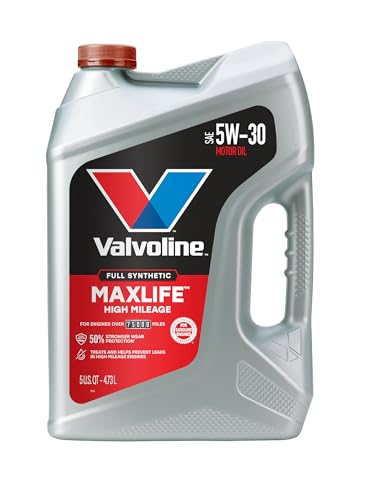
For engines with at least 75,000 miles, Valvoline MaxLife Full Synthetic 5W-30 adds seal conditioners to a full synthetic 5W-30 formula, setting it apart from Valvoline Advanced Full Synthetic 5W-30 and Valvoline Restore & Protect Full Synthetic 5W-30. The 5-quart container is intended to help prevent leaks and reduce oil consumption; Valvoline also claims 50% stronger wear protection, 20% stronger sludge defense and 2.5 times better heat protection than industry standards. This is the targeted choice for a high-mileage engine when the manual calls for 5W-30. The mileage threshold alone does not determine suitability: it may not match an engine that requires another viscosity or performance specification.
Bottom line: Pick this for a 75,000-mile-plus engine when its required oil specifications match.
Valvoline Restore & Protect Full Synthetic 5W-30

For buyers focused on piston deposits, Valvoline Restore & Protect Full Synthetic 5W-30 is the deposit-removal formula among these full synthetic 5W-30 options. Its 5-quart jug uses Active Clean Technology and Liqui-Shield; Valvoline says continuous use can remove up to 100% of piston deposits in four consecutive oil changes and help prevent future buildup. The maker also claims 79% stronger anti-wear protection than GF-6-qualified oil. It suits engines of any age only when 5W-30 is the correct viscosity. The maker does not establish a matching API or ILSAC category, so confirm the required performance specification before choosing it.
Bottom line: Choose this when deposit control is the priority and its required specification is suitable.
How to choose a Valvoline 5W-30 full synthetic
Start with the viscosity and oil specification in the owner’s manual; an oil’s advertised benefit cannot substitute for either requirement. SAE 5W-30 combines a winter grade and a hot-viscosity grade: the 5W rating is tested for cold cranking at −30°C and pumpability at −35°C, while SAE 30 has a kinematic viscosity of 9.3 to less than 12.5 mm²/s at 100°C. Match both the viscosity and the required API or ILSAC category. If the manual calls for API SQ or ILSAC GF-7A, Valvoline Advanced Full Synthetic 5W-30 and Valvoline MaxLife Full Synthetic 5W-30 list those categories; compare Valvoline Restore & Protect Full Synthetic 5W-30 only after confirming its required category. For an engine at 75,000 miles or more, Valvoline MaxLife Full Synthetic 5W-30 adds a specific high-mileage focus.
Do not choose a higher viscosity simply because an engine is older; use another grade only if the manual allows it.
What the oil specifications mean
API and ILSAC categories describe performance requirements, while SAE 5W-30 describes viscosity. API SQ and ILSAC GF-7A are current gasoline-engine oil categories; a category printed for an oil should match or exceed the manual’s requirement, subject to the vehicle maker’s guidance. The categories are not interchangeable with viscosity grades, so a 5W-30 oil can still be the wrong choice if its performance category does not meet the manual.
Use this quick rule: if the manual requires API SQ or ILSAC GF-7A, favor an option that explicitly gives that category, such as Valvoline Advanced Full Synthetic 5W-30 or Valvoline MaxLife Full Synthetic 5W-30. Valvoline Restore & Protect Full Synthetic 5W-30 requires a specification check before use. Diesel engines, motorcycles with shared engine-and-transmission oil, and some specialty engines may require different standards; do not assume passenger-car gasoline oil is suitable.
Full synthetic and synthetic blend differences
Full synthetic and synthetic blend are different oil formulations, not different SAE grades. A blend may suit an engine whose manual permits its category and viscosity, but the formula label alone does not confirm compatibility.
Choose by the engine requirement first, then by the formula and benefit that matter. High mileage is a use case rather than a separate viscosity grade: an engine over 75,000 miles still needs the grade and performance category its maker calls for. Do not treat seal conditioners or deposit-control claims as proof that an oil can correct a mechanical leak or engine fault.
Oil change intervals and safe handling
Follow the vehicle’s oil-life monitor or maintenance schedule; there is no single interval that fits every engine, driving pattern and oil capacity. Short trips, frequent idling, towing, dusty conditions and extreme temperatures can count as severe service and may shorten the interval specified by the manufacturer. Check the dipstick on level ground after the engine has been off long enough for oil to drain back, and add oil in small amounts to avoid overfilling.
Used engine oil can contain harmful contaminants, and a hot engine or drain oil can burn skin. Let components cool enough for safe handling, secure the vehicle on rated stands if lifting it, and take used oil to a collection or recycling facility; never pour it onto the ground or into a drain.
Frequently Asked Questions
What temperature range does 5W-30 cover?
SAE 5W-30 is a viscosity grade, not a guaranteed ambient-temperature operating range. The 5W test includes cold cranking at −30°C and oil pumpability at −35°C; the engine maker’s manual determines whether this grade suits a specific vehicle.
Can I use 5W-30 in a high-mileage engine?
Yes, if the vehicle maker permits SAE 5W-30 and the oil meets the required performance category. At 75,000 miles or more, a high-mileage formula such as Valvoline MaxLife Full Synthetic 5W-30 is an option, but mileage alone does not override the manual.
Does full synthetic oil last longer between changes?
Not automatically; the correct interval comes from the vehicle maintenance schedule or oil-life monitor. Severe use such as repeated short trips, towing or dusty driving can shorten the prescribed interval.
Can I switch from synthetic blend to full synthetic?
A switch is generally compatible when both oils meet the engine’s required viscosity and performance category. Check the manual for the exact grade and category rather than relying on the synthetic label alone.
How much 5W-30 does an engine need?
Engine oil capacity varies by vehicle and whether the filter is changed, so use the capacity in the owner’s manual rather than assuming a 5-quart jug is enough. After filling, verify the level on the dipstick and avoid overfilling.