
Rubber Pad for Trolley Jack: 5 Options Compared

For most pinch weld lifts, TONDA Standard Pinch Weld Pad, 1 Pack is the clearest choice because its slotted groove, waffle-textured grip and 3-ton vehicle limit are specified together. Choose a different pad if your jack saddle needs a smaller round adapter, you need a two-pack, or your vehicle’s lift point does not match a pinch weld slot.
A rubber jack pad sits between a trolley jack and the vehicle’s lift point to cushion contact; matching the saddle, groove and vehicle’s approved lift point matters more than a universal-fit claim.
We earn a commission if you buy through links on this page. As an Amazon Associate I earn from qualifying purchases. Products are compared on manufacturer specifications, not hands-on testing.
- Best overall: TONDA Standard Pinch Weld Pad, 1 Pack – Its 4.92-inch square profile, slotted groove and stated 3-ton vehicle limit are all specified.
- Best for a smaller saddle: Universal Round Jack Pad, 60 mm – The 60 mm diameter and 10 mm slot give a compact option with a maker-stated 4-ton load limit.
- Best for a two-pack: Rubber Jack Pad, 2-Piece Set – The set includes two 65 mm diameter pads with a full-length groove and underside recess.
| Product | Best for | Pad size | Load limit | Pack count | Shop |
|---|---|---|---|---|---|
| TONDA Standard Pinch Weld Pad, 1 Pack | Pinch weld lifting | 4.92 × 4.92 × 0.98 in | Up to 3 tons | 1 | Check Price on Amazon |
| Universal Round Jack Pad, 60 mm | Compact round pad | 2.36 in diameter × 0.94 in high; 0.39 in slot | 4 tons | 1 | Check Price on Amazon |
| Rubber Jack Pad, 2-Piece Set | Two-pad set | 2.56 in diameter × 0.94 in high | — | 2 | Check Price on Amazon |
| TONDA Standard Pinch Weld Pad, 2 Pack | Two-pad pinch weld set | — | Up to 3 tons | 2 | Check Price on Amazon |
| PLANGER Power PAD Flat, 65 mm | Flat contact surface | 2.56 × 2.56 × 1.06 in | — | — | Check Price on Amazon |
Rubber pads for trolley jacks
Compare pad dimensions, groove style and stated load limits, then verify that the pad seats securely on your jack saddle and matches the vehicle lift point.
TONDA Standard Pinch Weld Pad, 1 Pack

Unlike the smaller round adapters, this square pad provides a 4.92-inch-wide contact surface and a slotted cross-groove for pinch welds. TONDA says it is designed for compatible floor jacks and vehicles up to 3 tons; its waffle-textured top is intended to add grip at the lifting point. The rubber pad suits buyers who want a defined pinch weld interface and a single pad. The broad square footprint may not fit a compact jack saddle, so check the saddle dimensions and groove alignment before lifting.
Bottom line: Choose this for a compatible jack and pinch weld lift point within its vehicle limit.
Universal Round Jack Pad, 60 mm

This is the smallest specified round pad here, measuring 60 mm across and 24 mm high, with a 10 mm slot. The maker says the rubber pad fits a wide range of jacks and vehicles and gives it a 4-ton maximum load-bearing rating. Its compact shape may suit a smaller jack saddle or a lift point that needs a narrow channel. The universal-fit claim does not guarantee a match: verify the saddle diameter, slot width and vehicle lift point, and do not treat the pad rating as a substitute for the jack’s rating.
Bottom line: Pick this when its 60 mm footprint and 10 mm slot match the jack and lift point.
Rubber Jack Pad, 2-Piece Set
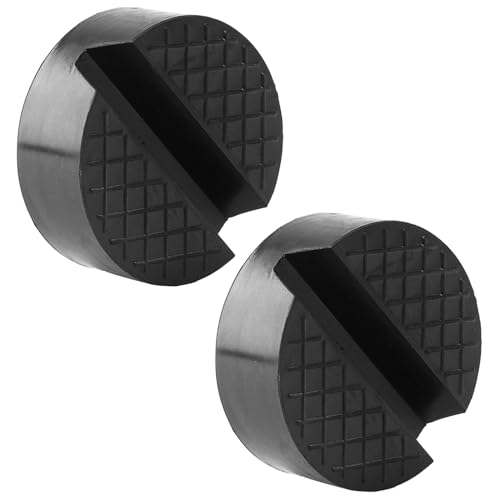
This two-pad set differs from the one-piece options by including a recess underneath each 65 mm round pad, intended to seat in a jack’s metal plate. A full-length groove accommodates a folded vehicle receiving point, and the maker describes the rubber as robust padding for cars and SUVs. The 24 mm height keeps the profile compact. No load rating accompanies the dimensions here, so this set is a poor choice when you need a documented capacity for the complete lifting setup; confirm the saddle recess fit before use.
Bottom line: Choose the pair if the underside recess fits your jack plate and you need two pads.
TONDA Standard Pinch Weld Pad, 2 Pack

This two-pack shares the specified pinch weld design and vehicle limit of the single TONDA pad, but supplies two pads for buyers who need a pair. Its slotted grooves are designed to align with pinch welds, while the waffle-textured rubber surface is intended to increase contact friction. TONDA says the pads are for compatible floor jacks and vehicles up to 3 tons. The pack listing does not give dimensions, so confirm the pad footprint and saddle fit before selecting it for a particular jack.
Bottom line: Choose this for a compatible pinch weld setup when you need a pair.
PLANGER Power PAD Flat, 65 mm

Unlike the slotted options, this PLANGER pad is explicitly the flat version, measuring 65 × 65 × 27 mm. Its square shape suits a buyer who needs a flat rubber interface rather than a groove aligned over a pinch weld. The manufacturer offers a one-year warranty. The available product facts give no load limit, so avoid relying on this pad where a verified capacity is necessary; check that the vehicle’s lift point and jack saddle are both intended for a flat contact pad.
Bottom line: Pick this when a flat 65 mm square pad matches the approved lifting surfaces.
How to choose a rubber trolley jack pad
Choose a pad by matching the jack saddle, vehicle lift point and capacity—not by the word “universal.” A slotted pad is for a pinch weld or folded seam that sits inside its groove; a flat pad is for a lift point designed for flat contact. Measure the saddle across its widest point and compare it with the pad’s base, then check that the groove clears the seam without forcing or crushing it. The pad’s load limit, when supplied, does not raise the capacity of the jack or vehicle. Use the lowest-rated component as the limit, and lift only at the vehicle maker’s approved lift points.
Pad size and pinch weld fit
A pad must sit fully on the jack saddle while its slot follows the vehicle seam. The options here range from 2.36-inch round to 4.92-inch square footprints, so a larger top does not necessarily fit a smaller saddle. Measure the jack’s saddle and the lift-point seam before choosing; for a slotted pad, the groove must accept the seam without pinching it. A too-wide slot can let the pad shift, while a groove that is too narrow can concentrate force on the seam. Keep the jack centered under the approved lifting point and stop if the pad tilts or slips.
This quick comparison distinguishes contact styles and the matching consideration.
| Pad style | Typical use | Fit check |
|---|---|---|
| Slotted | Pinch weld or folded seam | Slot width and alignment |
| Flat | Flat-approved lift surface | Full saddle contact |
| Round with underside recess | Jack plate with matching recess | Recess and saddle shape |
Safe use with a trolley jack
A trolley jack is for raising a vehicle, not supporting it while someone works underneath. Once the vehicle is raised, lower it onto correctly rated jack stands placed at approved support points; never rely on the jack and pad alone. Work on hard, level ground, keep the pad centered, and raise the vehicle only enough to position the stands. A rubber pad can cushion contact, but it cannot correct a bent pinch weld, an unstable saddle or a lift point in the wrong location. If the vehicle shifts, the pad deforms, or the saddle moves, lower the load and reposition rather than continuing the lift.
Common rubber jack pad mistakes
The common mistake is treating a pad capacity as the rating for the whole lift. The jack, vehicle lift point and support equipment each have limits; use the lowest applicable rating and do not exceed it. Another mistake is fitting a slotted pad over a seam without checking that the groove lines up and seats fully. Rubber must be clean and undamaged to maintain contact, so remove dirt and inspect for splits or crumbling before each lift. Do not stack loose pads to gain height: stacking can make the load unstable. Use a jack with enough reach and a pad designed for the contact surface instead.
Frequently Asked Questions
Can a rubber jack pad protect every pinch weld?
No pad guarantees protection if the groove, saddle or lift point is mismatched. Align the slot over the seam and stop if the pad rocks, shifts or compresses unevenly.
Does a 4-ton pad mean my car can be lifted?
No; the pad rating does not establish the capacity of the jack or the vehicle lift point. Keep the total load within the lowest applicable rating in the setup.
Can I work under a car held by a trolley jack?
No; a trolley jack and rubber pad raise the vehicle but do not replace rated jack stands. Set the stands at approved support points before going underneath.
How do I know whether a slotted pad fits?
Measure the seam and compare it with the groove width and depth, then check saddle seating. The 10 mm slot on one compact option is a concrete reference, not a universal fit dimension.
Should I use a flat pad on a pinch weld?
Use a flat pad only where the vehicle’s approved lift point is designed for flat contact. A pinch weld generally needs a correctly aligned slot rather than a flat surface pressing on the seam.