
Skandia 5 Piece Knife Set: Alternatives Compared

The Skandia 5-piece knife set is the closest match here: it has five stainless steel kitchen knives with colorful, non-slip handles. Choose a different set if you need named blade types, sheaths, or extras such as scissors and a peeler.
The Skandia set is absent from these options, so the alternatives below differ in knife selection and included accessories.
We earn a commission if you buy through links on this page. As an Amazon Associate I earn from qualifying purchases. Products are compared on manufacturer specifications, not hands-on testing.
- Best overall: Multicolor 5-Piece Stainless Steel Set – The five stainless steel knives and colored non-slip handles most closely match the Skandia set.
- Best for blade variety: SANDEWILY 5-Piece Japanese-Style Set – Includes five named knife types, from an 8-inch chef knife to a 7.5-inch Kiritsuke.
- Best for added tools: 5-Piece Knife Set with Scissors and Peeler – Pairs three knives with kitchen scissors and a vegetable peeler.
| Product | Best for | Knife count | Included blade lengths | Extras | Shop |
|---|---|---|---|---|---|
| Multicolor 5-Piece Stainless Steel Set | Color-coded basics | 5 knives | — | Colored handles | Check Price on Amazon |
| SANDEWILY 5-Piece Japanese-Style Set | Named blade variety | 5 knives | 8, 8, 7.5, 5, 5 in | Sheaths | Check Price on Amazon |
| hecef Silver 5-Piece Knife Set | Sheathed essentials | 5 knives | 8, 8, 8, 5, 3.5 in | Matching sheaths | Check Price on Amazon |
| 5-Piece Knife Set with Scissors and Peeler | Prep tool bundle | 3 knives | 8, 5.5, 3.5 in | Scissors, peeler, sheaths | Check Price on Amazon |
Five-Piece Knife Set Alternatives
Compare these options by their blade lineup and the additional pieces included in each set.
Multicolor 5-Piece Stainless Steel Set

Brightly colored handles distinguish this five-knife stainless steel set from the other options. The handles are described as ergonomic and non-slip, and the set is intended for slicing and chopping a range of foods. Color coding may help separate knives during meal prep, but the set does not identify individual blade types or lengths. Choose it if you want a simple five-piece assortment with contrasting handles; cooks who need a specific bread, chef, or paring knife should prioritize a set that names those blades.
Bottom line: Pick this set if color-coded handles matter more than a defined blade lineup.
SANDEWILY 5-Piece Japanese-Style Set

The SANDEWILY set stands out for naming all five knives and their lengths: an 8-inch chef knife, 8-inch bread knife, 7.5-inch Kiritsuke, 5-inch Santoku, and 5-inch multipurpose knife. Its features specify German high-carbon stainless steel and a 56±2 HRC hardness rating, plus Pakkawood handles and sheaths. That defined lineup suits cooks who want distinct tools for bread, vegetables, and general prep. It is a partial match rather than a close handle-style match for Skandia because its handles are Pakkawood rather than brightly colored.
Bottom line: Choose this if a named assortment and sheaths matter more than colored handles.
hecef Silver 5-Piece Knife Set
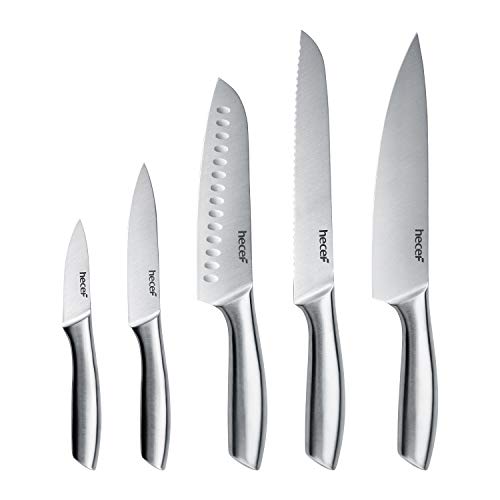
The hecef set gives a more specified everyday lineup than the colorful Skandia-style option: 8-inch chef, bread, and Santoku knives, plus 5-inch utility and 3.5-inch paring knives. It uses stainless steel blades with a satin finish, hollow handles, and matching protective sheaths. This suits cooks who want recognizable kitchen staples and individual covers. The limitation is its silver all-metal look rather than colored handles, so it is a weaker fit if fast visual identification is the main reason for choosing Skandia.
Bottom line: Pick this when named blade types and matching sheaths take priority.
5-Piece Knife Set with Scissors and Peeler

This set trades two knife slots for extra prep tools: it includes an 8-inch chef knife, 5.5-inch utility knife, 3.5-inch paring knife, kitchen scissors, and a vegetable peeler. The features describe stainless steel blades and comfortable handles, with sheaths also identified in the set name. It suits kitchens that need a few core knives plus tools for trimming and peeling. Since it contains three knives rather than five, it is only a partial match for a buyer seeking five separate knives like the Skandia set.
Bottom line: Choose this if scissors and a peeler are more useful than five knives.
How to choose a five-piece knife set
Start with the blade jobs you do most, not the piece count alone. A useful everyday mix often includes a chef knife around 8 inches, a paring knife around 3 to 4 inches, and a serrated bread knife around 8 inches; the remaining pieces can be a utility or Santoku knife. Check whether the count means knives only or includes tools such as scissors. For a household that mainly chops vegetables and slices bread, prioritize those two blade types; choose a set with a paring knife if peeling and small, precise cuts are frequent.
Handle and storage choices matter too. Sheaths cover individual blades, while a block takes counter space; a set without either needs a safe drawer organizer. Match the handle shape and material to a secure grip, and keep sharp knives away from loose utensils.
Blade lengths and kitchen tasks
An 8-inch chef knife is a common all-purpose length, while a 3.5-inch paring knife is easier to control for small produce and detail work. Serrated edges are useful for crusty bread because the teeth bite into a firm crust; a smooth edge is generally easier to hone for routine slicing and chopping. These are task-based distinctions, not guarantees of cutting performance.
Use this quick guide to compare length with typical kitchen jobs:
| Blade length | Typical task | Fit consideration |
|---|---|---|
| 3 to 4 in | Peeling and detail work | Compact control |
| 5 to 6 in | Utility cutting | Middle-ground size |
| 7 to 8 in | General prep or bread | Needs more board space |
Choose a longer blade only if your cutting board and grip comfortably accommodate it; a larger knife is not automatically more useful.
Handle, edge, and care choices
Stainless steel resists corrosion but is not immune to staining or damage, and a sharp edge still requires careful handling. Hand-wash knives and dry them promptly to reduce moisture exposure and protect edges; dishwashers can cause blades to knock against other items and handles to wear. Use a stable cutting board rather than glass, stone, or ceramic, which can blunt edges quickly.
Honing realigns a working edge, while sharpening removes metal to create a new edge. A honing rod is commonly used more often than sharpening, but the right interval depends on how frequently a knife is used and the cutting surface. Store sheathed knives securely or use a dedicated organizer; never reach blindly into a drawer with exposed blades.
What five pieces can include
Five pieces can mean five knives or a mixed kit with fewer knives and added tools, so count the blades before comparing sets. A chef, bread, utility, paring, and Santoku assortment offers more distinct blade roles, while three knives plus scissors and a peeler may cover a broader range of prep tasks with fewer blades.
Use the set’s named contents as the deciding rule: if bread slicing is routine, require a serrated bread knife; if small peeling work matters, look for a paring knife around 3 to 4 inches. Sheaths add individual blade coverage, while colored handles can help distinguish tools. Neither feature replaces safe storage and careful handling.
Frequently Asked Questions
How often should kitchen knives be sharpened?
Sharpening frequency depends on use, but a home knife used regularly may need sharpening every few months to about once a year. Honing can be done more often because it realigns rather than removes substantial metal.
Are stainless steel kitchen knives dishwasher safe?
Hand-washing and drying knives promptly is the safer care choice, even when a set is labeled dishwasher safe. Dishwasher racks and neighboring utensils can nick edges, and prolonged moisture can affect blades and handles.
What knife length works best for vegetables?
A 7- to 8-inch chef knife handles most board-based vegetable chopping, while a 5-inch Santoku or utility knife can feel more manageable for smaller boards or hands. Leave enough board space to keep the blade tip and heel controlled.
Do knife sheaths make storage safer?
Individual sheaths cover the cutting edge during storage and reduce accidental contact when handling a knife. Keep covered knives in a secure drawer or other stable location, away from children.
What is the difference between honing and sharpening?
Honing realigns the edge, while sharpening removes metal to form a new edge. A frequently used knife may benefit from honing between sharpenings, especially when it is used on a softer cutting board.