
Tri Fold Display Boards: Sizes and Packs Compared

For most school or office presentations, 48 x 36-Inch Corrugated Boards, 3-Pack is a practical choice because its 48 x 36 inch open size folds to 24 x 36 inches for carrying and storage. Choose 26 x 17-Inch Small Trifold Boards, 2-Pack instead when a smaller 26 x 17 inch board suits the project, or Flipside 36 x 48-Inch Project Boards, 24-Pack when you need a 24-board pack.
We earn a commission if you buy through links on this page. As an Amazon Associate I earn from qualifying purchases. Products are compared on manufacturer specifications, not hands-on testing.
- Best overall: 48 x 36-Inch Corrugated Boards, 3-Pack – Its 48 x 36 inch board folds to 24 x 36 inches and comes in a three-pack.
- Best for compact projects: 26 x 17-Inch Small Trifold Boards, 2-Pack – Each board measures 26 x 17 inches laid flat and the set contains two.
- Best for bulk projects: Flipside 36 x 48-Inch Project Boards, 24-Pack – The 36 x 48 inch boards come in a 24-pack.
| Product | Best for | Open size | Pack count | Construction | Shop |
|---|---|---|---|---|---|
| 48 x 36-Inch Corrugated Boards, 3-Pack | School presentations | 48 x 36 in | 3 | Single-wall corrugated | Check Price on Amazon |
| 26 x 17-Inch Small Trifold Boards, 2-Pack | Compact projects | 26 x 17 in | 2 | Corrugated cardboard | Check Price on Amazon |
| Flipside 36 x 48-Inch Project Boards, 24-Pack | Bulk projects | 36 x 48 in | 24 | — | Check Price on Amazon |
| Emraw White 36 x 48-Inch Boards, 2-Pack | Two-board projects | 36 x 48 in | 2 | Corrugated | Check Price on Amazon |
Tri fold display boards compared
Compare the board dimensions and pack sizes against the space and quantity your presentation needs.
48 x 36-Inch Corrugated Boards, 3-Pack

For projects that need a large display surface but still need to fold for transport, this three-pack measures 48 x 36 inches open and folds to 24 x 36 inches. Each board has a white front and natural kraft back, with single-wall corrugated cardboard construction. The maker says the boards stand on their own and can be wall-mounted, written on, pasted, or decorated. This size suits science fairs and office presentations; the limitation is its large open footprint, which may not suit a small tabletop or display area.
Bottom line: Choose this set for large presentations where fold-down storage matters.
26 x 17-Inch Small Trifold Boards, 2-Pack

The smaller 26 x 17 inch format is the main difference here, making these boards suited to compact school projects and event displays rather than a full-size presentation. The two-pack provides a pair of white corrugated cardboard boards, and the clean white surface is intended as a backdrop for mounted photos, charts, graphs, and text. Corrugated construction is described as stable for standing display. The trade-off is less display area than a 36 x 48 inch board, so choose this only when the project content fits the smaller panel.
Bottom line: Pick this pair when a compact board is enough for the material you need to show.
Flipside 36 x 48-Inch Project Boards, 24-Pack
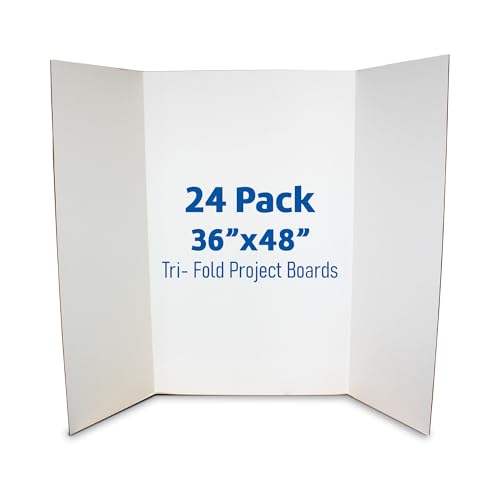
The 24-board quantity sets this option apart for classrooms, group events, or other projects that need many boards at once. Each clay-white board measures 36 inches high by 48 inches wide; the center panel is 22.5 inches wide and each side panel is 12.75 inches. The maker says the surface is suitable for paint, markers, crayons, glue, and other wet or dry media. The limitation is the large pack: it is a poor fit if you need only one or two boards, and the clay-white color differs from plain white choices.
Bottom line: Choose this pack for multiple projects that benefit from a clay-white surface.
Emraw White 36 x 48-Inch Boards, 2-Pack

The Emraw option pairs a familiar 36 x 48 inch format with a two-board quantity, unlike the single-board-sized small pack or the 24-board set. Its white corrugated presentation board is described for school, college, and business presentations. The product name also identifies self-adhesive science subtitles as included, which may help when a project needs those labels. The dimensions are substantial, so confirm that the open board will fit your display space. This is less suited to buyers who need a smaller footprint or want a larger classroom quantity.
Bottom line: Pick this two-pack if you need full-size white boards and the included subtitles.
How to choose a tri fold display board size
Start with the open display area, not the folded footprint: a 48 x 36 inch board presents 1,728 square inches, while a 26 x 17 inch board presents 442 square inches. That makes the larger format nearly four times the area, although layout and readable text matter as much as raw space. For a one-board presentation intended for a standard science-fair-style display, the 36 x 48 inch format is common; smaller assignments may work better on a compact board. Measure the table or booth width before choosing: if the display space is under 36 inches wide, a 36 x 48 inch board will not fit flat without overhang or repositioning. Leave room for any props beside the board.
How the panels affect layout
Plan the center panel for the main takeaway and use side panels for supporting material; this keeps the core message visible when viewers face the board. Panel widths vary: Flipside 36 x 48-Inch Project Boards, 24-Pack has a 22.5-inch center and two 12.75-inch sides, so its wings are narrower than the center. A layout designed for three equal columns may not align cleanly on that board. Keep headings and essential text away from folds, since creases interrupt lines and can obscure mounted items. A useful rule is to place the title in the upper center and reserve each wing for one category of supporting content. Test the arrangement with loose sheets before attaching anything permanently.
Corrugated board, mounting, and display stability
Corrugated cardboard uses a fluted inner layer between flat liner sheets, which adds stiffness without making a solid sheet. These boards are lightweight display materials, not structural supports: keep heavy objects off the wings and use paper, photos, or lightweight charts. Adhesives and paint can warp paperboard if applied heavily or wet; use thin layers and allow them to dry before standing the board. For boards that stand on their own, set them on a level surface and spread the side panels evenly. If a display is in a busy aisle or exposed to drafts, add a separate support rather than assuming a cardboard fold will resist a bump.
Choosing a pack for school and group use
Match the pack count to the number of projects, and consider keeping a spare only if storage space is available. A two- or three-board set suits individual or small-group work; a 24-pack serves repeated classroom assignments or a larger event. Store folded boards flat and dry to reduce crushed corners and moisture damage. Before buying, check that the open dimensions fit the presentation surface and the folded dimensions fit the storage spot; a board that fits a table may still be awkward in a car or closet. For projects with glued elements, assemble the board close to the event because transporting an already decorated panel can bend its wings.
Frequently Asked Questions
What size is a standard tri fold display board?
A common presentation format is 36 x 48 inches open, with a 24 x 36 inch folded footprint when the side panels are each 12 inches wide. Actual panel proportions vary, so verify the center and wing widths when a precise layout matters.
How much content fits on a small tri fold board?
A 26 x 17 inch board has 442 square inches of face area, about one quarter the area of a 48 x 36 inch board. Use it for concise text and a few visuals rather than a layout designed for full-size science fair panels.
How should I arrange information on a tri fold board?
Put the main conclusion or title on the center panel and supporting sections on the wings. Keep headings and important text clear of the fold lines, which interrupt content across panel edges.
Can a tri fold board hold heavy objects?
Corrugated cardboard is intended as a lightweight display surface, not a load-bearing support. Keep attached items light and add a separate support if a board will face drafts, bumps, or frequent handling.
How do I keep a display board from warping?
Use adhesive and paint sparingly because excess moisture can distort paperboard. Let applied materials dry fully before standing the board, and store it flat in a dry place.