
Auto Radio Antenna Booster: 5 Options Compared

For an auto radio antenna booster with installation accessories, choose TTLCFP 12V Car Antenna Booster; its package includes tape, a quick connector, and cable clamps. 12V Booster with Hidden Antenna is the alternative if you also need a separate electric replacement antenna, while Bingfu DIN Plug FM Booster is for a setup that uses a DIN connector.
An antenna booster amplifies the signal traveling from the antenna to the radio, but it cannot repair a damaged antenna or coax cable.
We earn a commission if you buy through links on this page. As an Amazon Associate I earn from qualifying purchases. Products are compared on manufacturer specifications, not hands-on testing.
- Best overall: TTLCFP 12V Car Antenna Booster – Includes double-sided tape, a quick connector, and two cable clamps for installation.
- Best for a replacement antenna: 12V Booster with Hidden Antenna – Includes a separate electric antenna that can replace a damaged factory antenna or suit a custom car.
- Best for DIN connections: Bingfu DIN Plug FM Booster – Uses a DIN plug connector adapter and switched 12V power.
| Product | Best for | Power | Radio band | Included connection or antenna | Shop |
|---|---|---|---|---|---|
| TTLCFP 12V Car Antenna Booster | DIY installation | 12V | AM/FM | Tape, quick connector, 2 clamps | Check Price on Amazon |
| 12V Booster with Hidden Antenna | Antenna replacement | 12V | AM/FM | Separate 7-inch electric antenna | Check Price on Amazon |
| 12V 25dB Car Antenna Booster | Claimed gain figure | 12V | AM/FM | Inline booster | Check Price on Amazon |
| Bingfu DIN Plug FM Booster | DIN connection | 12V switched | FM | DIN plug adapter | Check Price on Amazon |
| Mr.Ho 12V AM/FM Booster | Marine and RV use | 12V | AM/FM | Inline antenna connection | Check Price on Amazon |
Auto radio antenna boosters
Compare the power, radio-band coverage, and installation components that distinguish these inline signal amplifiers.
TTLCFP 12V Car Antenna Booster

Installation accessories set TTLCFP 12V Car Antenna Booster apart: the package includes double-sided tape, a quick connector, and two cable clamps. Its shielded metal housing is intended to block interference, and its ABS housing keeps the unit’s construction simple. The maker says the amplifier improves sensitivity and receiving distance while reducing background noise. It is a practical match for a driver who wants the basic connection pieces in one package. The package does not include a replacement antenna, so choose another option if the vehicle’s antenna itself needs replacing.
Bottom line: Pick this if you want a 12V AM/FM booster with basic installation accessories.
12V Booster with Hidden Antenna
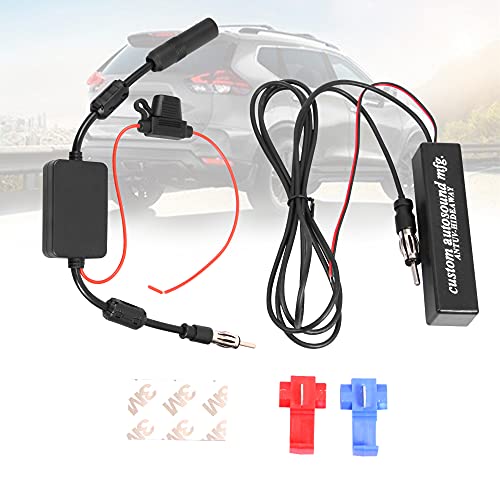
12V Booster with Hidden Antenna differs by pairing a signal booster with a separate 7-inch electric antenna, which can function in place of a factory antenna. The maker says the booster enhances AM/FM signal and reduces noise, and the unit is compatible with most vehicles, though some models may not fit. The antenna and booster are separate items and may not both be needed. This option suits a custom-car owner who wants an antenna out of sight or someone replacing a damaged factory antenna; it is less useful if the existing antenna is in good condition and only the booster is needed.
Bottom line: Choose this when a replacement electric antenna is part of the job.
12V 25dB Car Antenna Booster

12V 25dB Car Antenna Booster is the only option whose name gives a 25 dB amplification figure. The maker also says copper conductors and metal shielding help with reception clarity and electrical interference, and describes an ABS shell plus a capped fuse holder. Its 21-inch stated size may matter when choosing a mounting spot and routing wire. This suits buyers comparing an advertised gain figure, but the claim alone does not predict reception in a particular vehicle: antenna condition, wiring, and local signal strength still affect results.
Bottom line: Pick this if the 25 dB figure is a deciding specification for you.
Bingfu DIN Plug FM Booster

Bingfu DIN Plug FM Booster stands out for its DIN plug connector adapter and switched 12V power cable. The maker says the amplifier enhances radio signal and reduces noise, and specifies copper signal wire for interference resistance. Its radio coverage is FM, unlike the AM/FM options here, so it is a narrower choice for a driver who listens to AM. Check the head unit and antenna connection before choosing it; this model suits a vehicle setup that matches the DIN connection and needs FM amplification.
Bottom line: Choose this for an FM-only setup that uses a DIN connector.
Mr.Ho 12V AM/FM Booster
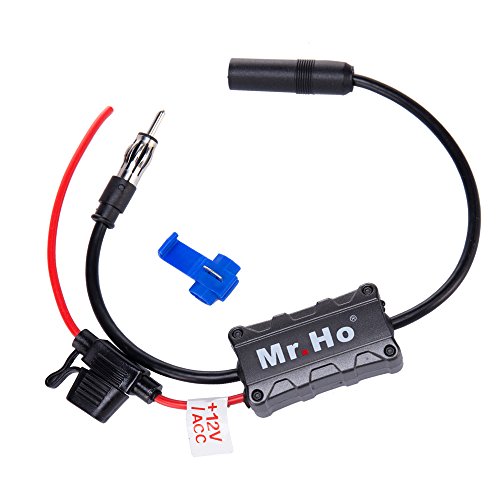
Mr.Ho 12V AM/FM Booster is explicitly aimed at marine, car, truck, and RV use, making its vehicle range broader than the car-focused options. The maker says it works with AM and FM, increases receiving distance and sensitivity, and uses copper signal wire under a thickened tinplate shielding cover. Installation is described as connecting to a 12V source and placing the unit inline with the car antenna. This is a straightforward choice for a boat or recreational vehicle, but the package description does not identify a replacement antenna or connection accessories.
Bottom line: Pick this for a 12V AM/FM setup in a boat, truck, or RV.
How to choose an auto radio antenna booster
Choose by radio band and connection first, then by any installation extras. US FM broadcasts span 88 to 108 MHz, while AM broadcasts occupy 530 to 1,700 kHz; a booster marked for FM alone is not a substitute for an AM/FM unit if you listen to both bands. Inline boosters need a compatible antenna-to-radio connection and a 12V power feed. A booster amplifies what reaches it, including electrical noise, so it is not a cure for a broken antenna, loose coax, or a poorly seated connector. If reception is weak only in one location, the source may be local signal coverage rather than the vehicle hardware.
Use this quick match to narrow the choice before checking your vehicle’s connector.
| Need | Choose |
|---|---|
| AM and FM | An AM/FM booster |
| FM only with DIN connection | A DIN-compatible FM booster |
| Replacement antenna too | A booster package that includes a separate antenna |
| Boat, truck, or RV use | A model identified for those vehicle types |
Radio bands and antenna size
FM’s 88–108 MHz band has wavelengths of roughly 110–129 inches, so a quarter-wave whip is about 27–32 inches before practical loading and installation effects. The car’s antenna length and placement affect reception; a small booster cannot make a badly mismatched or damaged antenna perform like a properly installed one. AM wavelengths are hundreds of feet long, so vehicle AM antennas use electrical loading rather than a physically full-size antenna. These differences help explain why a model’s AM/FM coverage matters independently of its advertised amplification. A 7-inch antenna can be convenient for a concealed installation, but it is not physically equivalent to a full quarter-wave FM whip.
Installation and 12V wiring
Most inline boosters go between the antenna lead and the radio, with a separate 12V feed powering the amplifier. Confirm that the vehicle’s antenna plug and radio input match the booster before wiring; a DIN adapter only helps when the vehicle uses the corresponding connector. Disconnect the negative battery terminal before working on powered wiring, and keep added wires clear of pedals, sharp edges, and airbag components. Route the antenna lead away from ignition and other high-current wiring where practical, since nearby electrical interference can add noise. A booster may require a switched 12V source so it is not continuously powered when the vehicle is off; use the vehicle wiring diagram to identify a suitable circuit.
Diagnosing weak radio reception
Check the antenna, coax, and connections before adding amplification. A loose plug, corroded connector, or damaged antenna can reduce the signal before it reaches the booster, while a faulty ground or nearby electrical interference can introduce noise. Compare reception with the engine off and running: a major change can point to vehicle electrical noise rather than insufficient antenna gain. FM reception can also fade behind terrain and buildings because its shorter wavelengths are more line-of-sight than AM. If reception remains weak across multiple locations after checking the cable and antenna, an inline booster may help a low-level signal; if the antenna circuit is open or shorted, repair that fault first.
Frequently Asked Questions
Will an antenna booster fix a broken car antenna?
No; a booster amplifies the signal it receives and cannot restore a broken antenna or damaged coax. Check the antenna and cable connection first, especially if reception disappeared suddenly.
Does an auto radio antenna booster need power?
An active booster needs a power connection, commonly 12V in vehicle systems. Verify whether the unit uses switched power so it turns off with the vehicle.
Can I use an FM-only booster for AM radio?
No; choose a booster specified for AM/FM if you need both bands. US FM broadcasts run from 88 to 108 MHz, while AM broadcasts are from 530 to 1,700 kHz.
Where does an inline antenna booster connect?
An inline booster generally connects between the antenna lead and the radio, with a separate power lead. Match the plugs to the vehicle before installation; connector adapters only work with compatible connections.
Why does my radio get noisier after adding a booster?
A booster can amplify interference along with the desired signal. Check antenna grounding, cable condition, and wire routing, particularly if reception changes when the engine is running.