
Best Hook Proof Fishing Gloves for Safer Fish Handling

For most anglers, Lindy Fish Handling Glove XX-Large is the strongest fit because its SuperFabric construction is designed to deflect hooks while gripping slippery fish. Choose Lindy Fish Handling Glove Small/Medium Right-Hand or Lindy Fish Handling Glove Small/Medium Left-Hand instead if you need a small/medium glove for a specific hand; choose Two-Piece Latex Fishing Gloves if a two-glove latex-coated pair better suits your grip needs.
We earn a commission if you buy through links on this page. As an Amazon Associate I earn from qualifying purchases. Products are compared on manufacturer specifications, not hands-on testing.
- Best overall: Lindy Fish Handling Glove XX-Large – SuperFabric construction is designed to deflect hooks and provide grip on slippery fish.
- Best for two gloves: Two-Piece Latex Fishing Gloves – The product is a two-piece pair with textured, latex-coated palms.
- Best for left hands: Lindy Fish Handling Glove Small/Medium Left-Hand – The small/medium Lindy glove is specified for the left hand.
| Product | Best for | Material | Hand / pack | Size | Shop |
|---|---|---|---|---|---|
| Lindy Fish Handling Glove XX-Large | Large right hands | SuperFabric | Right hand, 1 glove | XX-Large | Check Price on Amazon |
| Lindy Fish Handling Glove Small/Medium Right-Hand | Small right hands | SuperFabric | Right hand, 1 glove | Small/Medium | Check Price on Amazon |
| Lindy Fish Handling Glove Small/Medium Left-Hand | Small left hands | SuperFabric | Left hand, 1 glove | Small/Medium | Check Price on Amazon |
| Two-Piece Latex Fishing Gloves | Textured palm grip | Latex-coated protective material | Two gloves | — | Check Price on Amazon |
Hook Proof Fishing Gloves Compared
Compare construction, hand fit and pack configuration to choose gloves that suit your fish-handling tasks.
Lindy Fish Handling Glove XX-Large

Among these options, this glove combines SuperFabric construction with an XX-large, right-hand fit. The maker says its material deflects hooks, knives and teeth, and provides a sure grip on slippery fish; intended uses include unhooking, filleting and removing fish from livewells. The XX-large size may suit anglers who need more room than a small/medium glove. It is a single right-hand glove, so it does not provide a matching left glove; choose another configuration if you need protection on both hands.
Bottom line: Choose it if you want SuperFabric protection in an XX-large right-hand glove.
Lindy Fish Handling Glove Small/Medium Right-Hand

This is the small/medium right-hand option, unlike the XX-large glove, and suits anglers who need that hand and size combination. The maker describes it as cut-resistant and puncture-proof, with a secure hold for fish handling and hook work. Its SuperFabric material is the key distinction from the latex-coated pair. The package is one glove, so it leaves the other hand uncovered; anglers who routinely handle hooks with both hands should account for that before choosing.
Bottom line: Pick it when a small/medium right-hand fit is the priority.
Lindy Fish Handling Glove Small/Medium Left-Hand
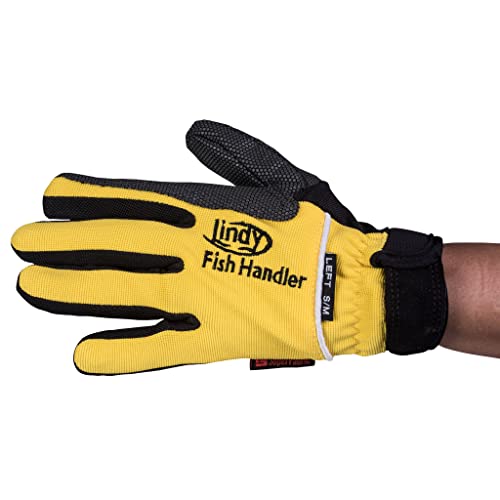
This Lindy option differs from Lindy Fish Handling Glove Small/Medium Right-Hand by covering the left hand rather than the right, while keeping the small/medium size. Its SuperFabric construction is described by the maker as cut-resistant and puncture-proof for fish handling and working with hooks. It is a useful choice when the left hand is the one that steadies fish during unhooking. The single-glove format does not cover both hands, and the size is small/medium rather than the XX-large fit offered by Lindy Fish Handling Glove XX-Large.
Bottom line: Choose it for a small/medium left-hand glove.
Two-Piece Latex Fishing Gloves

Unlike the single-hand Lindy gloves, this product is sold as a two-piece set and uses a latex-coated palm with irregular texture. The maker says the coating is waterproof, non-slip and puncture-resistant, and describes the gloves for catching fish and removing hooks. The magnet-release feature is another point of difference.
Bottom line: Pick it if you want a two-glove pair with textured latex palms.
How to choose hook proof fishing gloves
Start with the task: handling a fish, removing a hook and filleting involve different contact with hooks and blades. These gloves are protective barriers, not a reason to grip a hook or knife carelessly. Compare the material and palm surface, then match the glove to the hand doing the work; a one-hand glove leaves the other hand exposed. For fish that may thrash, use a secure grip and keep fingers clear of the hook point. A glove that is too loose can reduce control, so prioritize fit when handling small hooks.
For choosing among these options, the clearest dividing line is construction: SuperFabric on the Lindy models versus latex-coated palms on Two-Piece Latex Fishing Gloves.
| Need | Option to consider |
|---|---|
| SuperFabric, XX-large right hand | Lindy Fish Handling Glove XX-Large |
| SuperFabric, small/medium right hand | Lindy Fish Handling Glove Small/Medium Right-Hand |
| SuperFabric, small/medium left hand | Lindy Fish Handling Glove Small/Medium Left-Hand |
| Two gloves with textured latex palms | Two-Piece Latex Fishing Gloves |
Fishing glove fit and hand coverage
Hand coverage and fit are separate decisions: three options here are single gloves for a designated hand, while Two-Piece Latex Fishing Gloves is a two-piece set. Choose the handed Lindy size that matches the hand you use to control fish; a glove on the opposite hand will not protect the working hand as intended. If you need both hands protected, do not assume a single glove includes a mate. The available Lindy choices span small/medium and XX-large, but no numerical hand measurements accompany those sizes, so confirm the fit before ordering if you are between sizes.
Color can also help distinguish the Lindy size group: the maker identifies small/medium as yellow/black and larger sizes as orange/black. Fit and hand designation matter more than color when selecting coverage.
How to handle hooks safely with gloves
Gloves can reduce exposure to cuts and punctures, but no glove makes a hook safe to handle carelessly. Keep the hook point turned away from fingers, use pliers or a dehooking tool when practical, and avoid squeezing a fish near exposed hooks. Cut-resistant and puncture-resistant are not promises of total protection against every hook size or angle. Before unhooking, make sure the fish is controlled and the free hand is away from the point. The same caution applies to filleting: a glove does not replace safe knife technique.
When a glove is wet, test its grip on the fish before moving it; coatings and textures differ, and slime can still make handling difficult.
Cleaning and storing fishing gloves
Rinse fish residue and slime from fishing gloves after use, then let them dry fully before storage; trapped moisture can encourage odor and material breakdown. The latex-coated pair is described as easy to clean because of its seamless palm, while the Lindy gloves use SuperFabric. Do not assume both materials tolerate the same cleaning chemicals, heat or drying method. Keep gloves away from sharp tackle in storage so the protective surface is not damaged before the next trip. Inspect palms and seams for tears or peeling; replace a damaged glove rather than relying on compromised coverage.
Store each glove dry and identifiable by hand and size, especially single-hand gloves that may otherwise be mismatched with another pair.
Frequently Asked Questions
Can fishing gloves stop every hook puncture?
No glove should be treated as protection against every hook, angle or force. Keep hook points away from fingers and use pliers or a dehooking tool when practical.
Should I wear one glove or a pair?
Choose coverage based on which hands may contact fish, hooks or knives. A single-hand glove covers only its designated hand, while a two-glove set covers both.
Do latex fishing gloves work in wet conditions?
The maker describes Two-Piece Latex Fishing Gloves as waterproof and its latex-coated palms as non-slip. Fish slime and water can still reduce control, so handle the fish cautiously.
How do I choose the right glove hand?
Match a single glove to the hand that will contact the fish or hook. If both hands may be exposed, choose a pair rather than assuming one glove provides two-hand coverage.
Are puncture-resistant gloves safe for filleting?
They can add a protective layer, but they do not make knife work risk-free. Keep the cutting path away from fingers and use controlled knife technique.