
Wind Meter for Shooting: 5 Options Compared

For a wind meter for shooting, choose Kestrel Ballistics 2700 if you want wind readings alongside a built-in ballistic solver; choose Caldwell Wind Wizard II for a simpler handheld meter with five speed units. A general-purpose anemometer such as BTMETER BT-100 or BTMETER BT-816B can suit basic wind checks, while Calypso Mini AB Wind Meter is the compact Bluetooth option.
A handheld anemometer measures wind at your position, not necessarily along the bullet’s full path, so wind direction and changing conditions still matter.
We earn a commission if you buy through links on this page. As an Amazon Associate I earn from qualifying purchases. Products are compared on manufacturer specifications, not hands-on testing.
- Best overall: Kestrel Ballistics 2700 – Combines wind speed and direction readings with a G1/G7 solver and single-target windage and elevation solutions.
- Best for simple readings: Caldwell Wind Wizard II – Measures current wind speed in five units and has a backlit display and lanyard.
- Best for Bluetooth: Calypso Mini AB Wind Meter – Connects to a ballistic solver by Bluetooth and has a claimed 150-hour battery life.
| Product | Best for | Wind speed units | Wind speed range | Additional readings or tools | Shop |
|---|---|---|---|---|---|
| Kestrel Ballistics 2700 | Ballistic solutions | — | — | Direction, pressure, temperature | Check Price on Amazon |
| Caldwell Wind Wizard II | Basic field readings | mph, ft/min, km/h, m/s, knots | — | Backlit LCD; water resistant | Check Price on Amazon |
| Calypso Mini AB Wind Meter | Bluetooth connection | — | — | Bluetooth; 150-hour battery claim | Check Price on Amazon |
| BTMETER BT-100 | Wind and temperature | m/s, km/h, ft/min, knots, mph | 0.67–67.1 mph | Wind temperature and chill | Check Price on Amazon |
| BTMETER BT-816B | Mode selection | m/s, ft/min, knots, km/h, mph | 0.2–67 mph | Max, average, current; temperature and chill | Check Price on Amazon |
Wind Meters for Shooting
Compare each meter’s wind readings and extra functions against how much ballistic support you want in the field.
Kestrel Ballistics 2700

Unlike the basic handheld meters here, this unit pairs environmental readings with a shooting-specific solver. It measures wind speed and direction, air pressure and temperature, then displays elevation and windage solutions for one target. The maker says its G1/G7 solver supports a maximum range of 875 yards, and the unit has an IP-67 waterproof rating and MIL-STD-810 drop testing. Choose it when you want readings and ballistic calculations together. Its single-target display may be limiting if you need to compare several target solutions at once.
Bottom line: Choose this when you want a built-in solver as well as environmental readings.
Caldwell Wind Wizard II
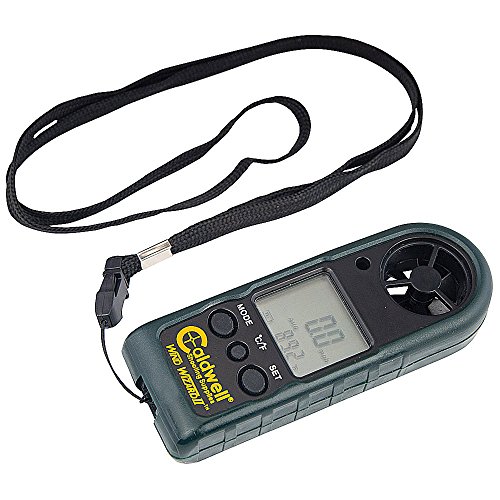
Unlike the solver-equipped options, this meter focuses on current wind speed in five selectable units. Its hand-sized body has a non-slip rubber casing, a lanyard, a backlit LCD and auto power-off; the maker describes the material as water resistant and provides a limited lifetime warranty. Choose it for straightforward field readings when a dedicated ballistic solution is not needed. It reports speed rather than wind direction, so shooters who need a directional reading for estimating a crosswind should consider a different tool.
Bottom line: Choose this for uncomplicated wind-speed readings in several units.
Calypso Mini AB Wind Meter

Unlike the larger handheld-style models, this pocket-sized ultrasonic meter is designed to send wind readings to a ballistic solver over Bluetooth. The maker says it provides real-time wind speed and direction, works with Applied Ballistics, and runs for 150 hours on a charge; it can recharge on a Qi pad. Choose it when wireless data transfer and a small form factor matter more than a standalone display.
Bottom line: Choose this for a compact meter intended to pair with a ballistic solver.
BTMETER BT-100

Compared with a speed-only meter, this model adds wind temperature and wind chill readings, which can be useful when you want several environmental measurements in one handheld device. The maker gives a wind-speed range of 0.67 to 67.1 mph with ±2% accuracy, plus temperature measurement from 14°F to 113°F. It also has a backlit display and five speed units. Choose it for those extra readings, but its functions do not include a ballistic solver or wind-direction measurement.
Bottom line: Choose this if temperature and wind-chill readings are useful alongside wind speed.
BTMETER BT-816B

Unlike the BT-100, this model emphasizes max, average and current wind-speed modes rather than a stated ±2% accuracy figure. Its name gives a 0.2 to 67 mph range, while the maker gives a speed range of 0.3 to 30 m/s and ±5% of reading; it also measures temperature and wind chill. Choose it if retaining a maximum or average reading is useful. It does not provide a ballistic solver or a wind-direction function, so it is less suited to buyers who want those features integrated.
Bottom line: Choose this when max, average and current readings are the priority.
How to choose a wind meter for shooting
Choose based on whether you need a speed reading alone, wind direction, or a ballistic solution. A basic anemometer reports local wind speed; a ballistic weather meter combines environmental measurements with a solver that estimates elevation and windage for a selected rifle and load. A crosswind at 90 degrees to the shooting line has its full lateral component, while a 45-degree wind has about 0.7 of the full component. The bullet’s path and changing wind conditions still affect the actual result. If your priority is seeing calculated corrections on the device, select a solver-equipped model; if you only need a field wind reading, a simpler unit may be enough.
Where to measure wind before a shot
A handheld meter reads wind where you hold it, not the wind at every point between muzzle and target. Wind speed and direction can differ across open ground, around tree lines and near terrain features, so one reading should not be treated as a complete path measurement. A 90-degree crosswind produces more lateral effect than a headwind or tailwind of the same speed. Record direction as well as speed when your equipment supports it, and reassess if the wind shifts before firing. Use a safe firing position and keep the muzzle pointed downrange while taking a reading; do not let wind measurement distract from firearm handling.
What wind units and readings mean
Meters per second, miles per hour, kilometers per hour, feet per minute and knots are speed units; the same wind value changes numerically when the unit changes. For example, 1 m/s is about 2.24 mph, so compare readings only after selecting a common unit. Current, average and maximum modes answer different questions: current captures a moment, average smooths variation over the selected interval, and maximum records a peak. Temperature and wind chill are separate environmental readings, not substitutes for wind direction. For consistent comparisons between locations or readings, leave the meter in the same unit and mode.
Handheld anemometers versus ballistic meters
Handheld anemometers prioritize direct wind readings, while ballistic meters add software that turns environmental inputs and rifle-specific data into a firing solution. A solver is useful only when its rifle, bullet and scope setup matches the equipment being used; a generic wind reading alone does not establish the correct correction. Use this comparison to match the tool to the task:
| Need | Meter type | What to look for |
|---|---|---|
| Basic wind speed | Handheld anemometer | Readable display and familiar units |
| Wind plus temperature | Multifunction anemometer | Temperature and chill readings |
| Calculated corrections | Ballistic weather meter | Solver support and matching rifle data |
| Wireless data transfer | Bluetooth wind meter | Compatibility with the intended solver |
Frequently Asked Questions
Does a handheld wind meter show wind at the target?
No, a handheld meter measures conditions at the meter’s location. Wind can vary along the bullet’s path, especially around terrain and vegetation, so reassess when conditions change.
Which wind direction matters most for bullet drift?
A wind at 90 degrees to the shooting line has the largest crosswind component. At 45 degrees, the crosswind component is about 0.7 of the wind speed.
What does a wind meter’s average mode do?
Average mode smooths changing readings over a time interval, unlike current mode, which shows a momentary value. Maximum mode captures a peak rather than the prevailing wind.
Are mph and meters per second interchangeable?
They express the same speed in different units: 1 m/s is about 2.24 mph. Convert readings to one common unit before comparing them.
Does a ballistic meter work with any rifle setup?
A ballistic solver needs data that matches the rifle, bullet and scope setup to calculate a relevant solution. Verify solver compatibility and enter the correct setup before relying on its output.