
Check Hemoglobin at Home: Meter Kits Compared

For checking hemoglobin at home, Hemoglobin Test Meter, 50 Strips offers 50 strips and stores up to 1,000 dated results, making it a fit for people who want a larger supply and a record of readings. Choose Hemoglobin Meter Kit, 25 Strips for a 15-second result, or Upgraded Hemoglobin Tester, 25 Strips for memory of up to 1,200 results.
Home meters measure hemoglobin from a blood sample, but they do not replace clinical evaluation; anyone who needs a diagnosis or has an unexpectedly abnormal reading should contact a healthcare professional.
We earn a commission if you buy through links on this page. As an Amazon Associate I earn from qualifying purchases. Products are compared on manufacturer specifications, not hands-on testing.
- Best overall: Hemoglobin Test Meter, 50 Strips – Includes 50 test strips and stores up to 1,000 results with time and date.
- Best for speed: Hemoglobin Meter Kit, 25 Strips – Provides results in 15 seconds and includes 25 strips, lancets and collection tubes.
- Best for tracking: Upgraded Hemoglobin Tester, 25 Strips – Stores up to 1,200 readings with date and time.
| Product | Best for | Included hemoglobin strips | Result time | Stored readings | Shop |
|---|---|---|---|---|---|
| Hemoglobin Test Meter, 50 Strips | Larger strip supply | 50 | About 20 seconds | 1,000 results | Check Price on Amazon |
| Hemoglobin Meter Kit, 25 Strips | Quick results | 25 | 15 seconds | — | Check Price on Amazon |
| Upgraded Hemoglobin Tester, 25 Strips | Reading history | 25 | About 20 seconds | 1,200 readings | Check Price on Amazon |
| Hemoglobin Levels Testing Kit, 25 Strips | Simple operation | 25 | — | Memory function | Check Price on Amazon |
At-Home Hemoglobin Test Meters
Compare these meters by strip supply, result timing and whether they retain dated readings.
Hemoglobin Test Meter, 50 Strips
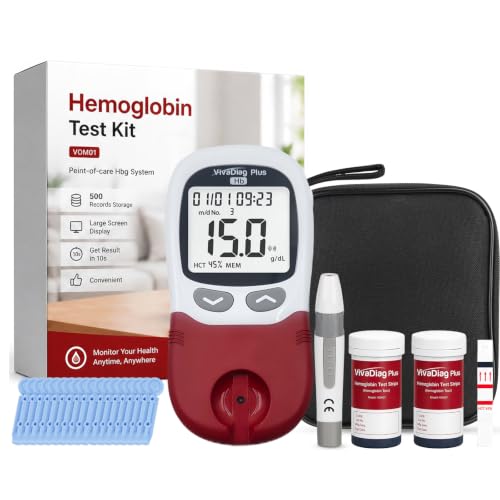
Hemoglobin Test Meter, 50 Strips stands out for its 50-strip supply and memory for 1,000 results with time and date. The kit is an at-home hemoglobin meter; its product name also identifies 50 test strips. The maker says it gives results in 20 seconds from a small sample. This option suits someone who wants a larger set of strips and a stored record. The facts do not identify included lancets or collection tubes, so buyers who need those components should confirm the kit contents before ordering.
Bottom line: Choose this if you want 50 strips and dated storage for 1,000 readings.
Hemoglobin Meter Kit, 25 Strips

Hemoglobin Meter Kit, 25 Strips is the speed-focused option: the maker says results arrive in 15 seconds, and the kit includes 25 strips, 25 lancets, 25 collection tubes, a lancing device, a quality control strip and a storage bag. The meter measures 135 × 66 × 19 mm. It suits buyers who want the sampling supplies bundled with the meter.
Bottom line: Pick this if a 15-second result and bundled sampling supplies matter most.
Upgraded Hemoglobin Tester, 25 Strips

Upgraded Hemoglobin Tester, 25 Strips offers the largest reading history here, saving up to 1,200 results with date and time. Its kit includes 25 strips, 25 lancets, an adjustable lancing device and a zippered carrying case, and it has a backlit display. The maker says results take about 20 seconds. This combination suits someone prioritizing a long record and portable storage. The strip supply is 25, half the 50 included with Hemoglobin Test Meter, 50 Strips, so frequent testing may make the smaller supply less convenient.
Bottom line: Choose this if dated memory for up to 1,200 readings is your priority.
Hemoglobin Levels Testing Kit, 25 Strips

Hemoglobin Levels Testing Kit, 25 Strips emphasizes simple operation with a three-step process, a clear display and a memory function for reviewing previous results. The product name identifies a 25-strip kit with lancets, making it a basic choice for someone focused on straightforward home checks rather than a specified speed or large memory count. The maker describes it as portable.
Bottom line: Pick this if a three-step process and basic result memory suit your needs.
How to Choose an At-Home Hemoglobin Meter
Choose a meter by matching its strip supply, result record and sampling supplies to how you plan to monitor. Hemoglobin is usually reported in grams per deciliter (g/dL) or grams per liter (g/L); 1 g/dL equals 10 g/L, so confirm the displayed unit before comparing readings. A larger memory can help retain a longer history, while included lancets and collection tubes can reduce the need to source components separately. Home readings are screening information, not a diagnosis. For persistent symptoms or a result outside the range your clinician gave you, contact a healthcare professional rather than changing medication or treatment based on one meter reading.
How to Compare Strip Counts and Result Records
Strip count determines how many tests the included supply supports, while memory capacity tells you how many readings the meter can retain. For example, a kit with 50 strips supports more tests from its included supply than a kit with 25; this does not mean the meter itself is more accurate. Check whether saved results include dates, since a time-stamped record is easier to discuss at an appointment than an undated sequence. The comparison below gives a quick way to match a priority to the feature.
| Priority | What to compare | Decision rule |
|---|---|---|
| Fewer kit restocks | Included strip count | Choose 50 strips over 25 if you want twice the included supply. |
| Faster check | Result time | Choose a 15-second meter over one stating about 20 seconds. |
| Longer record | Memory capacity | Choose a 1,200-reading capacity over a 1,000-reading capacity. |
How to Collect a Capillary Blood Sample Safely
Use a fresh lancet for each fingerstick and never share a lancing device, even if the lancet is changed; blood exposure can transmit infection. Wash and dry hands before sampling, because moisture or residue can affect a small blood drop. Follow the meter’s strip and sample procedure, since strip chemistry and required sample volume differ among devices. Put used lancets in a puncture-resistant sharps container, not loose in household trash. If a device requires a collection tube, use the type and avoid transferring blood between people or meters.
How to Interpret an At-Home Hemoglobin Reading
Adult reference intervals vary by laboratory and patient, but common ranges are roughly 13.8–17.2 g/dL for men and 12.1–15.1 g/dL for women. Age, pregnancy, altitude and the laboratory method can affect interpretation, so a meter value is not directly interchangeable with a clinical blood count. A reading outside a clinician-stated range, or repeated readings moving in the same direction, warrants discussion with a healthcare professional. Seek urgent care for severe shortness of breath, fainting or chest pain rather than relying on a home meter to determine the cause.
Frequently Asked Questions
Can a home hemoglobin meter diagnose anemia?
No, a home meter is not a substitute for a clinician’s diagnosis. Anemia assessment may require a complete blood count and evaluation of the cause, so discuss abnormal or concerning readings with a healthcare professional.
How often should I check hemoglobin at home?
There is no single schedule for everyone; the right interval depends on why you are monitoring and your clinician’s plan. For tracking change, record dates and use a consistent testing routine rather than increasing testing after one unexpected value.
What units do hemoglobin meters use?
Hemoglobin is commonly expressed as g/dL or g/L, and 1 g/dL equals 10 g/L. Confirm the unit on the device before comparing a result with a laboratory report or clinician-stated range.
Can I reuse a lancet for another test?
No, use a new lancet for each fingerstick and do not share lancing devices. Dispose of used lancets in a puncture-resistant sharps container to reduce injury and blood-exposure risk.
Why might a home reading differ from a lab result?
A home meter and a laboratory blood count can use different methods and sample handling, so small differences can occur. If a result is unexpected or affects a health decision, ask a healthcare professional to interpret it and determine whether laboratory testing is needed.