
Best Rear Differential Stop Leak: 4 Options Compared

Bar’s Leaks Axle and Differential Gear Repair is the best fit for most people because it is specifically formulated for differentials and compatible with synthetic and conventional GL-4 and GL-5 gear oils.
Choose a multipurpose seal reconditioner instead if you need one formula for several systems, but verify the correct fill point and fluid capacity for your vehicle before adding any additive.
We earn a commission if you buy through links on this page. As an Amazon Associate I earn from qualifying purchases. Products are compared on manufacturer specifications, not hands-on testing.
- Best overall: Bar’s Leaks Axle and Differential Gear Repair – A differential-focused treatment designed for multiple gear-oil grades, including GL-4 and GL-5.
- Best for multiple axles: Bar’s Leaks 1816 Differential Gear Repair, 4-Pack – The same differential treatment in a case of four bottles.
- Best for multi-system use: ATP Automotive AT-205 Re-Seal – Compatible with gear oil, ATF, conventional and synthetic oils, and hydraulic oil.
| Product | Best for | Package size | Fluid compatibility | Intended systems | Shop |
|---|---|---|---|---|---|
| Bar’s Leaks Axle and Differential Gear Repair | Differential leaks | 16.9 oz, 1 bottle | Synthetic and conventional GL-4, GL-5 | Differentials, manual gearboxes | Check Price on Amazon |
| Bar’s Leaks 1816 Differential Gear Repair, 4-Pack | Multiple applications | 16.9 oz per bottle, 4 bottles | Synthetic and conventional GL-4, GL-5 | Differentials, manual gearboxes | Check Price on Amazon |
| BlueSeal Oil Stop Leak | Multi-system seals | 8 oz | Gasoline and diesel engine oils | Engines, transmissions, differentials | Check Price on Amazon |
| ATP Automotive AT-205 Re-Seal | Broad fluid compatibility | 8 oz | Conventional and synthetic oils, ATF | Engines, transmissions, power steering | Check Price on Amazon |
Rear Differential Stop Leak Options
These options range from differential-specific gear-oil treatments to broader seal reconditioners intended for several vehicle systems.
Bar’s Leaks Axle and Differential Gear Repair
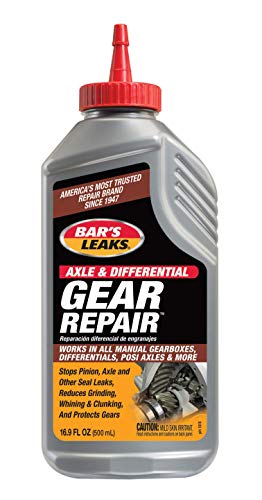
Bar’s Leaks Axle and Differential Gear Repair is the most directly targeted choice here: it is a gear-oil treatment for differential and axle seal leaks, rather than an engine-oil product. The maker says it is designed for synthetic and conventional GL-4, GL-5, and MT-1 lubricants, including grades such as 75W-90 and 80W-90. It also claims anti-wear, anti-foam, and anti-corrosion protection. That broad compatibility makes it relevant to many gear-oil applications, but it does not establish that every vehicle’s differential can take an additive; confirm the lubricant and fill requirements first.
Bottom line: Choose this for a differential-specific formula compatible with several gear-oil grades.
Bar’s Leaks 1816 Differential Gear Repair, 4-Pack

Bar’s Leaks 1816 Differential Gear Repair, 4-Pack differs from the single-bottle option by supplying four 16.9-ounce bottles of the same differential gear repair treatment. Its maker says the formula is designed for synthetic and conventional GL-4, GL-5, and MT-1 gear oils and for use in differentials, manual gearboxes, and open or posi axles. This package suits someone maintaining multiple compatible units or wanting several applications on hand. The four-bottle quantity is unnecessary if you have one vehicle and only need a single treatment, so match the amount to your actual service needs.
Bottom line: Pick this package if you need the differential treatment for multiple applications.
BlueSeal Oil Stop Leak

BlueSeal Oil Stop Leak is a multipurpose seal conditioner, not a differential-only gear-oil additive. The maker says its petroleum-free, non-clogging formula is intended for rubber seals in engines, transmissions, differentials, power steering, rack-and-pinion systems, and hydraulic systems; it also gives a direct-to-sump or crankcase application method. That breadth can suit a buyer treating more than one system. The product’s compatibility with particular differential gear-oil specifications is not established here, so it is a less direct match than a formula explicitly designed for GL-4 or GL-5 gear oil.
Bottom line: Consider it when broad multi-system use matters more than a gear-oil-specific formulation.
ATP Automotive AT-205 Re-Seal

ATP Automotive AT-205 Re-Seal distinguishes itself with a compatibility range spanning conventional and synthetic oils, ATF, gear oil, power-steering fluid, and hydraulic oil. The maker says it reconditions rubber seals and gaskets in engines, transmissions, power steering, differentials, and hydraulic systems, without petroleum distillates. That makes it a versatile alternative when the same formulation may serve different fluid systems.
Bottom line: Choose it when broad compatibility across several systems is the priority.
How to choose rear differential stop leak
Start with the lubricant specification, not the word “stop leak” on a bottle. Differential fluids commonly use API GL-5 gear oil; some manual gearboxes and axles call for GL-4, and limited-slip differentials may require a friction modifier or a specific lubricant. Match the additive’s compatibility to the fluid in the axle. A product meant for engine oil is not interchangeable with gear-oil treatment simply because both address rubber seals.
Also distinguish a seal seep from a mechanical failure. Additives cannot correct a damaged bearing, worn gear, loose fastener, or cracked housing. If the axle is noisy, hot, or losing fluid rapidly, diagnose the cause rather than relying on a chemical treatment.
Gear oil grades and differential fit
Gear oil viscosity is shown in SAE grades such as 75W-90 and 80W-90; the vehicle maker’s specification determines which grade and API category belong in the axle. The “W” grade describes cold-temperature flow, while the second number represents high-temperature viscosity behavior. Similar-looking grades are not automatically interchangeable, especially where a limited-slip unit has its own lubricant requirement.
Bar’s Leaks Axle and Differential Gear Repair and Bar’s Leaks 1816 Differential Gear Repair, 4-Pack are the products here whose features explicitly name GL-4, GL-5, and MT-1 gear oils. The broader formulas also mention differentials or gear oil, but do not give those specific API grades. Use the axle’s service specification as the deciding condition, and do not exceed its fill level when adding any treatment.
Stop leak additives versus repair
A seal conditioner is intended to affect elastomer seals; a mechanical leak can have a different cause. Pinion and axle seals sit where rotating shafts exit the housing, while the differential cover seals a stationary joint. A leak at a cover edge, a pinion seal, or a shaft seal calls for different inspection points, so identify the wettest area before choosing an additive.
Keep the axle filled to its specified level because low lubricant can damage gears and bearings. A persistent drip, burnt odor, grinding or whining sound, or visible metal in drained oil warrants prompt inspection. Additives are not a substitute for correcting the leak source or restoring the correct lubricant level.
Safe application and common mistakes
Use the product only in the fluid system named for it: engine-oil products belong in the crankcase, while differential treatments belong in compatible gear oil. Never pour a crankcase additive into an axle based only on the phrase “works with differentials.” Check the vehicle’s fluid specification and the additive’s dosage before opening the fill plug, and avoid overfilling the housing.
Work on a level surface and support a raised vehicle with rated jack stands; never rely on a jack alone. Gear oil can be hot after driving, so let the axle cool before opening it. If the leak is severe or the unit is making new noise, stop driving and have the differential assessed rather than masking symptoms.
Frequently Asked Questions
Can rear differential stop leak fix a leaking pinion seal?
A seal conditioner may help a minor leak caused by a seal, but it cannot repair a damaged pinion surface or worn bearing. A rapid drip or new driveline noise needs mechanical inspection.
Can I use engine oil stop leak in a differential?
No, not unless its compatibility specifically includes the differential’s gear oil. Engine oil additives are formulated for crankcase fluids, and the correct axle lubricant specification remains essential.
What gear oil goes in a rear differential?
The vehicle’s axle specification decides the oil, commonly an SAE grade such as 75W-90 or 80W-90 with an API category such as GL-5. Limited-slip axles can require a specific fluid or friction modifier.
How do I know whether a differential leak is serious?
A few damp traces differ from a steady drip or a falling fluid level; check the housing and nearby ground for active leakage. Whining, grinding, heat, or a burnt odor calls for prompt inspection.