
Best Fans for Classrooms: 3 Options Compared by Fit

Amazon Basics 28-Inch Tower Fan is the best fit for most classrooms because its 27.8-inch tower design is better suited to floor placement than a compact desk fan. Choose a desk fan instead when you need airflow near a teacher’s workstation or a small area.
Classroom fans move air for comfort; they do not replace ventilation or air conditioning.
We earn a commission if you buy through links on this page. As an Amazon Associate I earn from qualifying purchases. Products are compared on manufacturer specifications, not hands-on testing.
- Best overall: Amazon Basics 28-Inch Tower Fan – Its 27.8-inch tower format and 60-degree oscillation suit floor placement in a shared room.
- Best for a teacher’s desk: Dr. Prepare 13-Inch Oscillating Desk Fan – The 12.8-inch desktop fan combines three speeds with 110-degree oscillation.
- Best for focused desk airflow: 13-Inch Personal Tower Cooling Fan – Its compact 13-inch design offers three speeds and selectable 60- or 110-degree oscillation.
| Product | Best for | Height | Oscillation | Shop |
|---|---|---|---|---|
| Amazon Basics 28-Inch Tower Fan | Floor placement | 27.8 in | 60° | Check Price on Amazon |
| Dr. Prepare 13-Inch Oscillating Desk Fan | Teacher’s desk | 12.8 in | 110° | Check Price on Amazon |
| 13-Inch Personal Tower Cooling Fan | Focused desk airflow | 5 in | 60° / 110° | Check Price on Amazon |
Classroom Fans
Match the fan’s footprint and airflow direction to where students and staff spend time in the room.
Amazon Basics 28-Inch Tower Fan

For a shared classroom floor, this 27.8-inch tower fan is taller than the two desktop options and has a 9.4-inch square footprint. It offers three speeds and mechanical controls on top, so adjustments are straightforward when the unit is accessible. The maker describes it as an air circulator for enclosed spaces and gives its power use as 35W. Its 60-degree oscillation is narrower than the 110-degree sweep on Dr. Prepare 13-Inch Oscillating Desk Fan, so it may suit a defined seating area better than a wide sweep across the room. Keep the fan clear of walkways.
Bottom line: Choose this for floor placement when you want a taller unit and can keep it out of traffic.
Dr. Prepare 13-Inch Oscillating Desk Fan
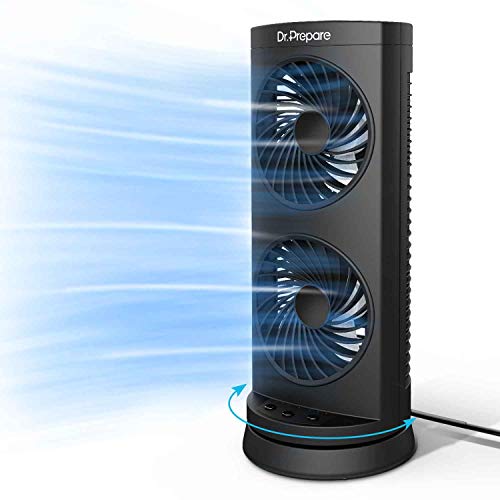
For a broad sweep from a desktop, this model’s 110-degree oscillation covers a wider angle than the 60-degree tower fan. Its 12.8-inch height and 5.4-inch depth and width make it a compact option for a desk or side table. It has three speeds, dual fans, and automatic shutoff timers at 2, 4, or 8 hours. The maker describes it as quiet, but the maker gives no decibel level, so buyers who need a particular noise limit should verify that before choosing it. A desk fan will not circulate air as high as a floor tower.
Bottom line: Pick this when a desktop location and wide oscillation matter more than floor-level placement.
13-Inch Personal Tower Cooling Fan

For a small desktop footprint, this fan is listed at 13 inches long and 5 inches wide and high, with three speed settings. Unlike Dr. Prepare 13-Inch Oscillating Desk Fan, it offers both 60- and 110-degree oscillation choices, allowing a narrower or wider sweep. The maker claims airflow up to 24 feet per second and a 25 dB sound level; those are performance claims rather than dimensions. Its short height makes it a personal fan rather than a floor unit, so it is better aimed at a nearby workstation than used to move air across a classroom. Confirm the oscillation controls suit your intended placement.
Bottom line: Choose this for personal airflow at a workstation when a low-profile desk unit is preferred.
How to Choose a Classroom Fan
Choose a classroom fan by matching its placement, sweep, and speed control to the occupied area. A tower fan stands on the floor, while a desktop fan serves a nearby desk or table; neither format should block a walkway or door. Oscillation angle is a useful comparison: a wider sweep reaches more directions, but room shape and furniture affect where airflow goes. Three speed settings offer basic adjustment as occupancy or comfort changes. For a fan near instruction or quiet work, consider the sound it produces; a claimed decibel figure is only useful if the classroom’s noise needs are clear. Fans move room air but do not supply outdoor air or replace required ventilation.
Floor Fans and Desk Fans Compared
Floor towers and desk fans solve different placement problems, so choose by where air needs to reach. A tower unit occupies floor space and can stand nearer a seating zone, while a compact desk fan directs air toward someone close by. Measure the intended surface and keep the fan and its cord away from paths students use. This comparison focuses on the distinguishing form and sweep.
| Need | Suitable format | Reason |
|---|---|---|
| Airflow from floor level | Tower fan | Taller form places the outlet above floor level. |
| Airflow at one workstation | Desk fan | Compact form can sit on a desk or table. |
| Wider directional sweep | Fan with wider oscillation | Greater angle moves airflow through more directions. |
Where to Place a Fan in a Classroom
Place a classroom fan on a stable surface or clear floor area, away from student traffic and reachable hands. Keep the airflow path clear of papers and lightweight classroom materials, which can shift in moving air. Route cords along a wall or secure them so they do not cross a walking route; a trip hazard matters more in a room where students move between desks. Point airflow toward the occupied area without aiming directly at papers, displays, or students who find the breeze distracting. Check that the fan’s controls can be reached by staff without stepping over cords or moving furniture.
Frequently Asked Questions
Can a classroom fan replace ventilation?
No. A fan recirculates room air rather than bringing in outdoor air, so it does not replace ventilation. Use it for air movement and comfort, not as a substitute for the room’s ventilation system.
How much oscillation does a classroom fan need?
A 110-degree sweep covers a wider range of directions than a 60-degree sweep. For a fan aimed at one workstation, the narrower angle may be sufficient; for a broader seating area, choose the wider option and keep furniture out of its path.
Where should a fan sit around students?
Keep the fan stable and outside walkways, with its cord routed away from student traffic. Leave clearance around the airflow path so papers and other light materials are less likely to move.
Are desk fans or tower fans better for classrooms?
Desk fans fit a teacher workstation or a nearby table, while tower fans use floor space and stand taller. If the intended location has less than a desk-sized surface available, a floor tower may be the more practical format.