
Izzo Swami Golf GPS Watch: Models Compared by Fit

The Izzo Swami Golf GPS Watch with Personalized Club Suggestions is the closest fit if you want wrist-worn yardages and club guidance based on target distance. Choose another watch if you prefer a simpler button-based interface or a higher stated course count; choose a handheld if a larger screen matters more than wearing the device.
We earn a commission if you buy through links on this page. As an Amazon Associate I earn from qualifying purchases. Products are compared on manufacturer specifications, not hands-on testing.
- Best overall: Izzo Swami GPS Watch – Combines green and hazard distances with i-Caddie club suggestions in a watch format.
- Best for button controls: TecTecTec ULT-G GPS Watch – Uses five buttons and works on course without a phone.
- Best for course coverage: NAVO W1 GPS Watch – Offers 42,000+ preloaded courses and a sunlight-readable display.
- Best for a large screen: Izzo Swami Max Handheld GPS – Its 3.5-inch color display and integrated magnet suit cart use.
| Product | Best for | Format | Preloaded courses | Distinctive feature | Shop |
|---|---|---|---|---|---|
| Izzo Swami GPS Watch | Club suggestions | Watch | 38,000+ | i-Caddie suggestions | Check Price on Amazon |
| TecTecTec ULT-G GPS Watch | Button controls | Watch | 40,000+ | Five-button controls | Check Price on Amazon |
| NAVO W1 GPS Watch | Course coverage | Watch | 42,000+ | Sunlight-readable display | Check Price on Amazon |
| Izzo Swami 7000i Handheld | Touchscreen operation | Handheld | 38,000+ | 2.5-inch touchscreen | Check Price on Amazon |
| Izzo Swami Max Handheld GPS | Cart-mounted display | Handheld | 38,000 | 3.5-inch color screen | Check Price on Amazon |
Izzo Swami Golf GPS Watch and Alternatives
Compare wrist-worn GPS watches with related handheld units by format, course coverage and the features that shape a round.
Izzo Swami GPS Watch

The Izzo Swami GPS Watch is the direct match for golfers who want personalized club suggestions alongside on-course yardages. It provides distances to the front, back and center of the green, plus layup and carry distances to hazards and doglegs. The maker says i-Caddie bases suggestions on distance to the target. The watch also includes shot-distance measurement, a digital scorecard, auto-course recognition and auto-hole advance. It suits someone who wants several planning and scoring functions on the wrist. Its dimensions are 7.75 by 3.5 by 2.5 inches, so verify the actual wearable fit before choosing it.
Bottom line: Choose this if wrist-based club suggestions and hazard yardages are priorities.
TecTecTec ULT-G GPS Watch
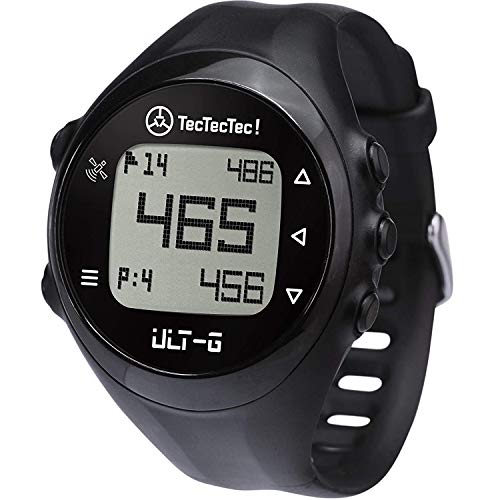
The TecTecTec ULT-G stands apart with five-button operation and no touchscreen, making it an alternative for golfers who want simple controls. It gives front, center and back green distances, hazard distances and shot-distance measurement. The maker says no phone is required during a round; an optional companion app is for course and firmware updates. Automatic hole progression is also included. Its dimensions are 1.8 inches long and wide, with a 0.75-inch height. Compared with the Swami, it emphasizes straightforward yardages rather than personalized club suggestions, so golfers seeking that guidance should look elsewhere.
Bottom line: Pick this if physical buttons and uncomplicated yardages matter most.
NAVO W1 GPS Watch

The NAVO W1 distinguishes itself with a 42,000+ preloaded courses and a high-contrast display intended to remain clear in bright sunlight. It shows front, middle and back green distances and tracks key hazards. The maker says the watch works independently on course, requires no subscription and includes free course updates. That makes it a fit for golfers who want a phone-free wearable and value the course count. The maker does not specify its dimensions or controls, so it is harder to compare wrist fit and interface preference against the other watches.
Bottom line: Choose this if the course count and sunlight readability stand out.
Izzo Swami 7000i Handheld
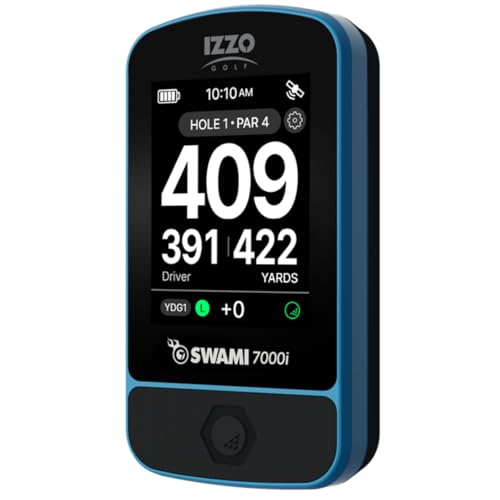
The Swami 7000i is a handheld rather than a watch, and its 2.5-inch color touchscreen is the key difference. It uses swipe and touch controls, offers multiple color themes, and includes auto-hole advance, shot-distance measurement and a digital scorecard. The maker says its i-Caddie feature suggests clubs by target distance and that more than 38,000 courses are preloaded without subscription fees. Choose this format if viewing a larger screen matters more than having yardages on your wrist. The maker describes green-distance measurements but cuts off before identifying all of the points measured.
Bottom line: Pick this if you want a touchscreen handheld instead of a wearable.
Izzo Swami Max Handheld GPS

The Swami Max is a handheld GPS unit, not a watch, and its 3.5-inch color display is the largest screen among these options. It measures distances to the front, center and back of the green, plus layup and carry distances to hazards and doglegs. The maker says it has a built-in magnet for attaching to a cart frame, along with auto-course recognition and auto-hole advance. Multiple orientations and a center-only large-font view are included. It suits cart riders who prefer glanceable screen access; golfers seeking wrist-based use should choose a watch instead.
Bottom line: Choose this if a large, cart-mountable screen is more useful than a watch.
How to choose a golf GPS format
Choose a watch for wrist access during play and a handheld when a larger screen or cart mounting is more useful. Golf GPS devices use satellite positioning to estimate distance to mapped course points; readings are not the same as a laser measurement to a specific flag. Front, middle and back yardages help account for pin position, while hazard carry distances can inform whether a shot clears an obstacle. A decision rule: if you want a screen at least 2.5 inches across, compare handhelds, since the Swami 7000i lists a 2.5-inch display and the Swami Max lists 3.5 inches. If your priority is club guidance, Izzo Swami GPS Watch uniquely offers the described personalized suggestions.
What green and hazard distances mean
Front, middle and back distances refer to mapped points on the green, not a guarantee of the flag’s exact position. A center yardage is a useful baseline, but the front and back figures matter when a green is deep or a shot must avoid going long. Layup distance helps plan to a chosen point short of an obstacle; carry distance estimates the distance needed to clear it. Compare which points each unit measures before selecting one: the Swami watch and Swami Max include layup and carry distances, while the ULT-G and NAVO emphasize green and hazard distances. Club choice still depends on the golfer’s own carry distances and conditions.
Course maps and updates to compare
Preloaded course counts are useful only when the device includes the courses you play. The counts range from 38,000 to 42,000+, but a larger count alone does not establish that a particular local course is mapped or current. Before buying, verify that your regular courses are supported and check how updates are handled; the NAVO says updates are free, while the Izzo models say there are no map-update fees. GPS yardages depend on a usable satellite signal and accurate course mapping. Tree cover, terrain and a course-map mismatch can affect what appears on screen, so a GPS number should not replace visual judgment around hazards.
Using GPS yardages for safer club decisions
Use a GPS yardage as one input, not as a promise that a shot will carry a hazard. Compare the carry number with your own reliable carry distance, then allow for wind, lie, elevation and temperature. For instance, if your dependable carry is below the displayed hazard carry distance, choose a layup target rather than assuming a full swing will clear it. Club-suggestion features can help organize decisions, but they cannot account for every playing condition unless the device’s functions specifically do so. GPS can also take time to acquire a satellite position; starting the device before the first tee gives it time to locate the course and avoids rushing setup.
Frequently Asked Questions
Does the Swami GPS watch need a phone during play?
The Swami watch’s features include preloaded course maps and auto-course recognition, so its described round functions do not depend on carrying a phone. The ULT-G and NAVO also say they work independently on course. Course availability and setup are separate from phone use during a round.
What do front, center and back distances tell golfers?
They give yardages to three mapped points on the green, helping golfers account for green depth and pin position. Use the front and back values to judge whether a club may leave a shot short or long; the center is not necessarily the flag distance.
Are golf GPS yardages the same as laser readings?
No. GPS devices estimate distance to mapped course points, while a laser rangefinder measures to a selected target with line of sight. A GPS yardage is useful for green and hazard planning, but it may not identify the exact flag location.
How should I use a hazard carry distance?
Compare the carry figure with your dependable carry distance for the club and current conditions. If your reliable carry is shorter than the required distance, aim for a layup rather than relying on a best-case shot.
Do preloaded golf course counts guarantee my course is included?
No. A count such as 38,000+ or 42,000+ does not confirm coverage of a particular course. Check that your regular courses are supported and learn whether map updates are available before choosing a device.