
Best Wall Anchors for Resistance Bands Compared

The FITKIT 3-pack is the strongest all-around pick on its 800-pound capacity and spring-locking design. Wall anchors create fixed attachment points for band exercises, but choose another option if you need a vertically adjustable rail or a hook-and-anchor combination.
Mount any anchor to structural framing or suitable masonry, not drywall alone; the wall and fasteners matter as much as the anchor.
We earn a commission if you buy through links on this page. As an Amazon Associate I earn from qualifying purchases. Products are compared on manufacturer specifications, not hands-on testing.
- Best overall: FITKIT 3-Pack Wall Mount Anchor Kit – Its spring-locking design and stated capacity of up to 800 pounds suit varied band and strap attachments.
- Best for adjustable height: Adjustable Resistance Band Wall Anchor, 40-Inch – The 40-inch rail range allows the attachment point to move vertically.
- Best for hook versatility: hoeslaw 3-Pack Steel Anchors and Hooks – The set combines an anchor with a safety hook that can lower a high attachment point.
| Product | Best for | Configuration | Adjustment | Stated pull capacity | Shop |
|---|---|---|---|---|---|
| FITKIT 3-Pack Wall Mount Anchor Kit | Band and strap use | 3 anchors; triangular connector ring | — | Up to 800 lb | Check Price on Amazon |
| Adjustable Resistance Band Wall Anchor, 40-Inch | Adjustable training height | Adjustable rail | 40 in | 400 lb | Check Price on Amazon |
| hoeslaw 3-Pack Steel Anchors and Hooks | Hook attachment option | 3 anchors with hooks | Fixed points | 330 lb | Check Price on Amazon |
| Resistance Band Wall Anchor, 3-Pack, 40-Inch | Three-point rail setup | 3-pack rail system | 40 in | 500 lb title; 600 lb feature claim | Check Price on Amazon |
| Wuno Shop 4-Piece Wall Anchor Clips | Spring-locking clips | 4 clips | Multiple heights claimed | — | Check Price on Amazon |
Wall Anchors for Resistance Bands
Compare the attachment style, adjustment options and stated capacity before choosing an anchor for your workout space.
FITKIT 3-Pack Wall Mount Anchor Kit

The FITKIT set stands out for combining a spring-locking mechanism with a triangular connector ring for straps. Its three steel anchors are made as single pieces without welds, and the maker says the set has a capacity of up to 800 pounds. That combination suits a home gym that uses resistance bands alongside suspension or yoga straps.
The set has no stated adjustment rail, so changing exercise height means choosing among installed anchor points rather than sliding an attachment along a track. Confirm the intended mounting surface and fasteners can support your planned load.
Bottom line: Choose this set if you want fixed anchor points for bands and compatible straps.
Adjustable Resistance Band Wall Anchor, 40-Inch

The 40-inch adjustable rail sets this system apart from fixed-point anchors, letting you move the attachment vertically for different exercises. The maker says its heavy-duty steel construction handles 400 pounds of tension in any direction and uses an auto-locking system. It suits a workout area where one wall-mounted position needs to serve movements at several heights.
The product is a single 40-inch unit; the 80-inch range requires two units. A rail also needs a suitable mounting location and secure installation, so confirm the wall structure and fastener compatibility before relying on the capacity claim.
Bottom line: Choose it if changing attachment height is more useful than adding several fixed points.
hoeslaw 3-Pack Steel Anchors and Hooks

The hoeslaw set pairs each anchor with a safety hook, unlike designs centered on a rail or spring-locking clip. The maker says the stainless steel anchors support up to 330 pounds of pull, and the hook can lower the attachment point when an anchor is mounted high. That makes the set useful when you want a fixed installation with an alternate way to clip bands or suspension straps.
The anchors are fixed rather than vertically adjustable, so multiple exercise heights require multiple mounting positions. The maker describes wall or ceiling mounting; verify that the chosen surface and hardware are suitable for dynamic pulling loads.
Bottom line: Pick this set if you want a hook option and fixed positions on a wall or ceiling.
Resistance Band Wall Anchor, 3-Pack, 40-Inch

This three-pack uses a 40-inch rail and a positive-locking anchor, giving it a sliding-track format rather than separate fixed hooks. The maker describes an aluminum-alloy rail, stainless-steel anchor and weld-free construction. Its load capacity is inconsistent: the product name says 500 pounds, while the maker says 600 pounds of pulling force.
That mismatch matters when selecting equipment for a particular load, so confirm the applicable capacity before ordering. The rail format suits users who want an adjustable attachment position, but safe installation still depends on appropriate structural support and fasteners.
Bottom line: Choose it for a rail-style setup only after confirming the applicable capacity.
Wuno Shop 4-Piece Wall Anchor Clips
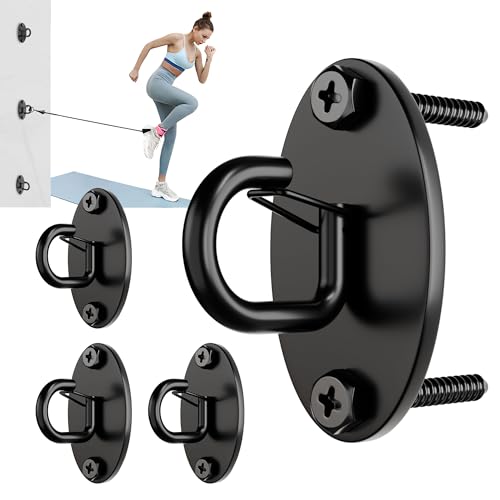
The Wuno Shop set is a four-piece clip-style option, distinct from the rail systems and anchor-hook combinations. Its spring-lock design is intended to keep a resistance band from slipping off, and the maker says the clips support multiple height adjustments. It may suit a home workout space where several clip positions are more useful than a continuous rail.
Confirm the mounting method and load suitability for your wall and intended exercises before installation.
Bottom line: Pick these clips for multiple attachment points when a capacity figure is not essential.
How to Choose Wall Anchors for Resistance Bands
Choose an anchor by attachment style, mounting surface and the force your training can apply. Fixed hooks or clips create distinct positions; a rail lets you slide the attachment vertically, while a hook-and-anchor combo can provide a second clipping method. A capacity is not a guarantee for every installation: fasteners, framing and pulling direction affect the finished setup. For a system whose capacity you need to rely on, resolve any conflicting capacity claims before buying. A practical rule is to skip any location that offers only drywall and no structural backing or suitable masonry; use a different position or a mount designed for that surface. Account for the band’s line of pull, since sideways or downward exercise forces can stress a mount differently from a straight pull.
Wall Mounting and Safe Placement
Resistance band anchors should attach to a structural stud or suitable masonry, not drywall alone. Many wood-framed walls place studs about 16 inches on center, but spacing varies, so locate the actual framing rather than assuming a position. Keep the band’s path clear of sharp edges and ensure the anchor does not create a point where the band can rub or snag. Install at a height that keeps the band aligned with the movement; a high anchor may suit pulldowns, while a low point supports rows or leg work. Inspect the mount, fasteners and band before each session, and stop using the setup if any part loosens, bends or shows damage. Never exceed the lowest capacity limit among the anchor, fasteners, wall and band.
Fixed Anchors Versus Adjustable Rails
Fixed anchors provide separate exercise positions, while adjustable rails allow a single attachment to move through a vertical range. Choose fixed points if you want multiple locations without moving a sliding carriage; choose a rail if height changes are central to your routine. The table compares the formats by the decision they support, not by load capacity, which varies by product and installation.
| Format | Best fit | Trade-off |
|---|---|---|
| Fixed clip or hook | Several set positions | Height changes require another position |
| Adjustable rail | One point moved vertically | Requires secure rail installation |
| Anchor with hook | Alternate clipping method | Still uses fixed mounting positions |
Measure the available wall height and plan the exercises before choosing a format. A 40-inch rail gives a defined adjustment range; multiple fixed mounts instead let you dedicate points to particular movements.
Frequently Asked Questions
Can I install resistance band anchors in drywall?
Do not rely on drywall alone for a resistance band anchor. Attach the mount to structural framing or suitable masonry, because fasteners and the wall must withstand repeated pulling forces.
How far apart should wall anchors be?
Space anchors according to your exercise positions and the wall structure, not a universal distance. Many wood-framed walls have studs about 16 inches on center, so locate the framing before setting mount positions.
Can resistance band anchors go on a ceiling?
Some anchor sets are intended for ceiling mounting, but the ceiling must have structural backing and suitable fasteners. Check the direction of pull and keep the band clear of edges that could wear it.
How often should I inspect a band wall anchor?
Inspect the anchor, fasteners and band before every workout. Stop using the setup if a mount loosens, metal bends, or a band shows cracks, cuts or fraying.
What capacity should a resistance band anchor have?
Use a capacity that exceeds the loads you plan to apply, and treat the wall and fasteners as part of the system. The lowest-rated component governs; resolve conflicting capacity claims before relying on a mount.