
T Zone Weed Killer: 3 Herbicide Options Compared

For a T Zone weed killer with four named active ingredients and yellow nutsedge suppression, choose TZone SE Broadleaf Herbicide, Quart; its quart size also suits buyers who want less product than the gallon options. Choose a gallon instead if that package size better fits your needs.
T Zone is a selective turf herbicide intended to control certain weeds while preserving listed lawn grasses; confirm the label covers your grass type and target weeds before use.
We earn a commission if you buy through links on this page. As an Amazon Associate I earn from qualifying purchases. Products are compared on manufacturer specifications, not hands-on testing.
- Best overall: TZone SE Broadleaf Herbicide, Quart – The quart formula names four active ingredients and notes yellow nutsedge suppression and use at temperatures as low as 50°F.
- Best for wild violet: TZone SE Broadleaf Herbicide, Gallon – Its target weeds include wild violet, ground ivy and black medic, in a gallon size.
- Best for several tough weeds: T-Zone Turf Herbicide, Gallon – The gallon option names wild violet, ground ivy, oxalis, clover and dandelion among its target weeds.
| Product | Best for | Package size | Notable feature | Shop |
|---|---|---|---|---|
| TZone SE Broadleaf Herbicide, Quart | Cool-weather use | 32 fl oz | Four active ingredients; nutsedge suppression | Check Price on Amazon |
| TZone SE Broadleaf Herbicide, Gallon | Wild violet control | 128 fl oz | Names wild violet, ground ivy and black medic | Check Price on Amazon |
| T-Zone Turf Herbicide, Gallon | Broad weed targets | 128 fl oz | Names violet, ivy, oxalis | Check Price on Amazon |
T Zone Weed Killer Options
Compare the quart and gallon options by package size and the weed-control features each one names.
TZone SE Broadleaf Herbicide, Quart
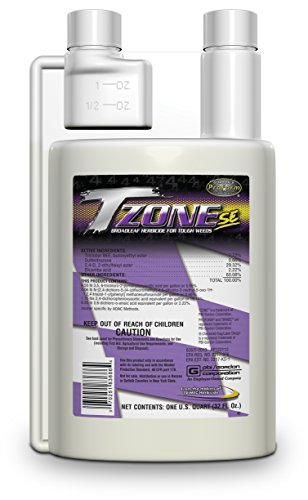
TZone SE Broadleaf Herbicide, Quart is the only quart option here, and it names triclopyr, 2,4-D, dicamba and sulfentrazone as active ingredients. The formula is designed for residential, commercial and golf sites, with yellow nutsedge suppression and a cool-weather option at temperatures as low as 50°F. That combination suits buyers seeking a smaller package with specific use conditions. As with other lawn herbicides, avoid contact with desirable plants not covered by the label.
Bottom line: Choose this quart if its temperature range and target use fit your lawn.
TZone SE Broadleaf Herbicide, Gallon

TZone SE Broadleaf Herbicide, Gallon is a gallon-size TZone SE option whose weed targets include wild violet, ground ivy and black medic. Its larger container distinguishes it from the quart-size choice, making it relevant when a gallon package matches the amount you plan to use. Selective lawn herbicides can still damage desirable plants outside the target list; prevent spray drift and keep treatment on the intended area.
Bottom line: Pick this option when the gallon size and its named weed targets are the fit.
T-Zone Turf Herbicide, Gallon

T-Zone Turf Herbicide, Gallon is another gallon option, distinguished by a longer list of named tough weeds: wild violets, ground ivy, oxalis, clover, dandelion, spurge and white clover. Its features also mention suppression of young, actively growing yellow nutsedge and improved cool-weather performance, but give no minimum temperature. This may suit buyers who want those targets represented on the label. Confirm the full weed list, turfgrass compatibility and seasonal limits before applying. Do not treat plants beyond the intended lawn area, since selective turf products may injure other broadleaf plants.
Bottom line: Choose this gallon if its weed targets match what you need to control.
How to Choose a T Zone Weed Killer
Start with the weed species and lawn type, then compare package size and application limits. Broadleaf herbicides are selective only for the turf types and weeds covered by their labels; a product that suits one lawn can injure another. The quart option names four active ingredients and yellow nutsedge suppression, while the gallon options list particular broadleaf weeds. A measurable decision rule is to choose the quart if 32 fluid ounces is the package size you want; both other matching options are 128 fluid ounces. Before treatment, identify the grass and weed, and verify each appears on the label. Do not assume that a longer weed list guarantees control at every growth stage or under every weather condition.
What the T Zone Active Ingredients Mean
Only the quart option names its ingredients: triclopyr, 2,4-D, dicamba and sulfentrazone. These are herbicide active ingredients used in weed-control formulations; the product’s target and turf safety depend on its complete formulation and labeled directions, not ingredient names alone. The gallon options provide named weed targets but do not identify their ingredients in the specifications. For a practical choice, compare the target weeds and turf compatibility on the package label rather than inferring that products with the TZone name have identical formulas. Keep herbicide spray away from desirable broadleaf ornamentals, and avoid applying in conditions that carry spray onto them.
When Cool-Weather Use Matters
Temperature can affect lawn herbicide performance, so a minimum is useful only when it belongs to the exact product. The quart formula gives a cool-weather option as low as 50°F; the other gallon descriptions say improved cool-weather performance without naming a temperature. That makes the quart the clearest fit when treatment near 50°F is a priority, but the label’s full temperature and use restrictions still control. Avoid treating drought-stressed or otherwise stressed turf unless the label permits it. Choose a dry, calm period consistent with the label to limit movement off target, and do not transfer a temperature limit from one TZone product to another.
Safe Application and Lawn Protection
Use a lawn herbicide only on turfgrass and weeds permitted by its label, and follow its specified mixing, application and protective-equipment directions. Broadleaf herbicides can harm flowers, shrubs, vegetable plants and other desirable broadleaf vegetation if spray drifts or runoff reaches them. Keep children and pets away during application and observe the product label’s re-entry instructions before allowing access again. Avoid spraying near drains or water unless the label allows it. A common mistake is treating the lawn based on the brand name alone: verify the exact product, target weed, grass type and application conditions before each use.
Frequently Asked Questions
Does T Zone control yellow nutsedge?
The quart formula notes yellow nutsedge suppression, and the gallon turf-herbicide option notes suppression of young, actively growing yellow nutsedge. Suppression is not the same as complete control, so check the product label for application limits.
How much T Zone should I apply per gallon?
Use the exact product label to determine the amount per gallon and the permitted treatment area; do not estimate a rate from package size.
Can I use T Zone on every type of lawn?
No single lawn-use assumption is safe: herbicide tolerance varies by turfgrass type and product. Check that the exact product label permits your grass before application.
How long should pets stay off treated grass?
Re-entry timing depends on the exact product label and application conditions. Keep pets away during spraying and follow that label’s instructions before allowing them back onto the treated area.