
Strongest Elastic for Bracelets: 4 Cords Compared

No listed cord has a tensile-strength rating, so none can be confirmed as the strongest; YMSDZHL 0.8 mm Elastic Cord is explicitly marketed as strong and provides 330 feet of 0.8 mm elastic cord. Choose a different cord when a bead hole requires another shape or thickness.
Elastic bracelet cord stretches to pass over the hand, then contracts around the wrist; bead-hole clearance and knot security matter alongside cord thickness.
We earn a commission if you buy through links on this page. As an Amazon Associate I earn from qualifying purchases. Products are compared on manufacturer specifications, not hands-on testing.
- Best overall: YMSDZHL 0.8 mm Elastic Cord – It is marketed as strong and offers 330 feet of 0.8 mm cord.
- Best for flat cord: Paxcoo 1 mm Flat Elastic Cord – Its flat profile measures about 1 mm wide and 0.7 mm thick.
- Best for two colors: LUSTEMBER 1 mm Elastic String – The package includes two rolls, one black and one white.
| Product | Best for | Cord size | Shape | Roll length | Shop |
|---|---|---|---|---|---|
| YMSDZHL 0.8 mm Elastic Cord | Long clear-cord supply | 0.8 mm | Flat | 330 ft | Check Price on Amazon |
| Paxcoo 1 mm Flat Elastic Cord | Flat white cord | 1 mm wide, 0.7 mm thick | Flat | 328 ft | Check Price on Amazon |
| JULIMAIDONG 0.8 mm Round Cord | Round clear cord | 0.8 mm | Round | 200 ft | Check Price on Amazon |
| LUSTEMBER 1 mm Elastic String | Black-and-white cord | 1 mm | — | 2 rolls | Check Price on Amazon |
Elastic Cord for Bracelets
Compare cord dimensions and package lengths, then match the cord to your bead holes and desired appearance.
YMSDZHL 0.8 mm Elastic Cord

For shoppers looking for a cord marketed as strong, this transparent polyester-spandex option pairs a 0.8 mm thickness with a 330-foot roll. The maker says it is flexible, easy to knot, and suitable for beads of different materials; the small knot can be hidden among beads. That long length suits making multiple bracelets or keeping one clear cord on hand for varied projects. Its flat profile differs from round cord, so check that the shape and thickness pass through your bead holes before choosing it.
Bottom line: Pick this when you want a long supply of transparent, flat 0.8 mm cord.
Paxcoo 1 mm Flat Elastic Cord
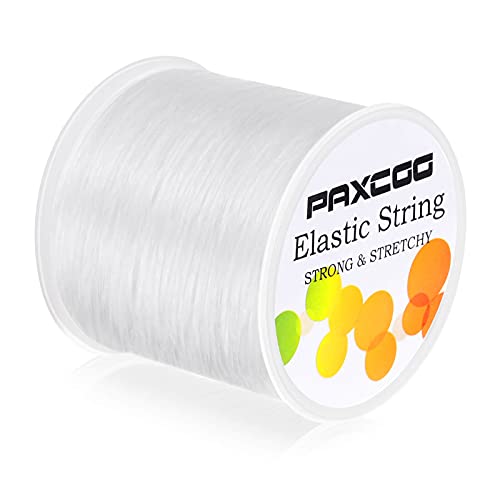
Unlike the round cords, this white polyester-spandex string has a flat profile measuring about 1 mm wide and 0.7 mm thick. The maker says it can pass through small and large beads, stretches flexibly, and forms a small knot that can be tucked among the beads. A 328-foot roll gives ample length for repeated bracelet projects. The width and thickness are not interchangeable with a round cord’s diameter, so this option matters most when a flat profile suits the bead holes and the visible finish.
Bottom line: Choose this if you prefer a white flat cord and its profile fits your beads.
JULIMAIDONG 0.8 mm Round Cord

This is the round cord choice among the 0.8 mm options, with a transparent polyester-spandex construction and a 200-foot roll. The maker says it is easy to tie and that its knots can be hidden, making it suitable for bracelet and other beading projects. Its round shape gives a different profile from flat string at the same nominal thickness. Choose it when a round cord is the better match for your beads; its roll is shorter than the 330-foot option.
Bottom line: Choose this for transparent, round 0.8 mm cord when 200 feet is enough.
LUSTEMBER 1 mm Elastic String

The main distinction here is the two-color pack: it contains black and white elastic string, while the other options are single-color rolls. The maker describes the cord as nylon-polyester fabric with braided rubber and says it is stretchy, easy to cut, and easy to tie. It is intended for bracelets as well as crafts such as hair ties and drawstring bags. The package size gives no roll length or cord shape, so this is a less precise choice when you need to plan a large project or match a specific profile.
Bottom line: Pick this when having both black and white cord matters more than a known roll length.
How to Choose Strong Bracelet Elastic
Cord strength depends on more than thickness: material, construction, wear, and the knot all affect how a finished bracelet holds together. First check whether the cord can pass through every bead hole; then consider whether round or flat cord suits the design. A useful rule is to leave visible clearance around the cord inside the smallest bead hole rather than forcing a tight fit. The 0.8 mm and 1 mm options are nominally different sizes, but the flat products report width or thickness differently from round cord, so those numbers are not directly equivalent.
Match Cord Shape to Bead Holes
Bead-hole clearance decides whether a cord can be threaded smoothly and whether a knot can be hidden. A cord that barely fits can snag during stringing, while a bulky knot may not sit inside a bead. Round and flat profiles can behave differently even when their dimensions look similar; measure the narrowest bead hole and test a short cord section before committing to a full bracelet. For small-hole beads, favor the slimmer compatible cord rather than assuming thicker means stronger. If bead holes are generous, choose based on the look and the way the cord passes through the design, not on an unsupported strength ranking.
Secure Elastic Bracelet Knots
A secure knot is essential because elastic cord is repeatedly stretched as a bracelet is put on and removed. Tie the ends firmly and make sure the knot holds under a gentle pull before trimming; hide it inside a bead only if the opening is large enough. Avoid relying on a knot that is loose, bulky, or forced into a small hole. Stretch cord can lose its shape with repeated overextension, so size the bracelet to slip over the hand without pulling it to its limit. If a bracelet will carry heavy beads or be worn frequently, make a short sample first and check the knot and cord fit before stringing the finished piece.
Frequently Asked Questions
Does thicker elastic always make a stronger bracelet?
No, thickness alone does not establish tensile strength. Material, construction, condition, bead-hole fit, and knot security also affect how the finished bracelet holds up.
How do I measure a bead hole for elastic cord?
Use the smallest hole in the bead set as the limiting measurement and check that the cord passes without force. Leave clearance so stringing does not scrape or bind the cord.
Should bracelet elastic be stretched before stringing?
A gentle pre-stretch can reduce slack after tying, but do not pull the cord to its limit. Excessive stretching during making or wear can shorten elastic cord life.
How many knots should I tie in elastic cord?
Use a knot that stays secure under a gentle pull rather than relying on a fixed number of knots. A bulky knot that cannot tuck into the bead can also interfere with the bracelet’s finish.