
Kustom PA50 Personal PA System and Portable Alternatives

The Kustom PA50 Personal PA System is the direct match for a compact personal PA, with a 3-channel mixer and 13-pound weight as its clearest buying factors. Choose a different setup if you need a larger woofer, Bluetooth streaming, or a mixer with more channels; those needs point to the portable alternatives.
We earn a commission if you buy through links on this page. As an Amazon Associate I earn from qualifying purchases. Products are compared on manufacturer specifications, not hands-on testing.
- Best overall: Kustom PA50 Personal PA System – Its 3-channel mixer and 13-pound weight suit a compact personal PA setup.
- Best for a 10-inch woofer: Pyle PSBT105A 10-Inch Portable PA – It pairs a 10-inch subwoofer with Bluetooth audio and a rechargeable battery.
- Best for multiple inputs: Pyle PPHP898MX 8-Channel PA System – Its powered console provides an 8-channel mixer for several audio sources.
| Product | Best for | Woofer size | Weight | Shop |
|---|---|---|---|---|
| Kustom PA50 Personal PA System | Compact personal PA | — | 13 lb | Check Price on Amazon |
| Pyle PSBT105A 10-Inch Portable PA | Bluetooth and battery | 10 in | 14.33 lb | Check Price on Amazon |
| Pyle PPHP898MX 8-Channel PA System | Multi-source mixing | 8 in | 31.97 lb | Check Price on Amazon |
| Pyle PWMA230BT 8-Inch Portable PA | Karaoke inputs | 8 in | 25 lb | Check Price on Amazon |
| PRORECK Party 12 Speaker System | Large gatherings | 12 in | 60 lb | Check Price on Amazon |
Kustom PA50 Personal PA System and Alternatives
Compare the personal PA with larger portable systems by speaker size, mixer capacity and weight.
Kustom PA50 Personal PA System

The PA50 stands apart as the compact personal-PA option, weighing 13 pounds and pairing a self-contained speaker with a 3-channel mixer. Kustom lists SYNC and a subwoofer output among its features, which may suit a setup that needs a straightforward mixing section and an output for a separate subwoofer. This is the direct fit for someone prioritizing a personal system over a larger party speaker or multi-channel console. Its 50-watt output is lower than the larger systems’ maker-stated power figures, so buyers planning for larger events should compare venue needs and coverage before choosing.
Bottom line: Choose this for a compact personal setup with three mixer channels.
Pyle PSBT105A 10-Inch Portable PA

The PSBT105A adds Bluetooth streaming and a rechargeable battery to a portable speaker with a 10-inch subwoofer and 3-inch treble speaker. It also includes a UHF wireless microphone, an LED battery indicator, and the ability to record audio streamed through the speaker or picked up by the included microphone. Pyle says its Bluetooth range reaches more than 33 feet and calls the system 1,000 watts; that power figure is a maker claim, not a directly comparable measure to another model’s figure. At 14.33 pounds, it is a different choice from the PA50’s 3-channel personal-PA layout.
Bottom line: Pick this when battery operation, Bluetooth and a wireless mic matter most.
Pyle PPHP898MX 8-Channel PA System
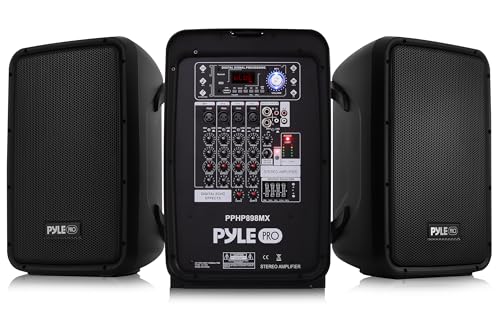
The PPHP898MX is the mixer-focused alternative, with an 8-channel powered console and a pair of speakers fitted with 8-inch subwoofers. The feature set includes Bluetooth streaming, a digital LCD display, and connections including USB, XLR, 1/4-inch and RCA. Pyle calls the system 600 watts, a maker-stated figure that should not be treated as directly comparable with peak or RMS figures from other systems. At 31.97 pounds, it is substantially heavier than the PA50; that trade-off makes it more appropriate when handling multiple sources is more important than keeping the setup compact.
Bottom line: Choose this when a larger mixer and multiple source connections are priorities.
Pyle PWMA230BT 8-Inch Portable PA

The PWMA230BT emphasizes portable karaoke connections, combining Bluetooth audio with two 1/4-inch microphone inputs and a 1/4-inch guitar or instrument input. Its 8-inch woofer is smaller than the 10- and 12-inch woofers in other portable options, and its 25-pound weight is nearly twice the PA50’s. Pyle gives conflicting power figures in the product wording: 400 watts peak and 200 watts RMS appear alongside a 120-watt maximum-output figure, so those numbers should not be used as a clean comparison. Choose it for the mic and instrument inputs rather than a lightweight personal-PA format.
Bottom line: Pick this if karaoke microphone and instrument inputs are the deciding features.
PRORECK Party 12 Speaker System
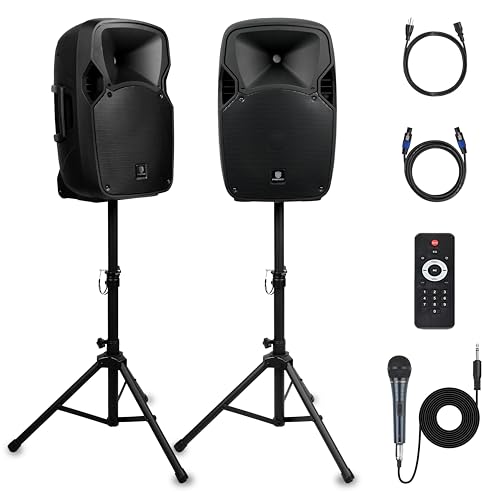
The Party 12 is the largest-format option here, with a 12-inch bass unit, 1-inch tweeter, and an active-plus-passive speaker arrangement. It adds speaker stands and playback options that include Bluetooth, USB drive, SD card, FM and a remote control. PRORECK calls the system 1,800 watts peak; peak power should not be compared directly with RMS ratings, and the maker’s peak figure alone does not establish usable coverage for a particular venue. At 60 pounds, it suits buyers who want a two-speaker party setup and can accommodate a heavier system rather than a compact personal PA.
Bottom line: Choose this for a larger party setup where speaker stands and playback options are useful.
How to choose a personal PA system
Choose by the job the system must do: speech reinforcement, music playback, or mixing several live sources. A powered PA combines an amplifier and speaker, while a passive speaker needs a separate amplifier; an active-plus-passive pair has amplification built into one speaker to drive the other. For a solo speaker or presenter, a small mixer may be enough; for several microphones or instruments, count the inputs you will use at once and leave a spare channel if possible. Watt figures alone are a poor way to compare systems because peak and RMS power are different measurements. If you expect to use more than three separate sources at once, favor a mixer with at least four usable channels rather than choosing by the largest watt claim.
Speaker size, room coverage and placement
Woofer diameter is only one clue to a PA’s sound: cabinet design, amplifier power, crossover and room acoustics also shape output. An 8-inch woofer is common in portable compact speakers, while 10- and 12-inch units generally allow more low-frequency output, but they do not guarantee greater clarity or coverage. For spoken word, raise the speaker so its high-frequency driver is above seated audience head level and aim it toward listeners. Keep microphones behind and away from the speakers to reduce feedback. In a small room, start with the speaker near the audience and at a modest volume; in a larger or noisy space, one compact speaker may not cover the room evenly.
What PA inputs and features matter
Match the inputs to the equipment you actually plan to connect. Microphones commonly use XLR or 1/4-inch connections; keyboards and many instruments often use 1/4-inch outputs, while consumer playback devices may use Bluetooth, RCA or auxiliary inputs. Bluetooth is convenient for backing tracks, but a wired connection avoids depending on a wireless link during a presentation. A subwoofer output is useful only if you plan to add a compatible powered subwoofer; check connector type and signal compatibility before ordering one. A mixer’s channel count refers to sources it can mix, not necessarily the number of speakers it can drive. Use the channel count and connection types, not the advertised peak-watt figure, as the first filter for a multi-source setup.
Moving and operating portable PA speakers
Portable systems vary sharply in handling: a 13-pound unit is easier to carry than a 25- to 60-pound speaker or pair. Wheels and a handle help move a heavier cabinet over smooth ground, but they do not make it easy to lift into a vehicle or carry up stairs. Use a stable speaker stand rated for the cabinet’s weight, secure the speaker’s mounting point, and keep stands away from walkways. Run power and audio cables where people will not trip over them, and lower the volume before connecting or disconnecting equipment. For battery models, check charge status before leaving for an event; a battery indicator can help, but it does not tell you how much runtime remains unless the manufacturer provides that figure.
Frequently Asked Questions
How many mixer channels do I need for a PA system?
Count every microphone, instrument and playback source that must be mixed at the same time. A solo speaker may need only a few channels, while several performers can quickly use four or more.
Are peak watts comparable to RMS watts?
No; peak and RMS ratings describe different power measurements and should not be compared as if they were equivalent. Compare like-for-like ratings and consider speaker size, placement and the room as well.
Does a larger PA woofer mean louder sound?
Not by itself: woofer diameter does not determine total output without amplifier power, cabinet design and sensitivity. A 12-inch speaker may provide more bass potential than an 8-inch unit, but it is not automatically louder or clearer.
Where should I place a PA speaker to avoid feedback?
Place the speaker in front of the microphone and aim it toward the audience, keeping the microphone behind the speaker’s main sound direction. Increase volume gradually and move the microphone or speaker if a ringing tone starts.
Can I connect a subwoofer to any PA system?
No; the PA needs an appropriate subwoofer output or another compatible signal path, and the subwoofer must match that connection. Check compatibility before adding a subwoofer rather than assuming any output can drive one.