
Tools to Remove Tonsil Stones: Kits Compared by Design

For a multi-tool starting point, ORAVIX Lighted Tonsil Stone Kit combines a lighted scoop, syringe and tongue scraper; choose a different style if you want a camera view or a metal pick with silicone tips.
Tonsil stone tools are small oral-care instruments intended to help remove visible debris from tonsil crypts, but throat tissue is delicate. No tool makes removal risk-free.
We earn a commission if you buy through links on this page. As an Amazon Associate I earn from qualifying purchases. Products are compared on manufacturer specifications, not hands-on testing.
- Best overall: ORAVIX Lighted Tonsil Stone Kit – Pairs a lighted scoop and curved syringe with a tongue scraper and travel case.
- Best for camera visibility: 1080P Camera Tonsil Stone Kit – Includes a 1080P camera and six LED lights, according to the maker.
- Best for silicone tips: ORAVIX Stainless Steel Pick Set – Includes two metal picks and soft silicone tips.
| Product | Best for | Tool type | Visibility | Included accessories | Shop |
|---|---|---|---|---|---|
| ORAVIX Lighted Tonsil Stone Kit | Multi-tool care | Lighted scoop, syringe | Lighted scoop | 4 nozzles, tongue scraper, sleeves, case | Check Price on Amazon |
| ORAVIX Stainless Steel Pick Set | Silicone-tip picks | Metal picks | — | 10 silicone tips | Check Price on Amazon |
| Dr. Frederick’s Lighted Remover Kit | Washable attachments | Lighted wand, irrigator | Lighted wand | 5 removable tips, pick, case | Check Price on Amazon |
| 1080P Camera Tonsil Stone Kit | Camera viewing | Camera kit, steel tools | 1080P camera, 6 LEDs | Multiple tools, syringe, retractors | Check Price on Amazon |
| 1080P Tonsil Stone Camera Kit | App-connected viewing | Camera kit, steel heads | 1080P camera, LED light | 5 steel heads, irrigator | Check Price on Amazon |
Tools to Remove Tonsil Stones
Compare the included tool styles and choose based on the visibility and attachments you need.
ORAVIX Lighted Tonsil Stone Kit

ORAVIX Lighted Tonsil Stone Kit stands apart by combining a lighted scoop with a curved syringe and tongue scraper. The seven-piece set also includes four nozzles, silicone sleeves, six batteries and a travel case. The maker says the kit is intended for tonsil stone removal and oral care; those claims do not guarantee that removal will be comfortable or successful. This set suits someone who wants several tool styles together. Its limitation is that it relies on manual use near sensitive throat tissue, so it is not a good choice for anyone who cannot see the target clearly or control a gentle touch.
Bottom line: Choose this if you want a lighted scoop and several oral-care attachments in one set.
ORAVIX Stainless Steel Pick Set
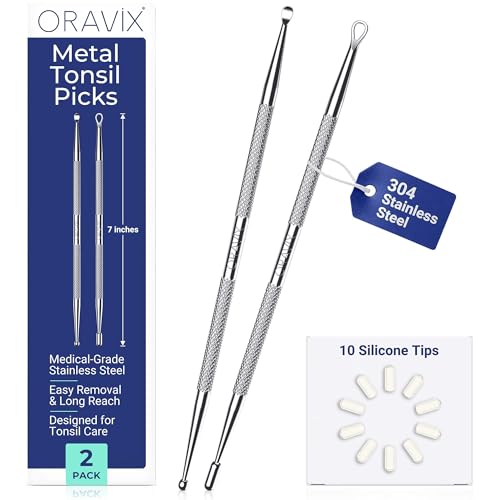
ORAVIX Stainless Steel Pick Set differs from the kits with lights or cameras: it is a pair of 7-inch stainless steel picks supplied with 10 soft silicone tips. The specifications identify the steel as 304 stainless steel and describe the tips as soft. This format suits a buyer specifically looking for a pick rather than an irrigator or viewing device. The limitation is that the fields do not describe illumination or a camera, so the pick requires adequate visibility from another source. Metal instruments can injure tonsil tissue if pushed or scraped; avoid force and stop if pain or bleeding occurs.
Bottom line: Pick this set if removable silicone tips are your priority and you can see the area clearly.
Dr. Frederick’s Lighted Remover Kit

Dr. Frederick’s Lighted Remover Kit distinguishes itself with five removable, washable tips in two lengths: 9 centimeters and 6.5 centimeters. The kit also includes a water irrigator, lighted wand, pick, spare batteries and case. The maker describes the attachments as intended to assist with tonsil stones and oral hygiene. Its range of attachments may suit someone who wants both a lighted tool and irrigation options. The limitation is that the included wand still involves working near the throat; washable attachments do not remove the risk of scraping or irritating tissue, and forceful water flow can also be uncomfortable.
Bottom line: Choose this if you want multiple washable tip lengths plus an irrigator.
1080P Camera Tonsil Stone Kit

1080P Camera Tonsil Stone Kit is the camera-equipped option, with a 1080P camera, six LED lights, multiple stainless steel tools, an oral syringe and mouth retractors. The maker says the camera supports viewing hard-to-reach areas and the device is IPX7-rated; that rating applies to water-ingress protection, not safe use in the throat. This kit suits someone who prioritizes a live view. Its limitation is that a clear image does not make deep probing safe or necessary. Keep instruments away from the back of the throat if gagging, pain or bleeding begins.
Bottom line: Choose this if seeing a live camera view is more important than a simple wand.
1080P Tonsil Stone Camera Kit

1080P Tonsil Stone Camera Kit combines a 1080P camera and LED lighting with five stainless steel heads and an irrigator, with phone connection through Wi-Fi rather than Bluetooth. The maker says the app can export photos and videos to a phone album. This format suits someone who wants app-connected viewing and several interchangeable heads. The limitation is the Wi-Fi setup, which adds a connection step before use; check that the phone can connect to the device as intended. A camera feed is not a substitute for gentle technique, and do not continue if the tool causes pain or bleeding.
Bottom line: Choose this if you specifically want app-connected camera viewing and interchangeable heads.
How to Choose Tonsil Stone Removal Tools
Choose based on visibility and how much control you can maintain, not on the number of attachments. A lighted wand can illuminate the area, while camera models provide a phone-view image; neither makes deep probing safe. Irrigators direct water toward the tonsil area, but pressure that feels forceful or causes discomfort is a reason to stop. For a visible stone near the surface, a gentle approach is more appropriate than reaching into a crypt. Avoid sharp household substitutes such as pins or tweezers. If stones recur, cause persistent discomfort, or are difficult to see, ask a dentist or clinician about options rather than escalating pressure or reach.
Using Tonsil Stone Tools Safely
Tonsil tissue can bleed when scraped, so stop immediately if you see blood, feel pain, or begin gagging. Do not insert a pick or wand deeply into the throat, and do not force an attachment against the tonsil. Small instruments can be difficult to control when the mouth is open and the throat contracts. Use any tool only when the area is clearly visible and you can maintain a light touch. Seek medical advice for significant or ongoing bleeding, difficulty swallowing or breathing, fever, or severe throat pain. An at-home tool should not delay care for those symptoms.
Camera Tools, Lighted Wands and Irrigators Compared
Camera tools prioritize a visual feed, lighted wands illuminate the target, and irrigators use a stream of water rather than a contact tip. Camera kits in this group pair viewing with other attachments; a camera does not itself remove a stone. A wand can be simpler, but visibility still depends on positioning and lighting. Irrigation may seem less direct, yet water pressure can irritate tissue if aimed forcefully. Use the table to match the tool type to the feature you value most, not as a safety ranking.
| Tool style | Primary feature | Consider when |
|---|---|---|
| Lighted wand | Illuminated view | You want a simple lit tool |
| Camera kit | Phone-view image | You prioritize visual feedback |
| Irrigator | Directed water | You prefer a water-based approach |
| Silicone-tip pick | Contact tip | You can see clearly and use a gentle touch |
When Tonsil Stones Need Clinical Advice
Repeated stones, persistent bad breath, or ongoing throat discomfort merit discussion with a dentist or clinician, especially when gentle self-care is not helping. Tonsil stones are material collected in small tonsil crevices; a tool cannot address every cause of throat symptoms or bad breath. Do not attempt removal when you cannot see the area, when a stone appears embedded, or when touching it triggers bleeding or substantial pain. Fever, severe swelling, difficulty swallowing, and breathing trouble are not situations for continued home tool use; seek prompt medical care instead.
Frequently Asked Questions
Can a tonsil stone tool cause bleeding?
Yes. Tonsil tissue can bleed if scraped or punctured, so stop at the first sign of blood and do not resume probing. Seek medical advice if bleeding is significant or continues.
Are camera tonsil stone removers safer?
A camera can provide a view, but it does not prevent a tool from scraping tissue or being inserted too deeply. Use only a gentle touch and stop if pain, gagging, or bleeding occurs.
Should I use water pressure to remove tonsil stones?
Use caution because forceful water flow can irritate sensitive tonsil tissue. Stop if the stream causes pain or bleeding, and seek clinical advice for a stone that is difficult to reach.
When should I ask a doctor about tonsil stones?
Ask a clinician about stones that recur or cause persistent discomfort, particularly if gentle self-care is not helping. Fever, severe swelling, or trouble swallowing or breathing calls for prompt medical attention.
Can I use a pin to remove a tonsil stone?
No; a pin is sharp and can puncture or scrape throat tissue. Avoid sharp household objects and seek clinical advice if a visible stone cannot be addressed gently.