
Sewer Cleanout Cover Box: Types and Fit Compared

For a sewer cleanout cover box, SUPPLYGIANT 8-Inch Sewer Cleanout Box is the closest match because it is an 8-inch cast-iron sewer box with a marked lid and ring. Choose Oatey 74127 PVC Cleanout with Brass Cover instead if you need a PVC cleanout fitting with a brass cover; irrigation valve boxes such as 6-Inch Round Valve Box with Cover, NDS 117BC Jumbo Valve Box, and Rocky Mountain Goods 6-Inch Round Valve Box serve a different purpose.
A cleanout is an access point for clearing a drain line, while a valve box protects irrigation components. Match the replacement to the existing installation rather than choosing by outside dimensions alone.
We earn a commission if you buy through links on this page. As an Amazon Associate I earn from qualifying purchases. Products are compared on manufacturer specifications, not hands-on testing.
- Best overall: SUPPLYGIANT 8-Inch Sewer Cleanout Box – Purpose-made 8-inch cast-iron sewer box with a lid marked Sewer and an included ring.
- Best for PVC cleanouts: Oatey 74127 PVC Cleanout with Brass Cover – Combines a 3- or 4-inch PVC cleanout with a 6-inch brass cover.
- Best for a small valve box: 6-Inch Round Valve Box with Cover – Round plastic irrigation valve box with a 6-inch width and overlapping cover.
| Product | Best for | Type | Material | Key size | Shop |
|---|---|---|---|---|---|
| SUPPLYGIANT 8-Inch Sewer Cleanout Box | Sewer access | Cleanout box | Cast iron | 8 in; 11 × 11 × 2.5 in | Check Price on Amazon |
| Oatey 74127 PVC Cleanout with Brass Cover | PVC cleanout fitting | PVC cleanout | PVC; brass strainer | 3 or 4 in; 6.6 in high | Check Price on Amazon |
| 6-Inch Round Valve Box with Cover | Small irrigation valves | Irrigation valve box | Plastic | 6 in wide; 9.1 in high | Check Price on Amazon |
| NDS 117BC Jumbo Valve Box | Large irrigation components | Irrigation valve box | Plastic | 15 × 22 in; 12 in high | Check Price on Amazon |
| Rocky Mountain Goods 6-Inch Round Valve Box | Tall valve enclosure | Irrigation valve box | — | 6 in diameter; 9 in high | Check Price on Amazon |
Sewer Cleanout Cover Box Options
Compare sewer cleanout assemblies with related valve boxes, and choose by function and fit.
SUPPLYGIANT 8-Inch Sewer Cleanout Box

The clearest sewer-specific match here is this cast-iron box with a lid marked “Sewer.” The assembly includes a lid and ring, measures 11 by 11 inches, and is 2.5 inches tall. Those dimensions describe the box, not the pipe or cleanout opening, so compare the installation’s actual opening and clearance before choosing it. The black finish and sewer marking distinguish it from the irrigation boxes, which are designed around valves and other yard components. Its 8-inch size is the key fit to verify; this is not the best choice when the existing cleanout requires a different opening size or a flush fitting cover.
Bottom line: Choose this when the installation calls for an 8-inch sewer cleanout box and lid.
Oatey 74127 PVC Cleanout with Brass Cover

Unlike a standalone box, this Oatey assembly combines a PVC cleanout with a brass cover, making it relevant when the cleanout fitting itself is part of the replacement. The size is listed as 3-inch or 4-inch, and the product dimensions include a 6.6-inch height, 8.5-inch length, and 6.7-inch width. Check the pipe size and the way the existing cleanout is installed before selecting it; those dimensions do not establish compatibility with every box or surface. The product is a partial match for someone searching for a sewer cover box because it is a cleanout fitting and cover, rather than a separate cast-iron box and ring.
Bottom line: Choose this when replacing a compatible 3- or 4-inch PVC cleanout assembly.
6-Inch Round Valve Box with Cover

This round plastic box is intended for irrigation valves, not a sewer cleanout, and its overlapping cover is designed to limit dirt and grass from settling between the body and lid. Its width is 6 inches and its height is 9.1 inches. That deeper, narrow form suits a different kind of yard access than a low-profile sewer lid-and-ring assembly. Use it only when the item being enclosed is an irrigation component and the opening matches; its 6-inch width alone does not make it a fit for a 6-inch sewer cover. The black-and-green color also makes it visually distinct from the black sewer box.
Bottom line: Choose this for a matching irrigation valve location, not sewer access.
NDS 117BC Jumbo Valve Box

For a much larger irrigation enclosure, this rectangular NDS box measures 15 by 22 inches and stands 12 inches high. Its ICV-marked overlapping green cover and reinforcing ribs are aimed at protecting irrigation controls and accessories while allowing maintenance access. These features make it a related yard utility product, not a sewer cleanout cover. Confirm the space available around the irrigation equipment: the box’s overall length and width are 25.75 by 19 inches, while its nominal size is given as 13 by 20 inches. The large footprint is a limitation where a compact cleanout cover is required.
Bottom line: Choose this for a large irrigation-control enclosure with room for its footprint.
Rocky Mountain Goods 6-Inch Round Valve Box
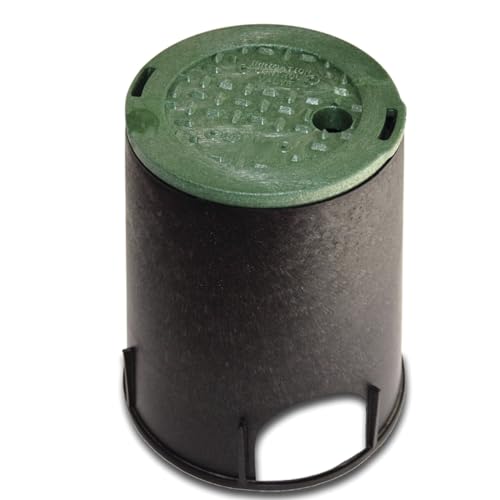
This 6-inch round valve box is 9 inches high, making its depth a distinguishing feature among the related irrigation options. It has a green cover and is described for protecting sprinkler valves, water lines, electrical cables, and TV cables. The specifications do not identify its construction material, so base a choice on the dimensions and intended utility use rather than assuming a particular resin or load capacity. It is not a sewer-specific cover: a 6-inch diameter does not establish that it will fit a sewer cleanout opening. Match the box to the existing irrigation enclosure and the components it must accommodate.
Bottom line: Choose this for a compatible, deeper irrigation utility enclosure.
How to choose a sewer cleanout cover box
Start by identifying whether you need a sewer cleanout cover or a valve box: the former keeps access to a drain cleanout, while the latter encloses irrigation hardware. Measure the existing opening, the cover or ring, and available vertical clearance separately; outside box dimensions do not equal the pipe diameter. A cover that is too small can fall into the opening, while an oversized box may not seat on the existing assembly. For a direct match, prioritize the sewer purpose and nominal size, then compare the actual dimensions. If the existing cleanout opening is not 8 inches, do not choose an 8-inch box solely because its overall footprint appears close. For an irrigation installation, select a valve box sized for the components rather than substituting a sewer-marked lid.
Cleanout size, opening, and installation fit
Cleanout fit depends on the opening and how the cover is supported, not just the outside width of the surrounding box. Measure the clear opening across its widest point and the outside dimensions of any ring or flange; record both in inches. Then compare those measurements with the assembly’s size and footprint. A practical rule is to reject any option whose opening dimension is smaller than the cleanout access you must reach, and verify the seating arrangement before ordering. The 8-inch designation on a box should not be read as its 11-inch overall width. Likewise, a 3- or 4-inch PVC cleanout fitting is a different kind of component from a separate box lid. Keep the cleanout accessible rather than permanently covering it with soil, paving, or landscaping.
Sewer boxes versus irrigation valve boxes
A sewer cleanout box, a cleanout fitting, and an irrigation valve box are different product types even when all have covers. Use this guide to narrow the category before comparing dimensions.
| Need | Type to choose | Fit check |
|---|---|---|
| Access a sewer cleanout | Sewer-marked box and lid | Opening, ring, footprint |
| Replace a PVC cleanout fitting | Cleanout with cover | Pipe size and assembly type |
| Protect irrigation valves | Valve box | Equipment space and box footprint |
Valve boxes can be round and compact or rectangular and much larger; their shape and depth are selected around the equipment below. A cover’s color or nominal diameter alone does not make an irrigation box suitable for a sewer cleanout. Choose a product that names the intended application, then check the dimensions against the actual installation.
Measuring and maintaining access
Measure twice before replacing a buried cover: note the clear opening, outside footprint, and vertical depth in inches, then compare each with the replacement. Soil, lawn growth, and debris can obscure the edge of a cleanout, so clear the area gently and keep the access point identifiable after installation. A cleanout should remain reachable for drain maintenance; do not seal it permanently beneath a fixed surface. For a marked sewer lid, orient the marking so the access point can be found later. For an overlapping valve box cover, keep grass and debris from wedging around the overlap so the lid remains removable. If the existing installation’s support or opening is unusual, verify that arrangement before replacing the cover rather than forcing a mismatched part.
Frequently Asked Questions
How do I measure a sewer cleanout cover opening?
Measure the clear opening across its widest point in inches, then measure the outside ring or box footprint separately. Compare both measurements because a nominal opening size is not the same as the overall cover width.
Can an irrigation valve box cover a sewer cleanout?
Only if the opening and support arrangement match, and the box preserves access to the cleanout. Valve boxes are intended for irrigation components, so choose a sewer-specific assembly when the installation calls for one.
What is the difference between a cleanout fitting and a cleanout box?
A cleanout fitting is part of the drain piping and provides access to the line; a cover box or lid protects the access point at the surface. A 3- or 4-inch fitting size should not be confused with a box’s outside footprint.
Should a sewer cleanout remain accessible?
Yes, keep the cleanout reachable for drain maintenance rather than burying or permanently sealing it. Leave the cover identifiable and clear enough to remove when access is needed.