
Easiest Dog Harness to Put On: 3 Styles Compared

PHOEPET No Pull Harness, Medium is the easiest dog harness to put on here because its three buckles let you fasten it without pulling it over your dog’s head. Choose another style if you prefer fewer fasteners or need the Didog size that fits a 19–23-inch chest.
A dog harness distributes leash attachment around the torso rather than relying on a collar; fit and fastening style determine how manageable it is to put on.
We earn a commission if you buy through links on this page. As an Amazon Associate I earn from qualifying purchases. Products are compared on manufacturer specifications, not hands-on testing.
- Best overall: PHOEPET No Pull Harness, Medium – Three buckles fasten around the dog, so the harness does not need to go over the head.
- Best for one buckle: Didog Quick-Fit Harness, Small – A single buckle controls the harness for a simpler fastening routine.
- Best for leash options: ShawnCo Essential Harness, Medium – Three leash clips provide more attachment choices than the two-ring alternatives.
| Product | Best for | Fastening | Leash attachment points | Weight | Shop |
|---|---|---|---|---|---|
| PHOEPET No Pull Harness, Medium | No head-over fit | 3 buckles | 2 metal rings | 0.48 lb | Check Price on Amazon |
| Didog Quick-Fit Harness, Small | Single buckle | 1 buckle | 1 front D-ring | 0.15 lb | Check Price on Amazon |
| ShawnCo Essential Harness, Medium | Leash choices | Adjustable chest and belly straps | 3 leash clips | 0.53 lb | Check Price on Amazon |
Easiest Dog Harnesses to Put On
Compare how each harness fastens, where a leash can attach and the fit details that matter before choosing.
PHOEPET No Pull Harness, Medium
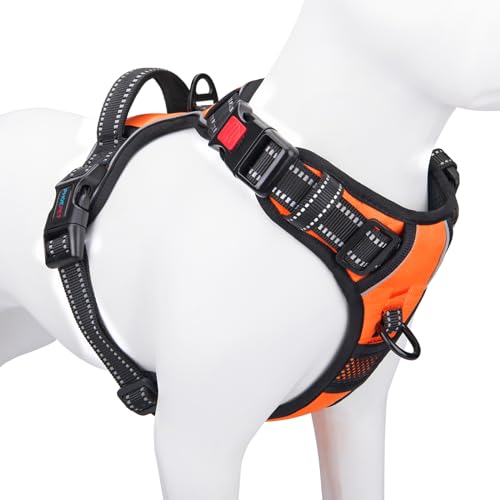
PHOEPET No Pull Harness, Medium stands out for a fast-on routine because its three buckles let you avoid sliding the harness over your dog’s head. The neck buckle locks, and two buckles close across the chest. Two metal rings give you front and back leash attachment choices, while reflective material and a handle are included. The medium orange vest suits buyers who want a wraparound fastening approach with two leash positions. The extra buckles mean more closures to secure than a one-buckle harness, so it may be less convenient if minimizing fastening steps matters more than avoiding the head.
Bottom line: Choose this if your dog resists having gear pulled over its head.
Didog Quick-Fit Harness, Small

Didog Quick-Fit Harness, Small uses one buckle to control the harness, making its fastening design the simplest of these options. The small size is specified for a 19–23-inch chest, and the harness has a welded front D-ring, flannel padding and reflective material. Its lightweight design suits owners looking for fewer closures and a compact harness for a small dog. Fit is the key limitation: the chest range is specific, so measure around the widest part of the rib cage before choosing this size. The front ring is the only leash attachment point identified.
Bottom line: Choose this if your dog’s chest measures 19–23 inches and you want one buckle.
ShawnCo Essential Harness, Medium

ShawnCo Essential Harness, Medium offers the most leash attachment choices, with three clips, and both chest and belly straps adjust for fit. Its medium orchid harness has a breathable mesh underside, padded comfort, reflective material and a control handle. This suits buyers who want to adjust two strap areas and select among several leash positions rather than prioritize a head-free fastening design. The maker does not identify how many buckles secure the harness, so the exact on-and-off steps may matter if your dog dislikes handling; confirm the fastening arrangement before choosing it for that reason.
Bottom line: Choose this if adjustable straps and three leash positions matter most.
How to Choose an Easy-On Dog Harness
Choose by the fastening motion your dog accepts best: neck-free wraparound closures avoid pulling gear over the head, while fewer buckles can reduce the number of steps. A typical harness fit leaves room for about two fingers between the straps and your dog; a loose harness can shift or slip off, while a tight one can rub. Measure chest girth around the widest part of the rib cage, just behind the front legs, and compare it with the size range for the specific harness. If your dog backs out of equipment or reacts to handling, prioritize a secure, calm fitting routine over the number of leash rings. A harness is not a substitute for holding the leash securely.
Use this decision rule: if avoiding head contact is your priority, choose a design with a neck buckle; if fewer closures matter more, choose a one-buckle style.
Harness Fit and Chest Measurement
Measure chest girth at the widest point behind the front legs, with the tape snug but not compressing the coat or body. The Didog small size is the only one here with a chest range, 19–23 inches; use that range as a direct fit check rather than relying on a label such as small or medium. Harness sizing differs by maker and design, so a medium in one style does not establish a match in another. Recheck the fit after fastening: the straps should lie flat and allow about two fingers of space, without rotating around the torso. For a growing puppy, measure again regularly because a previously correct fit can become restrictive.
Front and Back Leash Clips Compared
Front attachment places the leash connection at the chest, while a back attachment places it over the dog’s back; the connection point changes leash direction and handling. Harnesses with two or more rings offer a choice of attachment, but a ring count alone does not establish how a dog will walk. The Didog has a front D-ring, PHOEPET has two metal rings, and ShawnCo has three clips. Use the harness’s intended attachment point and check that the leash clip closes fully before walking. A harness can reduce pressure on the neck compared with clipping a leash to a collar, but it does not prevent pulling or guarantee control; keep a secure grip and avoid relying on the handle as a restraint.
Putting On and Checking a Dog Harness
Put a harness on in a calm space and give your dog time to sniff it before fastening; rushing can make handling harder. Buckle one closure at a time, then check that each buckle is fully engaged and that straps are not twisted or pinching skin. For a neck-buckle design, open the neck section before positioning it rather than forcing it over the head. Before each walk, inspect webbing, seams, buckles and leash rings for fraying, cracks or looseness. Replace a damaged harness instead of relying on a partly secure closure. After the first few steps, check that the harness has not shifted and that your dog can move its shoulders and legs freely.
Frequently Asked Questions
How tight should a dog harness fit?
A well-fitted harness generally leaves room for about two fingers between the strap and your dog. Check the fit around the chest and behind the front legs, and readjust if the harness shifts or rubs.
Where should I measure my dog for a harness?
Measure chest girth around the widest part of the rib cage, just behind the front legs. Compare that measurement with the exact harness size range; the Didog small size here is for a 19–23-inch chest.
Can a dog harness go over the head?
Some harnesses are designed to fasten without going over the head, using a neck buckle instead. Open the neck section before placing that style, and avoid forcing any harness onto a dog that resists.
Are front-clip harnesses better for pulling?
A front clip changes the direction of leash pressure and may help redirect a dog, but it does not guarantee that pulling will stop. Use the attachment point intended for the harness and maintain a secure grip.
How often should I check a dog harness?
Inspect the harness before each walk for frayed webbing, damaged buckles, loose stitching or a compromised leash ring. Recheck fit after growth, weight changes or strap adjustments.