
Solar Panel to 12 Volt Battery: 4 Chargers Compared

For a 12-volt battery, choose SUNER POWER 50W Ultra if you want the highest panel wattage here: its 50W rating exceeds the other options. For maintaining a battery between uses, a smaller panel such as SUNER POWER 12W Pro may be a better fit; check that the controller supports your battery chemistry before connecting it.
We earn a commission if you buy through links on this page. As an Amazon Associate I earn from qualifying purchases. Products are compared on manufacturer specifications, not hands-on testing.
- Best overall: SUNER POWER 50W Ultra – Its 50W panel has the highest wattage among these options.
- Best for battery variety: Voltset 20W Smart MPPT Kit – The maker says it works with LiFePO4, AGM, gel, flooded and lithium-ion batteries.
- Best for wet conditions: 20W IP68 Solar Charger Kit – The maker says both the panel and controller are IP68 rated.
- Best for maintenance: SUNER POWER 12W Pro – Its 12W panel is the lowest-wattage option in this group.
| Product | Best for | Panel wattage | Panel dimensions | Battery modes or compatibility | Shop |
|---|---|---|---|---|---|
| SUNER POWER 50W Ultra | Higher panel output | 50W | 23.23 × 17.32 in | 3 modes; battery types not specified | Check Price on Amazon |
| Voltset 20W Smart MPPT Kit | Battery variety | 20W | 15 × 13.58 in | LiFePO4, AGM, gel, flooded, lithium-ion | Check Price on Amazon |
| 20W IP68 Solar Charger Kit | Water exposure | 20W | 14 × 11.5 in | — | Check Price on Amazon |
| SUNER POWER 12W Pro | Low-output maintenance | 12W | 16.5 × 9.4 in | — | Check Price on Amazon |
Solar Panels for a 12 Volt Battery
Compare panel output and controller features with your battery type and charging goal.
SUNER POWER 50W Ultra

The 50W panel gives this option the highest rated output in the group, making it the better match when you want more solar capacity than a small maintainer provides. SUNER POWER says its controller uses MPPT and a three-stage bulk, absorption and float charging algorithm, and provides three battery modes. The panel measures 23.23 × 17.32 inches. Consider it for a vehicle, boat or RV battery with room for a larger panel. Its larger footprint matters if mounting space is tight; confirm the battery mode matches your battery chemistry before use.
Bottom line: Choose this when panel wattage matters more than compact size.
Voltset 20W Smart MPPT Kit
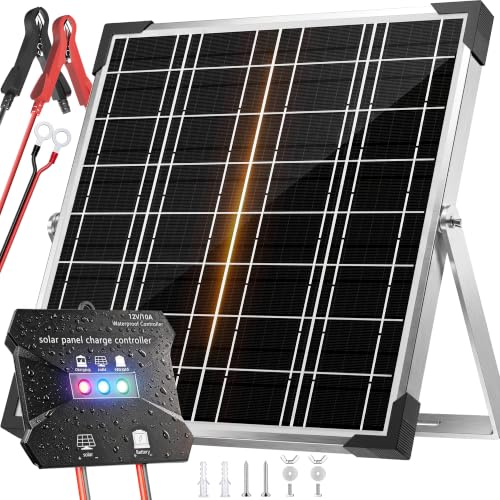
Unlike the other options, this 20W kit explicitly names several compatible battery chemistries: LiFePO4, AGM, gel, flooded and lithium-ion. The panel measures 15 × 13.58 inches and weighs 4 pounds. The maker says its smart controller includes protections against overcharge, over-discharge, short circuit and reverse polarity, and stops nighttime power drain. That breadth of stated compatibility can help when a vehicle or boat uses a less common battery type. The limitation is its 20W rating, below the 50W option, so it is better suited to maintaining charge than replacing a larger charging setup.
Bottom line: Pick this when the named battery-chemistry compatibility matches your battery.
20W IP68 Solar Charger Kit

The clearest differentiator here is the maker’s IP68 rating for both the panel and controller, a useful specification for a kit exposed to wet conditions. The 20W panel measures 14 × 11.5 inches. Its controller is described by the maker as having protections for overcharge, discharge, reverse polarity, overcurrent, overvoltage, backflow, short circuits and high temperatures. This kit may suit a marine or outdoor vehicle setup where weather protection is a priority. Its 20W output is lower than the 50W choice, and the battery chemistry compatibility should be confirmed before connecting it.
Bottom line: Choose this if its weather-rating claim and 20W output fit your setup.
SUNER POWER 12W Pro
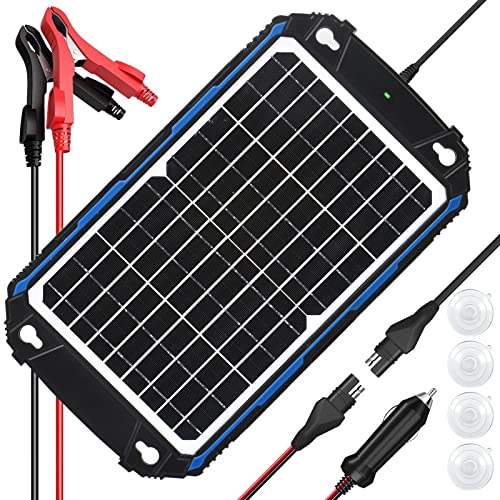
The 12W rating makes this the lowest-output choice, which can be appropriate for maintaining a battery rather than seeking the strongest charging contribution. SUNER POWER says its controller uses MPPT and a three-stage bulk, absorption and float algorithm, and that charging stops when the battery is full and resumes as needed. The panel measures 16.5 × 9.4 inches and weighs 3.25 pounds. Its narrower panel may suit installations where width is constrained. The tradeoff is lower rated output than the 20W and 50W kits, so it is not the pick when faster replenishment is the priority.
Bottom line: Pick this for a modest maintenance role where its lower wattage is sufficient.
How to Choose a Solar Panel for a 12 Volt Battery
Match panel wattage to the job: a maintainer needs less output than a panel expected to replace substantial daily battery use. In strong sun, a 20W panel can produce roughly 1 amp at 12 volts and a 50W panel roughly 4 amps, before real-world losses; shade, panel angle, clouds and controller efficiency reduce output. A charge controller regulates the panel-to-battery connection, so use a controller intended for the battery’s chemistry rather than connecting a panel directly. For a small, parked battery, consider 12W or 20W; choose the 50W option when you need more potential charging current and have room to mount it. Solar charging cannot guarantee a full recharge if the battery’s daily use exceeds the panel’s energy yield.
| Goal | Panel class here | Tradeoff |
|---|---|---|
| Low-output maintenance | 12W | Less potential current |
| Middle output | 20W | Moderate panel footprint |
| More potential charging | 50W | Larger mounting area |
Match the Controller to Battery Chemistry
Choose a controller mode that matches the battery chemistry, because lead-acid and lithium batteries use different charging profiles. A 12-volt lead-acid battery is commonly charged through bulk, absorption and float stages; a lithium battery generally needs a controller mode designed for that chemistry and may not use the same float behavior. Battery labels can distinguish AGM, gel, flooded lead-acid and LiFePO4, so identify the exact type before wiring. A measurable decision rule is simple: if the controller does not offer a mode explicitly compatible with the battery type, do not connect the kit until compatibility is confirmed. Avoid assuming that a panel labeled “12V” regulates its own output; the controller is the part that manages charging.
Plan Mounting, Sun and Wiring
Panel placement can matter as much as rated wattage: even partial shade across a panel can cut output, so choose an unshaded location and orient the panel toward the strongest available sun. Leave space around a mounted panel for secure attachment and avoid locations where cargo, doors or moving equipment can strike it. Battery wiring deserves particular care because a 12-volt battery can deliver very high short-circuit current. Use wire sized for the controller’s maximum current and cable run, keep connections insulated, and fit an appropriately rated fuse close to the battery’s positive terminal. Disconnect the battery according to the controller’s connection sequence; a controller may require the battery to be connected before the panel.
Weather Ratings and Safe Charging
Weather resistance applies only to the components and conditions covered by the rating; IP68 does not mean a kit can be mounted carelessly or submerged indefinitely. Check that cable entries, connectors and mounting points remain protected from water, and keep the controller ventilated and away from excessive heat. Do not charge a damaged, swollen, leaking or frozen battery. Place lead-acid batteries where ventilation is adequate, since charging can release gas, and keep sparks or flames away. A solar maintainer is not a substitute for diagnosing a battery that repeatedly discharges; parasitic loads, age or a charging-system fault can overwhelm even a larger panel.
Frequently Asked Questions
Can I connect a solar panel directly to a 12 volt battery?
Use a charge controller between the panel and battery unless the panel is specifically designed with regulation for direct connection. The controller regulates charging and should match the battery chemistry.
How many watts do I need to maintain a 12 volt battery?
A small 12W or 20W panel may suit maintenance when the battery has little ongoing load and receives good sun. Choose more wattage when the battery must support larger loads or has limited daily sun; shade and clouds reduce output.
Will a 20 watt solar panel charge a 12 volt battery?
Yes, a 20W panel can contribute charge through a compatible controller in suitable sunlight. At 12 volts, 20W corresponds to about 1.7 amps under ideal conditions before losses, and charging takes longer when sunlight is weak or the battery is heavily discharged.
Does a 12 volt solar panel work with a lithium battery?
It can when the charge controller has a mode compatible with the specific lithium chemistry, such as LiFePO4. Confirm the battery type and controller mode before connecting; a lead-acid charging profile is not automatically suitable for lithium.
Can a solar battery maintainer stay connected overnight?
A maintainer can remain connected if its controller prevents reverse current or nighttime battery drain. The Voltset maker says its controller stops draining power at night; verify this function on any other setup before leaving it connected.