
OmniBreeze Tower Fan With Internal Oscillation Compared

The OmniBreeze tower fan suits buyers who want internal oscillation, four airflow speeds and four modes in a 38.3-inch-tall unit. Choose another model if you need a specified 90-degree oscillation angle, more speed settings or a narrower footprint.
Tower fans move room air through a vertical outlet; they circulate air rather than lower the room’s temperature.
We earn a commission if you buy through links on this page. As an Amazon Associate I earn from qualifying purchases. Products are compared on manufacturer specifications, not hands-on testing.
- Best overall: OmniBreeze 40-Inch Inner-Oscillation Fan – Internal oscillation, four speeds and four modes make it the closest match to the requested fan.
- Best for more speed choices: DREO 36-Inch Tower Fan, 8-Speed – Eight speeds provide more adjustment steps than the other models.
- Best for a narrow footprint: DREO 36-Inch Tower Fan, 4-Speed – Its 8.03-inch listed width is narrower than the other models’ listed widths.
| Product | Best for | Height | Speed settings | Oscillation | Shop |
|---|---|---|---|---|---|
| OmniBreeze 40-Inch Inner-Oscillation Fan | Internal oscillation | 38.3 in | 4 | Internal; angle — | Check Price on Amazon |
| DREO 36-Inch Tower Fan, 8-Speed | Fine speed control | 36.22 in | 8 | 90° | Check Price on Amazon |
| DREO 36-Inch Tower Fan, 4-Speed | Narrow footprint | 36.26 in | 4 | 90° | Check Price on Amazon |
| Levoit 36-Inch Tower Fan | Temperature-based Auto | 36.2 in | 5 | 90° | Check Price on Amazon |
OmniBreeze Tower Fan With Internal Oscillation
Compare the requested inner-oscillation model with related tower fans by their controls, dimensions and stated airflow features.
OmniBreeze 40-Inch Inner-Oscillation Fan
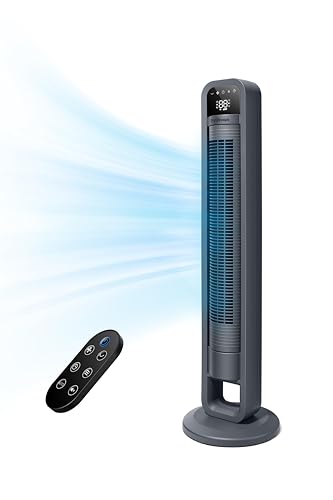
The OmniBreeze is the only model here identified with internal oscillation, making it the direct fit for buyers seeking that design. Its four speeds pair with Normal, Natural, Sleep and Auto modes; the maker says Auto adjusts speed to room temperature. The fan also has mute and display-off functions, useful when control sounds or lights are a concern. At 38.3 inches tall and 10.3 inches wide, it has a broader listed footprint than the two DREO models.
Bottom line: Pick this if internal oscillation is your deciding feature.
DREO 36-Inch Tower Fan, 8-Speed

The eight-speed control gives this DREO more adjustment steps than the other fans, while its 90-degree oscillation is an explicit angle rather than an internal-oscillation description. The maker says airflow reaches 28 feet per second and projects up to 34 feet. Four modes include Normal, Natural, Sleep and Auto. Its height is 36.22 inches, and its 11.81-inch width makes it broader than the other models here. Choose it when granular speed selection and an oscillation angle matter more than matching the OmniBreeze’s internal design.
Bottom line: Choose it for eight speed settings and a 90-degree sweep.
DREO 36-Inch Tower Fan, 4-Speed

The compact listed width sets this DREO apart: at 8.03 inches, it is narrower than the other models in this comparison. It offers four speeds, three modes, an 8-hour timer and 90-degree oscillation. The maker gives airflow speed as 26 feet per second and reach as up to 33 feet, and claims a 28 dB operating level. Those performance claims make it relevant for buyers comparing airflow and quiet operation, but the unit does not match the OmniBreeze’s internal-oscillation description. Its 8-hour timer is shorter than the Levoit’s 12-hour timer.
Bottom line: Choose it when a narrower listed width is the priority.
Levoit 36-Inch Tower Fan

The Levoit combines a temperature sensor with Auto mode, which the maker says adjusts airflow to room temperature. It has five speeds, four modes, 90-degree oscillation and a 12-hour timer. The maker also claims airflow up to 28 feet per second and a 28 dB noise level. Its 6.5-inch width is the narrowest in this group, and the 36.2-inch height is close to the other 36-inch models. Buyers seeking internal rather than angle-specified oscillation should choose the OmniBreeze instead; the Levoit is a different-style alternative.
Bottom line: Choose it for temperature-sensing Auto mode and a 12-hour timer.
How to choose a tower fan
Choose by the control that matters most: speed steps for airflow adjustment, modes for changing behavior, or oscillation for sweeping air across a wider area. A fan circulates existing room air; it does not cool the room like an air conditioner. Higher speed can feel more cooling on skin, while a lower speed may suit sleep or quiet work. In this group, the models offer four to eight speed settings and three or four modes. For frequent small adjustments, favor eight speeds; for temperature-responsive control, select a model whose maker identifies Auto operation. Match the unit’s physical width and height to available floor space before choosing features.
| Need | Feature to prioritize |
|---|---|
| Exact internal-oscillation design | Internal oscillation |
| More airflow steps | Eight speed settings |
| Automatic room response | Auto mode with temperature sensor |
| Smaller footprint | Compare listed width |
Fan size and floor placement
Measure the intended spot before choosing a tower fan: the widths here range from 6.5 to 11.81 inches, and heights range from 36.2 to 38.3 inches. Leave room around the air intake and outlet so furniture, curtains or bedding do not obstruct airflow. Place a floor fan on a level, stable surface, and route its power cord away from walkways to reduce trip risk. A narrow body can fit beside a bed or desk more readily, but width alone does not establish how far air travels or how much floor area the fan can cool. For a tight space, use the actual footprint as a filter, then compare the controls that remain.
Oscillation and airflow claims
Oscillation turns or redirects a fan’s outlet so moving air sweeps across a wider area instead of staying aimed in one direction. An angle such as 90 degrees gives a numerical sweep; an internal-oscillation label identifies a mechanism but does not provide an angle. Airspeed and projection claims use different measurements: feet per second describes airflow velocity, while feet of reach describes a claimed distance. Neither number by itself establishes room temperature reduction. When comparing these figures, treat the makers’ performance claims as distinct from physical dimensions and control counts, and choose based on the room layout and whether you want fixed-direction or moving airflow.
Using tower fan modes and timers
Normal mode generally keeps airflow at the selected speed, while Natural mode varies airflow to imitate changing breezes; Sleep modes may reduce airflow over time. Auto behavior is model-specific, so choose a model with a temperature sensor when temperature-responsive adjustment is important. Timers are useful for scheduled shutoff: the Levoit offers 12 hours and one DREO offers 8 hours. Keep fan placement clear of loose fabric and do not let cords cross walking paths, especially in a bedroom at night. A fan can improve perceived comfort by moving air over skin, but it is not a substitute for cooling during dangerous heat.
Frequently Asked Questions
Do tower fans lower the room temperature?
No, a tower fan circulates room air rather than removing heat from the room. Air moving across skin can feel cooler, but use air conditioning or another cooling method when the indoor temperature itself needs to drop.
What does internal oscillation mean on a tower fan?
Internal oscillation means the fan redirects airflow using a mechanism within its housing rather than visibly turning the whole body. An angle such as 90 degrees is a separate coverage specification, so compare angle figures when a defined sweep matters.
How much space should a tower fan have around it?
Keep the intake and outlet unobstructed by furniture, curtains and bedding. Leave enough clearance for the full oscillation sweep, and set the fan on a stable, level floor with its cord out of walkways.
Is a higher fan speed always more comfortable?
No, comfort depends on distance, room conditions and personal preference. More speed settings, such as eight rather than four, allow smaller adjustment steps, while lower speeds may be preferable for sleep or quiet work.