
Best Heater for Dog in Garage: 5 Picks by Use

Dog House Heater, 300/600W is the best fit for most people because its thermostat cycles between about 95°F and 100°F and it is sized for pet houses up to 105 cubic feet. Choose WiFi Dog House Heater, 600W instead if remote temperature adjustment matters; for an open garage, a general garage heater may warm the work area but is not a substitute for a protected pet enclosure.
Pet-house heaters warm a small shelter rather than an entire garage, so match their capacity and controls to where your dog rests.
We earn a commission if you buy through links on this page. As an Amazon Associate I earn from qualifying purchases. Products are compared on manufacturer specifications, not hands-on testing.
- Best overall: Dog House Heater, 300/600W – Thermostat cycles around 95°F–100°F, and the maker says it can heat pet houses up to 105 cubic feet.
- Best for remote control: WiFi Dog House Heater, 600W – App control and an adjustable 40°F–115°F thermostat allow remote changes.
- Best for mounted radiant heat: Shinic 2-Pack Ceiling Garage Heater – Ceiling mounting and 90-degree adjustment direct radiant heat without using floor space.
| Product | Best for | Power | Temperature control | Mounting or coverage | Shop |
|---|---|---|---|---|---|
| Dog House Heater, 300/600W | Thermostat cycling | 300W / 600W | About 95°F–100°F | Up to 105 cu ft | Check Price on Amazon |
| WiFi Dog House Heater, 600W | Remote adjustments | 600W | 40°F–115°F | Pet-house enclosure | Check Price on Amazon |
| Shinic 2-Pack Ceiling Garage Heater | Fixed radiant warmth | 750W / 1500W | 5 heat and light settings | Ceiling mount; 90° adjust | Check Price on Amazon |
| 1500W Portable Garage Heater | Portable spot heat | 1500W | 3 modes | Portable; 7.5 × 6 × 9.8 in | Check Price on Amazon |
| Joanolga 1500W Greenhouse Heater | Three heat settings | 20W / 750W / 1500W | 3 settings | Portable; 7 × 8 × 9 in | Check Price on Amazon |
Dog and Garage Heaters
Choose a pet-house unit for a contained shelter, or a garage heater for broader or directional warmth.
Dog House Heater, 300/600W
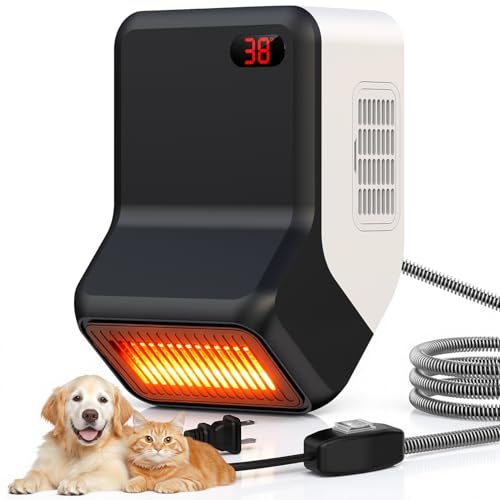
Dog House Heater, 300/600W is the pet-house option with a defined thermostat cycle and stated enclosure capacity: the maker says it heats up to 105 cubic feet, stopping near 100°F and restarting below 95°F. It offers 300W and 600W modes, a built-in fan, and a 6-foot anti-chew cord. This setup suits a dog resting in a small shelter inside a garage, rather than someone trying to heat the whole garage. Its temperature range is narrow, so choose another option if you need remote adjustment or a wider setpoint range.
Bottom line: Pick this for a compact dog shelter where automatic cycling matters.
WiFi Dog House Heater, 600W

WiFi Dog House Heater, 600W stands apart with app-based remote control and a 40°F–115°F adjustable working range. It uses a 600W PTC ceramic element, has overheat auto-shutoff, and a metal casing described as anti-chew and corrosion-resistant. The maker positions it for outdoor pet houses and dry enclosures, making it a fit when a dog’s shelter needs remote temperature changes. The broad setpoint range does not itself ensure a safe temperature for every dog or shelter; keep the control setting appropriate and verify the shelter’s actual temperature.
Bottom line: Choose this when remote thermostat adjustment is the priority.
Shinic 2-Pack Ceiling Garage Heater

Shinic 2-Pack Ceiling Garage Heater is a two-unit ceiling-mounted radiant set, unlike the pet-house heaters, which are designed around a small enclosure. The maker says its quartz tubes warm people and objects directly in front; each heater offers 750W and 1500W settings, a halogen work light, and up to 90 degrees of adjustment. This may suit an occupied garage work area where fixed, directional heat is useful. It is not described as a pet-house heater, so do not rely on it to maintain a controlled temperature in a dog’s shelter.
Bottom line: Pick this for directional heat in a garage work area, not a pet shelter.
1500W Portable Garage Heater
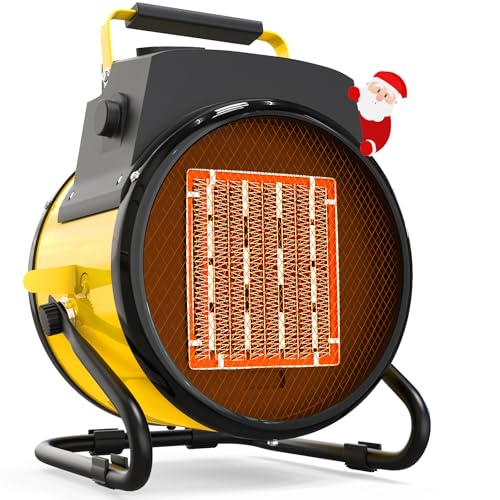
1500W Portable Garage Heater is a compact, portable general-purpose heater rather than a pet-specific unit. The maker describes three modes, a carry handle, and overheat shutoff; the dimensions are 7.5 × 6 × 9.8 inches. It may suit an adult who needs movable spot heat in a garage, but the maker does not describe a pet-house thermostat or enclosure capacity. Because dogs can approach, bump, or chew nearby equipment, this is a poor choice within a dog’s reach unless it can be securely kept away from the animal.
Bottom line: Choose this only for supervised spot heating kept out of a dog’s reach.
Joanolga 1500W Greenhouse Heater
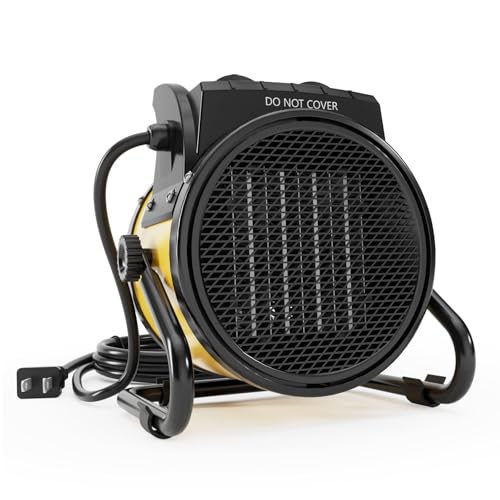
Joanolga 1500W Greenhouse Heater offers three power settings—20W, 750W, and 1500W—so it differs from fixed-output options by providing a very low setting as well as two higher ones. The maker describes PTC ceramic heating and overheat protection, and the dimensions are 7 × 8 × 9 inches. Its uses include greenhouses, patios, and garages, not a dog-specific shelter. Consider it for an attended garage area where adjustable output is useful, but not as an unattended heat source accessible to a dog.
Bottom line: Pick this for adjustable spot heat in a supervised garage area.
How to choose a heater for a dog in a garage
Choose by the heated zone: a pet-house heater is intended for a small shelter, while a garage heater is intended to warm a work area or direct radiant heat. Electric resistance heat produces about 3.41 BTU per watt-hour, so a 600W unit supplies roughly 2,050 BTU per hour and a 1,500W unit roughly 5,120; insulation, drafts, ceiling height, and outdoor temperature determine how far that goes. For a dog’s resting spot, favor a controlled pet-house heater over an open portable heater. Keep heaters and cords inaccessible to chewing, use them only in dry conditions as appropriate to the unit, and maintain the manufacturer’s clearance from bedding and other combustibles. Never leave a portable heater where an animal can knock it over.
Pet-house heaters versus garage heaters
Pet-house heaters are a better match when the goal is warming a small enclosed resting area; general garage units are better suited to a person using a larger space. Radiant quartz units heat objects and people in their line of sight, whereas a fan-equipped pet heater circulates warm air within a small enclosure. A thermostat can reduce temperature swings, but the reading near a heater may not match the dog’s bed-level temperature. Check the shelter temperature where the dog lies, not only the heater setting. The table separates the main use cases so you can avoid expecting a spot heater to heat a whole garage.
| Heater type | Best use | Decision rule |
|---|---|---|
| Pet-house heater | Small shelter | Choose when an enclosure volume and thermostat are useful |
| Ceiling radiant heater | Garage work zone | Choose when heat should be directed at a fixed area |
| Portable space heater | Attended spot heating | Use only when the heater can remain inaccessible to the dog |
Electrical load and heater placement
A 1,500W heater on 120V draws 12.5 amps, while a 600W heater draws 5 amps; a typical 15-amp circuit has limited capacity once lights, tools, or other appliances share it. Avoid running a high-wattage heater on an overloaded circuit or through an undersized extension cord. Place the heater on a stable surface or use its intended mounting method, keep bedding and stored items outside its required clearance, and route cords where a dog cannot chew or trip over them. Garage floors can be damp, so keep electrical heaters away from water and use a model only in conditions it is intended to handle. For whole-garage heating, calculate the space’s heat loss rather than choosing by wattage alone.
Set a safe temperature for a dog shelter
A heater’s setpoint is not proof that the dog’s resting area is at that temperature; shelter size, drafts, bedding, and sensor placement all affect the result. Start with a modest setting and check the temperature at bed height after the heater has cycled, then recheck as outdoor conditions change. Avoid directing a hot-air outlet or radiant element at the dog, since animals may not move away promptly from uncomfortable heat. Keep the heater guarded and the cord protected from chewing, and provide a way for the dog to leave the heated area. If the garage is damp or the shelter is not dry, do not assume an indoor pet heater is suitable there.
Frequently Asked Questions
How many watts does a dog house heater need?
A 600W heater supplies about 2,050 BTU per hour, while 1,500W supplies about 5,120 BTU per hour. The right output depends on shelter volume, insulation, and drafts; match any coverage to the actual enclosure.
Can a space heater warm an entire garage?
A 1,500W heater provides roughly 5,120 BTU per hour, which may be inadequate for a large, drafty garage. Measure the garage and account for insulation and outdoor temperature before treating a portable heater as whole-room heat.
Is a fan heater or radiant heater better for a dog?
A fan heater circulates warm air in a small shelter, while radiant heat warms objects and people directly in its path. For a dog’s resting area, a pet-house unit with temperature control is generally the more appropriate type; keep either heater inaccessible to the dog.
Where should a heater sit in a dog’s shelter?
Keep the heater away from bedding and where the dog can touch, chew, or knock it over, observing the clearance required by its maker. Check the temperature at the dog’s resting height because heat near the unit can differ from the rest of the shelter.
Can I plug a 1500-watt heater into a garage outlet?
A 1,500W heater on 120V draws about 12.5 amps, leaving little capacity on a shared 15-amp circuit. Check what else is powered by that circuit, avoid undersized extension cords, and stop using the heater if a plug or outlet becomes warm.