
80s Electronic Football Game: Classic Styles Compared

The Classic Retro Handheld Football game is the closest fit for an 80s electronic football game because it specifically promises original-style run-and-dodge play and includes three AAA batteries. Choose a different model if you want computer play, passing and kicking, or a physical throwing target rather than a handheld game.
We earn a commission if you buy through links on this page. As an Amazon Associate I earn from qualifying purchases. Products are compared on manufacturer specifications, not hands-on testing.
- Best overall: Classic Retro Handheld Football – The features call out original-style running and dodging, and three AAA batteries are included.
- Best for multiplayer modes: Mattel Classic Football 2 Game – It supports play against another person or the computer, with passing, kicking and backward movement.
- Best for solo computer play: Mattel Classic Electronic Football – Its features specify football play against a computer opponent as well as a friend.
| Product | Best for | Player modes | Dimensions | Shop |
|---|---|---|---|---|
| Classic Retro Handheld Football | Classic handheld play | Solo or two players | 5.5 × 3.25 × 1.25 in. | Check Price on Amazon |
| Mattel Classic Football 2 Game | Passing and kicking | One or two players; computer | 10.39 × 6.69 × 1.69 in. | Check Price on Amazon |
| Mattel Classic Electronic Football | Solo computer play | Solo or two players; computer | 10.39 × 6.42 × 1.42 in. | Check Price on Amazon |
| Assorted Colors & Styles Electronic Football | Basic electronic football | — | 7.95 × 5.35 × 1.5 in. | Check Price on Amazon |
80s Electronic Football Games
Compare the handheld styles by their play modes and form factor before choosing.
Classic Retro Handheld Football
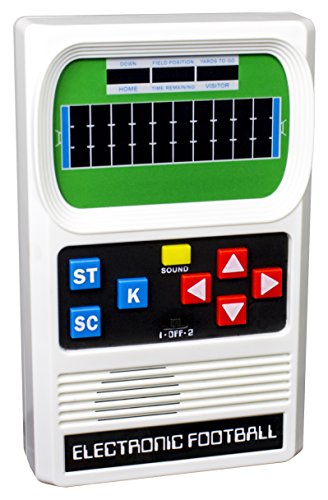
Classic run-and-dodge play makes this the closest match for a nostalgic 80s electronic football game. The handheld lets players run, kick and move forward or sideways to avoid tacklers, and it can be played alone or with someone else. Its 5.5-inch height and included three AAA batteries make it ready for immediate play. The limitation is its emphasis on the original-style running game; choose another option if passing and backward movement are essential.
Bottom line: Pick this for original-style handheld running and dodging.
Mattel Classic Football 2 Game

Passing, kicking and backward movement distinguish this version from the simpler run-and-dodge handheld. The game supports competition against another person or the computer, so it suits players who want more ways to move the ball and score. At 10.39 inches long, it has a larger listed footprint than the compact 5.5-inch-tall classic handheld. The features call it a next-generation take on electronic football, so it is a partial fit for shoppers seeking a specifically original-style 80s game.
Bottom line: Choose this for passing, kicking and computer play.
Mattel Classic Electronic Football

Computer-opponent play is the clearest distinction here: the game is built around a player trying to outscore the computer, while also allowing a friend match. Its 10.39-inch length gives it a broader handheld format than the 5.5-inch-tall retro model. Mattel identifies it as a game like the original and gives an age recommendation of 8 and up. The features do not call out passing or backward movement, so pick the other Mattel option if those specific mechanics matter.
Bottom line: Pick this if solo play against a computer matters most.
Assorted Colors & Styles Electronic Football

This assorted-color electronic football is a partial match for buyers focused on the game category rather than a documented specific 80s-style model. Its dimensions are 7.95 by 5.35 by 1.5 inches, which provide a useful size comparison with the other handheld options. No play mode or distinctive mechanics are given, so buyers who need solo play, a computer opponent or classic run-and-dodge movement should favor a model whose features confirm those specifics.
Bottom line: Consider it only when a basic electronic football format is enough.
How to choose an 80s electronic football game
Choose by the play mechanic you want, because classic handheld football games can range from simple run-and-dodge movement to passing and computer opponents. The older-style handheld format simulates players as moving lights on a field rather than a physical miniature game; direction changes and timing are central to avoiding tacklers. For nostalgic original-style movement, select a game that explicitly includes running and dodging. If you want broader football actions, look for passing, kicking and backward movement as named features. A useful decision rule is to prioritize explicit mechanics over appearance when you want a particular style of play; a retro label alone does not tell you whether computer play or passing is included.
Handheld size and portability
Handheld football games often fit in a small bag, but compare the length, width and depth rather than relying on the word “handheld.” The examples here range from a compact 5.5-inch-high unit to models over 10 inches long, a meaningful difference for storage and grip. Check the dimensions against the player’s hands and intended storage spot; for children, a smaller body can be easier to hold, though button layout also affects comfort. Battery-powered electronic games need a secure battery compartment, and loose batteries should be kept away from young children because swallowing them can cause severe internal injury.
Use the dimensions as a quick fit guide:
| Use case | What to prioritize |
|---|---|
| Compact nostalgic play | About 5.5 inches in the longest dimension |
| More room for controls | Compare models around 10 inches long |
| Specific game mechanics | Confirm run, pass, kick or computer play is named |
What the different football game types do
Electronic handheld football uses a screen and controls to simulate movement, while a throwing target uses a physical ball and aims at scoring zones. A handheld game is for directional play and scoring through on-screen actions; a target game is for practicing throws toward openings or marked zones. These are not interchangeable formats, even when both are electronic and football-themed. If your goal is a nostalgic tabletop-style challenge, look for a handheld unit. If the goal is throwing practice with movement and a target, choose an over-the-door setup instead. The term “football game” alone can refer to either type, so identify the format before weighing secondary features.
Battery and age considerations
Small electronic games commonly use replaceable batteries, so check the battery type and compartment before play; one included set does not establish how long it will last. Keep spare button or AAA batteries in their packaging and supervise children who handle them, since batteries present a serious ingestion hazard. Age recommendations also matter: the retro handheld is specified for ages 8 and up, and younger children may need help with rules or controls. Before choosing for a child, pair the age guidance with the physical dimensions and the game’s complexity rather than assuming every football-themed electronic toy suits the same age group.
Frequently Asked Questions
How does handheld electronic football work?
Handheld electronic football represents players and movement on a small screen, with the player steering to avoid tacklers and advance. Classic versions commonly use directional controls and timed movement rather than a physical ball or field.
Are 80s-style football games good for two players?
Some support head-to-head play, but the feature set varies by model. Choose one that explicitly names two-player or friend play; some also offer a computer opponent for solo matches.
What batteries do classic handheld football games use?
Battery type varies by model, so confirm the required type before setting up a game. One option includes three AAA batteries, but that should not be assumed for every handheld football game.
What age is suitable for electronic football games?
A recommendation of 8 and up is a useful guide for one classic handheld option. Consider control size and the child’s ability to follow game rules, and keep loose batteries away from children.
Do handheld football games include passing and kicking?
Some models specifically add passing and kicking, while classic run-and-dodge play may focus on advancing and avoiding tacklers. Choose based on the exact mechanics named for the game.