
Best Magnifying Glasses for Needlework Compared

The YOCTOSUN headset with five lenses from 0.75X to 4.0X suits the widest range of needlework tasks because it combines hands-free wear with selectable magnification. Choose a full-page magnifier instead if you want a broad reading-style lens, or wearable glasses if you prefer a simple fixed view without a headset.
We earn a commission if you buy through links on this page. As an Amazon Associate I earn from qualifying purchases. Products are compared on manufacturer specifications, not hands-on testing.
- Best overall: YOCTOSUN 0.75X–4.0X Headset Magnifier – Five lens strengths from 0.75X to 4.0X and three built-in LEDs let you adjust the view and light.
- Best for five lens options: YOCTOSUN 1X–3.5X Headband Magnifier – Five lenses run from 1X to 3.5X, with four LEDs and two brightness levels.
- Best for lightweight wear: NOMEAROD 180% Wearable Magnifier – The wearable magnifier weighs 30 g and is designed to fit over regular glasses.
| Product | Best for | Magnification | Lighting | Style | Shop |
|---|---|---|---|---|---|
| YOCTOSUN 0.75X–4.0X Headset Magnifier | Variable close work | 0.75X–4.0X, 5 lenses | 3 LEDs, 2 levels | Headset | Check Price on Amazon |
| YOCTOSUN 1X–3.5X Headband Magnifier | Lit stitching | 1X–3.5X, 5 lenses | 4 LEDs, 2 levels | Headband | Check Price on Amazon |
| YOCTOSUN 1X–3.5X Magnifier with Head Strap | Flexible wearing | 1X–3.5X, 5 lenses | 2 LEDs, 2 levels | Glasses or head strap | Check Price on Amazon |
| NOMEAROD 180% Wearable Magnifier | Glasses wearers | 180% enlargement | — | Wearable glasses | Check Price on Amazon |
| Full-Page 5X Lighted Magnifier | Page-size viewing | 5X | 48 LEDs, 3 tones | Full-page handheld / hands-free | Check Price on Amazon |
Magnifying Glasses for Needlework
Compare lens range, lighting and wearing style to match magnification to your stitch size and working distance.
YOCTOSUN 0.75X–4.0X Headset Magnifier

The 0.75X to 4.0X range is the broadest among these magnifiers, giving needleworkers five lens strengths for switching between a wider view and finer detail. The hands-free headset has three LEDs with two brightness levels, and the acrylic lenses have a 5H surface hardness. The maker says the unit is rechargeable. Its headset format takes up more space than wearable glasses, so it suits a dedicated stitching station better than someone seeking a compact, glasses-only style.
Bottom line: Choose this if you want the broadest selectable magnification range for different needlework.
YOCTOSUN 1X–3.5X Headband Magnifier

Four LEDs distinguish this headband magnifier from the other interchangeable-lens options, while its five lenses cover 1X, 1.5X, 2X, 2.5X and 3.5X. Two brightness levels offer a simple light adjustment for detailed surfaces. The maker says it has a rechargeable built-in battery and includes a USB-C cable. The lowest lens strength is 1X rather than below 1X, so stitchers who want a broader view at reduced magnification may prefer a different range.
Bottom line: Pick this if four LEDs and a five-strength lens set fit your stitching setup.
YOCTOSUN 1X–3.5X Magnifier with Head Strap
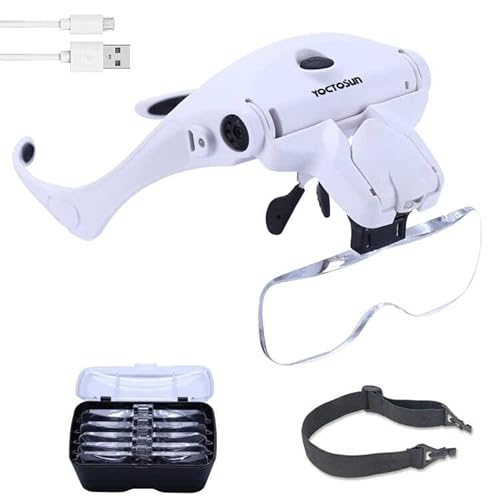
The glasses-style frame can also be secured with the included head strap, making this option distinct for stitchers who want to change how it sits during a project. Five interchangeable lenses span 1X to 3.5X, and two LEDs have two brightness levels. The maker says the battery is rechargeable. Its lighting has fewer LEDs than the four-light headband model, so it may be less suitable when you want more built-in light coverage across the work.
Bottom line: Choose this if switching between glasses wear and a head strap matters.
NOMEAROD 180% Wearable Magnifier

The fixed 180% wearable style is simpler than a headset with multiple lenses, and its 30 g weight is the lightest specific weight provided among these products. It is designed to fit over regular glasses and gives an optimal viewing distance of 8–10 inches, which can help when setting up a close-work position. It has no built-in lighting, so it is a better fit for a bright, well-lit workspace than for dim embroidery or stitching areas.
Bottom line: Pick this for a light wearable style that can fit over prescription glasses.
Full-Page 5X Lighted Magnifier

The 7.4-by-4.4-inch lens is designed to cover a full-page, unlike the smaller interchangeable lenses on headset magnifiers. It has 48 LEDs and three light tones; power can come from USB or batteries, with the maker describing USB operation as non-rechargeable. The larger lens can help with pattern pages or printed instructions, but it is a handheld or neck-style format rather than a head-worn magnifier tailored to keeping both hands free over needlework.
Bottom line: Choose this for viewing pattern pages or printed instructions at a larger scale.
How to choose magnification for needlework
Choose the lowest magnification that makes the stitch or thread detail clear while keeping enough of the fabric in view. A lower setting generally gives a wider field of view and more working distance; stronger magnification narrows the visible area and often requires closer positioning. A useful setup rule is to start at the lowest lens strength, then move up only if the stitch remains hard to distinguish at a comfortable posture. For threading needles, focus on a clear close view of the needle eye; for following a pattern, retain enough field of view to track the next few stitches. Match the lens range to your main task rather than assuming the highest number is always best.
Headset, wearable glasses and page magnifiers
Headset magnifiers keep hands available for stitching and often use interchangeable lenses, while wearable glasses offer a simpler fit and a fixed enlargement. Full-page magnifiers cover printed material rather than sitting as a close-work lens in front of the eyes. The table compares the main formats by the task they suit; lighting and magnification still vary by individual model.
| Format | Works well for | Trade-off |
|---|---|---|
| Headset with lenses | Close stitches, adjustable viewing | Requires fitting and lens changes |
| Wearable glasses | Simple hands-free viewing | Fixed enlargement |
| Full-page lens | Patterns and printed instructions | Large lens, not a head-worn view |
Needlework often involves both near detail and pattern reading, so a headset or wearable glasses usually suits stitching itself better than a page lens.
Set a comfortable working distance
Position the fabric where your neck and shoulders can stay relaxed, then choose a lens that focuses at that distance. The NOMEAROD wearable magnifier gives an 8–10-inch optimal viewing distance; other magnifiers may require a different position, so confirm the comfortable focus range before ordering if your table setup is fixed. Stronger magnification can make small head movements more noticeable because the view covers less area. Keep the work supported and move the fabric into view rather than leaning forward for long periods. If you wear regular glasses, check whether the chosen frame is designed to fit over them.
Lighting and safe needlework setup
Built-in LEDs can brighten the stitching area, but they do not replace comfortable room lighting; reduce glare by aiming light at the fabric rather than into your eyes. The products with built-in lights offer different LED counts and brightness or tone choices, while the wearable 180% glasses have no lighting feature. Keep needles, scissors and other sharp tools on a stable surface within reach, and remove the magnifier before moving around if the frame or headset restricts your field of view. For long sessions, take regular vision breaks and refocus on a distant object to reduce eye strain.
Frequently Asked Questions
What magnification is useful for cross stitch?
A selectable range around 1X to 3.5X can cover both broader fabric viewing and finer stitch detail. Start with the lowest lens that makes the thread and stitch legible, since stronger settings reduce the visible area.
How far should needlework be from a magnifier?
The NOMEAROD wearable magnifier gives an 8–10-inch optimal viewing distance. Other styles may focus differently, so test the setup at your natural working posture and verify the focus distance if your workspace cannot be adjusted.
Are illuminated magnifiers useful for embroidery?
Built-in lights can brighten stitches when room light is uneven, but they are not a substitute for general task lighting. Aim the LEDs at the fabric and avoid direct glare into your eyes.
Can I wear a magnifier over prescription glasses?
The NOMEAROD wearable model is designed to fit over regular glasses. For other frame or headset styles, check the fit before choosing if you need to keep prescription lenses on.
Is stronger magnification always better for sewing?
No; higher magnification narrows the visible field and can require closer positioning. Choose the lowest setting that clearly shows the stitch at a comfortable distance, then increase strength only for finer details.