
Best Mouse for Tennis Elbow: 5 Vertical Options Compared

The Logitech Lift is the best mouse for tennis elbow to start with because it is made for small to medium right hands and has customizable buttons. A vertical mouse changes the hand position compared with a conventional flat mouse, but it cannot diagnose or treat elbow pain.
Choose another option if you need a left-handed model, a mouse sized for a larger hand, or a particular receiver or device connection; fit and connection compatibility are the deciding factors.
We earn a commission if you buy through links on this page. As an Amazon Associate I earn from qualifying purchases. Products are compared on manufacturer specifications, not hands-on testing.
- Best overall: Logitech Lift Vertical Mouse – Designed for small to medium right hands, with Bluetooth or a Logi Bolt receiver and customizable buttons.
- Best for small-to-medium hands: ProtoArc EM11 NL – The 58-degree shape is designed for hand lengths under 7.5 inches and connects to up to three devices.
- Best for connection options: POJTK 3-in-1 Vertical Mouse – Offers Bluetooth 5.3 and USB-A or USB-C receiver connections, with up to 4,800 DPI.
| Product | Best for | Connection | DPI | Rechargeable | Shop |
|---|---|---|---|---|---|
| Logitech Lift Vertical Mouse | Small right hands | Bluetooth or Logi Bolt USB-A | — | — | Check Price on Amazon |
| ProtoArc EM11 NL | Multi-device setups | Bluetooth or 2.4G USB-A | — | Yes, 500 mAh | Check Price on Amazon |
| Anker 2.4G Vertical Mouse | DPI adjustment | 2.4 GHz USB receiver | 800–1,600 | — | Check Price on Amazon |
| Lekvey Rechargeable Vertical Mouse | USB-C charging | 2.4G wireless | 800–1,600 | Yes, 600 mAh | Check Price on Amazon |
| POJTK 3-in-1 Vertical Mouse | USB-C receivers | Bluetooth 5.3, USB-A or USB-C | Up to 4,800 | Yes | Check Price on Amazon |
Vertical mice for tennis elbow
Compare hand fit, connection choices and controls before choosing a vertical mouse for desk work.
Logitech Lift Vertical Mouse
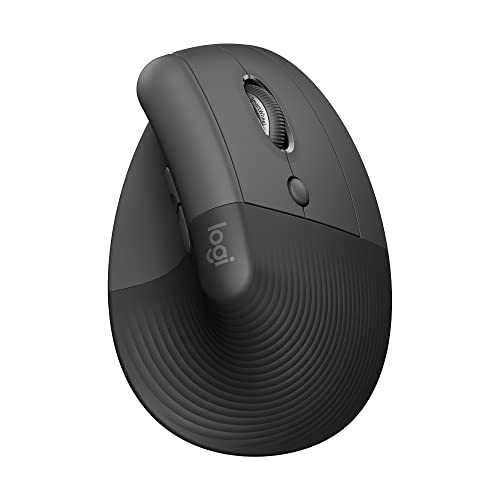
The Logitech Lift stands out for its fit guidance and customizable controls: it is designed for small to medium right hands, and four of its six buttons can be customized. Its 57-degree vertical shape, textured grip and thumb rest distinguish it from simpler vertical mice. Bluetooth and the included Logi Bolt USB-A receiver provide two connection routes; the mouse also has quiet clicks and a SmartWheel. Choose it if your hand and handedness match its design and you value configurable controls. Its fit is limited to small-to-medium right hands, so it may not suit left-handed users or larger hands.
Bottom line: Pick this if you have a small-to-medium right hand and want customizable controls.
ProtoArc EM11 NL

The ProtoArc EM11 NL is the clearest choice here for switching among several devices: it can connect to three through Bluetooth and 2.4G USB-A. Its 58-degree vertical design is intended for hand lengths under 7.5 inches, so measure your hand before choosing it. A 500 mAh rechargeable battery and USB-C charging avoid routine battery replacement. This model suits a small-to-medium hand and a multi-device desk. Its size guidance is a limitation for people with longer hands, and the included wireless receiver uses USB-A.
Bottom line: Pick this for a hand under 7.5 inches and a three-device setup.
Anker 2.4G Vertical Mouse

The Anker differs from the other options by using a 2.4 GHz USB receiver rather than Bluetooth, and it provides three tracking settings: 800, 1,200 and 1,600 DPI. Its right-hand vertical shape is designed around a neutral handshake position. Choose it if you prefer receiver-based connection and want to change pointer sensitivity without software. The USB receiver is a constraint for devices without a compatible USB port, and this model is specified for right-hand use. Confirm that your computer can accept the receiver before selecting it.
Bottom line: Pick this if you want three DPI settings and can use a USB receiver.
Lekvey Rechargeable Vertical Mouse

The Lekvey pairs a rechargeable 600 mAh battery with three DPI settings—800, 1,200 and 1,600—and adds page-back and page-forward buttons. Its 2.4G wireless connection makes it a straightforward fit for a desk setup that uses a receiver. The maker says a full charge lasts about three to four weeks with 8–10 hours of daily use, or two to three months with light use. Choose it if you want onboard sensitivity choices and rechargeable power. Its single 2.4G connection is less flexible than models that also offer Bluetooth.
Bottom line: Pick this if rechargeable power and page-navigation buttons suit your work.
POJTK 3-in-1 Vertical Mouse

The POJTK offers the broadest connection selection: Bluetooth 5.3, a USB-A receiver, or a USB-C receiver. It supports up to 4,800 DPI and has six silent buttons, making it a fit for users who want a higher maximum sensitivity setting or a receiver for a USB-C port. The rechargeable design avoids disposable batteries. Choose it when device ports or pointer sensitivity are priorities. The maker gives no hand-size guidance, so fit is less certain than for models with a target hand size; check the shape in person if hand fit is a concern.
Bottom line: Pick this if you need a USB-C receiver option or higher maximum DPI.
How to choose a vertical mouse for tennis elbow
Start with hand fit and a relaxed grip, not the steepest angle or the highest DPI. A vertical mouse rotates the hand toward a handshake position; the ProtoArc and Logitech specify angles near 57–58 degrees, while other models here do not provide an angle. Keep the mouse close to the keyboard so reaching does not pull the shoulder forward, and set the pointer speed so you can cross the screen without repeated large arm movements. DPI is a sensitivity setting, not a measure of medical benefit. If a mouse makes you pinch, bend the wrist, or reach farther, it is a poor ergonomic fit even if its shape is vertical.
Hand fit and desk position matter
Measure from the wrist crease to the tip of the middle finger and compare that length with the maker’s fit guidance. The ProtoArc is specified for hands under 7.5 inches, and the Logitech Lift is designed for small-to-medium right hands; the Anker is also a right-hand mouse. Set the pointer so the mouse sits beside the keyboard, with the elbow near the body and bent roughly 90 degrees, rather than reaching across the desk. A simple decision rule: if the mouse forces your elbow away from your side or your wrist to bend, reposition the setup or choose a different shape. Handedness matters as much as angle.
Vertical mouse connection types compared
Choose the connection that matches the ports and devices you use. Bluetooth avoids occupying a USB port, while a 2.4 GHz receiver needs a compatible port; the POJTK includes both USB-A and USB-C receiver options. Some mice can pair with more than one device, but switching behavior differs, so check the control method if frequent switching is essential.
| Need | Connection to consider |
|---|---|
| No free USB port | Bluetooth |
| USB-A available | 2.4 GHz USB-A receiver |
| USB-C only | USB-C receiver, such as POJTK |
| Several devices | ProtoArc supports up to three connections |
Before choosing a receiver model, check the computer’s available port and whether an adapter is acceptable for your setup.
Using a mouse when your elbow hurts
A mouse cannot establish the cause of elbow pain, and changing grip alone may not resolve it. Keep the forearm supported without pressing the elbow on a hard edge, use a relaxed hand, and alternate tasks when practical. Frequent short breaks—such as a few minutes away from continuous mouse work each hour—can reduce uninterrupted repetitive motion. Stop using a position that increases pain, and seek medical advice for persistent, worsening, or function-limiting symptoms. Do not rely on an ergonomic device as treatment or delay care for substantial pain, weakness, or loss of movement.
Frequently Asked Questions
Will a vertical mouse cure tennis elbow?
No mouse can be relied on to cure tennis elbow. A vertical grip may change wrist and forearm position, but persistent or worsening elbow pain warrants medical advice.
How should I position a mouse beside my keyboard?
Keep the mouse close to the keyboard so your upper arm stays near your side instead of reaching outward. Aim for an elbow bend near 90 degrees and a wrist that is not sharply bent.
How do I measure my hand for a vertical mouse?
Measure from the wrist crease to the tip of your middle finger. Compare the result with the model’s hand-size guidance; for example, the ProtoArc is designed for hand lengths under 7.5 inches.
Is Bluetooth better than a wireless USB receiver?
Neither connection is universally better: Bluetooth preserves a USB port, while a 2.4 GHz receiver needs a compatible port. If your device has only USB-C, choose a model with a USB-C receiver or Bluetooth.
When should I take breaks from mouse work?
Breaks should interrupt long stretches of repetitive mouse use; a few minutes away from continuous work each hour is a practical target. Take a break sooner if your pain increases, and seek care if symptoms persist or worsen.