
4-20 Milliamp Signal Generators Compared by Output

Riiai SG004A suits most buyers seeking a 4-20 milliamp signal generator because it combines current output with voltage, passive current, pulse, resistance and millivolt modes. Choose another model if you only need current and voltage, or if you need a particular display or protection feature instead.
A 4-20 mA signal generator supplies a controllable current for checking analog inputs and related instrumentation; match its output mode to the input circuit before connecting it.
We earn a commission if you buy through links on this page. As an Amazon Associate I earn from qualifying purchases. Products are compared on manufacturer specifications, not hands-on testing.
- Best overall: Riiai SG004A – Offers current and voltage plus passive current, pulse, resistance and millivolt modes.
- Best for simple mode switching: Riiai SG003A – Provides current, voltage, passive current and frequency output with a color display.
- Best for PWM output: Adjustable 4-20mA / 0-12V Generator – Adds adjustable 1-150 kHz PWM output alongside current and voltage.
| Product | Best for | Current output | Other output modes | Display or protection | Shop |
|---|---|---|---|---|---|
| Riiai SG004A | Multi-signal checks | 0-24 mA | Voltage, passive current, pulse, resistance | Real-time curve; 3,000 mAh battery | Check Price on Amazon |
| Riiai SG003A | Color display | 0-24 mA | Voltage, passive current, frequency | 2.4-inch TFT color display | Check Price on Amazon |
| Riiai 0-10V / 0-22mA Generator | Encoder adjustment | 0-22 mA | Bipolar voltage | Four-digit display | Check Price on Amazon |
| Adjustable 4-20mA / 0-12V Generator | PWM signal work | 0-24 mA | Voltage, PWM | Short-circuit protection | Check Price on Amazon |
| LB78 Current Signal Generator | Fused protection | 4-20 mA | Voltage, millivolt | Built-in quick-break fuse | Check Price on Amazon |
4-20 Milliamp Signal Generators
Compare the current ranges and added signal modes to match a generator to your input checks.
Riiai SG004A
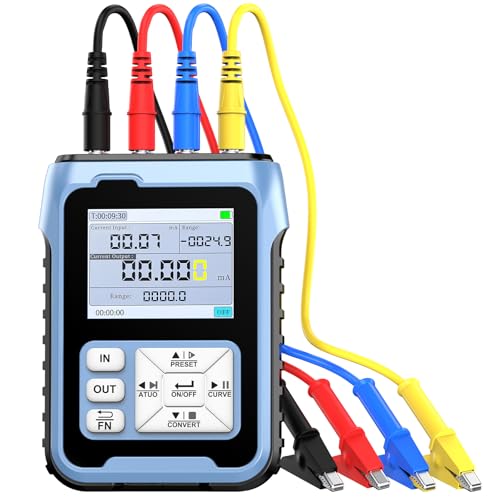
The SG004A covers the broadest set of signal types here, including resistance and millivolt outputs in addition to current, voltage, passive current and pulse. Riiai specifies 0-24 mA current output with 0.001 mA resolution, and the model also offers four preset signal groups and a real-time curve. Those extra modes suit technicians checking more than standard current and voltage inputs. Its expanded options may be unnecessary if your work only calls for a basic current source, so prioritize the modes your instruments actually accept.
Bottom line: Pick it if your checks span current, resistance and millivolt inputs.
Riiai SG003A

The SG003A gives a color-screen alternative to the broader SG004A, with current, voltage, passive-current and frequency modes. Riiai specifies current output from 0 to 24 mA at 0.01 mA precision, voltage from 0 to 24 V at 0.01 V precision, and frequency output up to 9,999 Hz. The 2.4-inch TFT display and adjustable button backlight are useful when screen readability matters. It does not include the resistance and millivolt modes offered by the SG004A, which matters if those signals are part of your work.
Bottom line: Choose it when a color screen and the core signal modes fit your checks.
Riiai 0-10V / 0-22mA Generator
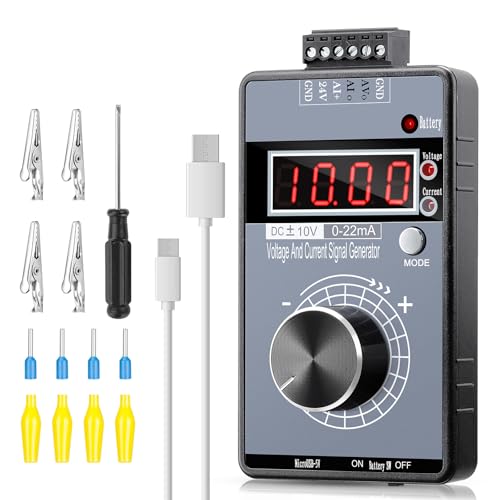
The Riiai 0-10V / 0-22mA model stands apart with an encoder knob for adjusting output and a four-digit display that can switch between voltage and current. Riiai specifies a -10 to +10 V range and 0-22 mA current output, both at 0.01-unit precision. The display can also show percentage or frequency modes. This suits users who prefer knob adjustment and a compact numeric readout. Its current ceiling is lower than the 24 mA models here, so confirm that the range covers the signal values you need to generate.
Bottom line: Pick it if encoder adjustment and a four-digit readout are priorities.
Adjustable 4-20mA / 0-12V Generator

The adjustable signal generator adds PWM output, distinguishing it from the other models in this group. Its maker gives a 1-150 kHz adjustable PWM frequency and 0-100% duty cycle; current output is adjustable from 0 to 24 mA, with 4-20 mA as the factory default. The maker specifies 0.05 mA current accuracy after calibration and short-circuit protection for voltage output. This combination suits work that includes pulse-width modulation. The battery runtime depends on output load, so consider that variable for extended field sessions.
Bottom line: Choose it when PWM output is part of your signal checks.
LB78 Current Signal Generator
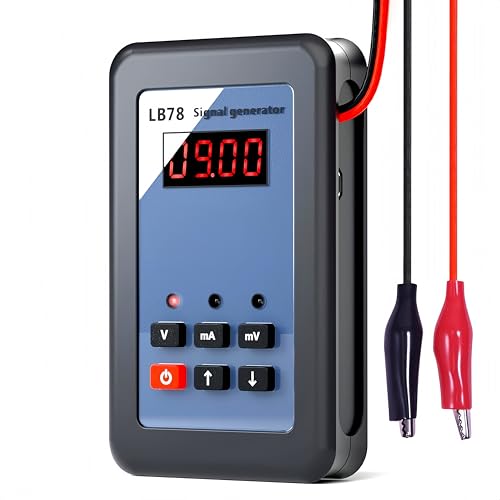
The LB78 is the only model here whose name centers a built-in fuse, with coverage for current, voltage and millivolt signals. The maker describes the quick-break fuse as protection against accidental damage to the instrument. Its keypad assigns functions to individual buttons, a straightforward arrangement for users who prefer direct controls over an encoder or menu-driven color display. The feature set does not give an output range or precision figure, so this is a less transparent choice when you need to match a specific current span or accuracy requirement.
Bottom line: Pick it if a built-in fuse is a deciding feature for your setup.
How to choose a 4-20 milliamp signal generator
Choose by output mode first, then by range and adjustment method. A 4-20 mA loop uses 4 mA as a live zero and 20 mA as full scale, so a source intended for this work needs to cover that interval. A 250-ohm receiver resistor converts the range to 1-5 V by Ohm’s law; this can help when checking a voltage-measuring input, but the resistor and input must be rated for the circuit. Check whether you need voltage, pulse, resistance or millivolt output as well as current. If your tasks include PWM, choose a model with a frequency and duty-cycle range suited to the device. For knob-based work, confirm the adjustment style and display are practical for the setting.
Active and passive current output compatibility
Current output mode must match the way the receiving circuit is wired. An active current source drives the loop current, while a passive output typically relies on an external loop supply; connecting the wrong arrangement can prevent a reading or put incompatible supplies together. Some generators explicitly offer a passive-current mode, while others in this selection do not establish that capability. Before ordering, verify whether your PLC input needs an active source or a passive loop input. A typical industrial loop supply is 24 V DC, but the available voltage must cover the transmitter, receiver and wiring drops. Never connect a signal generator to an energized loop until you understand the circuit’s source and input configuration.
Signal generator output modes compared
Additional modes matter when one instrument must check different analog and pulse inputs. Current mode suits loop inputs; voltage mode suits voltage-measuring inputs; resistance and millivolt modes serve other sensor and instrument checks. Frequency output and PWM are not interchangeable: PWM carries information in pulse width, while frequency output sets pulse rate. Use the table to narrow the type by the extra function required, then confirm its range matches the device under test.
| Need | Relevant output type | Selection rule |
|---|---|---|
| Loop-current input | 4-20 mA current | Ensure the range spans 4-20 mA |
| Voltage analog input | Voltage | Match the input’s voltage span and polarity |
| Pulse-width input | PWM | Match frequency and duty-cycle limits |
| Resistance or millivolt input | Resistance or millivolt | Confirm the input accepts that signal type |
Safe connection and setup checks
Start with the input terminals and circuit drawing, not the generator leads. Industrial loop current is often measured in series, while voltage is measured across an input; placing a current output across the wrong terminals can cause a fault. Verify polarity, loop supply and input mode before applying a signal. Set the output to zero or the lowest intended value before wiring, and increase it while observing the input reading. Do not exceed the instrument’s output or the receiving device’s limits. A current loop can remain energized from an external supply even when a controller is stopped, so isolate power where the wiring procedure requires it and avoid exposed conductive contacts.
Frequently Asked Questions
Why does a 4-20 mA loop start at 4 mA?
Four milliamps acts as a live zero, leaving 0 mA available to indicate a broken loop or loss of power in many designs. The span from 4 to 20 mA is 16 mA.
What voltage does a 250-ohm resistor produce?
A 250-ohm resistor produces 1-5 V across a 4-20 mA loop, using the relationship voltage equals current multiplied by resistance. Confirm the input measures across that resistor and that its rating suits the circuit.
Can I connect a signal generator to a live loop?
Only when the generator mode and loop wiring are compatible. A typical loop may have a 24 V supply, so identify the active source and whether the generator is sourcing or providing passive current before connecting.
How do I convert a current reading to a percentage?
For a 4-20 mA span, subtract 4 mA and divide by 16 mA, then multiply by 100. For example, 12 mA is 50% of span.
What is the difference between PWM and frequency output?
Frequency output sets how many pulses occur per second, while PWM varies the fraction of each cycle spent high. A PWM input may require both a particular frequency and duty cycle, so match both limits.