
Diesel Heaters for Homes: 3 Models Compared

For home spaces with access to a standard outlet, LF Bros 5KW All-in-One Heater is the clearest fit because its kit includes a 110V transformer alongside 12V and 24V support. 12KW All-in-One Heater with App Control also lists 110V operation and adds wireless room-temperature sensing; choose a different model if you need a vehicle-only 12V setup or a heater specifically sized for another space.
Portable diesel air heaters warm air through a heat exchanger while routing combustion exhaust separately, so safe exhaust placement matters wherever one is operated.
We earn a commission if you buy through links on this page. As an Amazon Associate I earn from qualifying purchases. Products are compared on manufacturer specifications, not hands-on testing.
- Best overall: LF Bros 5KW All-in-One Heater – Its included 110V transformer makes it usable with a standard outlet, and the 5-liter tank is specified.
- Best for thermostat control: 12KW All-in-One Heater with App Control – The wireless remote doubles as an indoor thermostat, and the heater supports 110V, 12V, and 24V.
- Best for app control: VEVOR 8KW Bluetooth Heater – Bluetooth app control works up to 98 feet, and automatic altitude adjustment is specified up to 18,045 feet.
| Product | Best for | Power | Supply | Fuel tank | Shop |
|---|---|---|---|---|---|
| LF Bros 5KW All-in-One Heater | Outlet-powered spaces | 5 kW | 12V / 24V / 110V | 5 L | Check Price on Amazon |
| 12KW All-in-One Heater with App Control | Room thermostat control | 12 kW | 110V / 12V / 24V | 8 L | Check Price on Amazon |
| VEVOR 8KW Bluetooth Heater | App and altitude control | 8 kW | 12V | — | Check Price on Amazon |
Diesel Heaters for Homes Compared
Compare each heater’s power, electrical supply, and tank capacity before choosing where and how to use it.
LF Bros 5KW All-in-One Heater

Unlike the vehicle-voltage-only option here, this 5 kW heater includes a 110V transformer, so it can connect to a household outlet as well as 12V or 24V power. The 5-liter tank and digital display suit a garage, basement, or camper where portable heating is wanted. The maker gives a fuel-use range of 0.18–0.53 L per hour and a heat output of 4,700–17,000 BTU. Its limitation is that the figures do not establish how quickly it will heat a particular room; match the space and insulation to the heater rather than assuming one output fits all.
Bottom line: Choose this when you want a portable heater with a 110V transformer and a 5-liter tank.
12KW All-in-One Heater with App Control

The wireless remote doubles as an indoor thermostat, distinguishing this model from heaters controlled only at the unit or by a basic remote. The 12 kW unit supports 110V, 12V, and 24V, and its 8-liter tank is larger than the 5-liter tanks specified for two alternatives. Its adjustable thermostat range is 46°F to 97°F; the maker gives fuel consumption as 0.18–0.53 L per hour. This is a portable air heater, not a whole-home furnace, so consider it for a defined area such as a garage or cabin rather than relying on it to heat multiple rooms.
Bottom line: Choose this if a wireless room-temperature sensor and 110V support are priorities.
VEVOR 8KW Bluetooth Heater
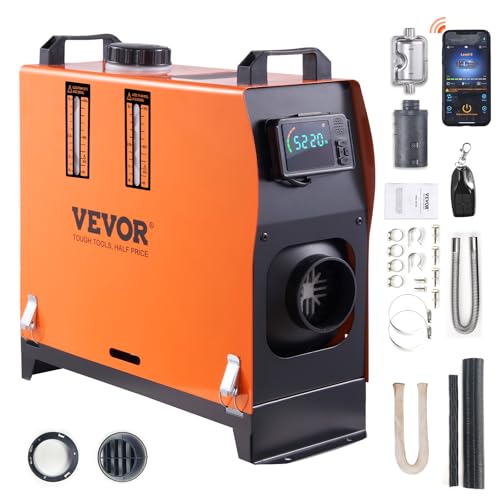
Bluetooth app control and automatic altitude adjustment distinguish this 8 kW model; the maker specifies app control up to 98 feet and altitude adjustment up to 18,045 feet. It runs on 12V and is described for vehicles and indoor use, with an applicable area of 215–269 square feet. That makes the power supply an important constraint for a home setup: unlike the models with a 110V option, this one needs a suitable 12V source.
Bottom line: Choose this when app control and altitude adjustment matter and a 12V supply is available.
How to Choose a Diesel Heater for Home Use
Start with power supply and the area you intend to heat: a 110V-compatible model can use a household outlet, while a 12V–24V unit needs a matching DC source. Diesel air heaters warm air across a heat exchanger; fuel is burned in a separate combustion chamber, and exhaust must be routed outdoors. They are generally used to heat a defined space, not as a substitute for a central furnace serving several rooms. Match a heater’s coverage to the room’s size and insulation, and treat the maker’s coverage as a guide rather than a guarantee. If the heater will be used in an occupied area, confirm the exhaust arrangement and operating requirements before use.
Use this quick comparison to narrow the electrical fit.
| Setup | What to choose |
|---|---|
| Household outlet available | Model specifying 110V support |
| Vehicle DC supply only | Model matching the available 12V or 24V source |
| Room-temperature sensing wanted | Model with a wireless thermostat remote |
Diesel Heater Safety and Exhaust Placement
Keep combustion exhaust outside the occupied space: carbon monoxide is an odorless, potentially fatal gas, and a heater’s exhaust must never vent into a home, garage, or camper. A heat exchanger separates combustion from heated air, but safe installation still depends on intact exhaust routing and seals. Use a working carbon monoxide alarm in any occupied space where a fuel-burning appliance is operated, and do not treat an open door or window as a substitute for proper exhaust installation. Keep exhaust outlets away from windows, doors, and other air intakes so fumes are less likely to re-enter. Stop using a heater if exhaust enters the space or a CO alarm sounds, leave the area, and get fresh air.
Portable does not mean suitable for unattended indoor operation; use the product’s designated operating setup and keep combustible materials clear of hot components.
Fuel Use, Tank Size, and Runtime
Estimate runtime by dividing tank capacity in liters by the heater’s fuel-use rate in liters per hour; the resulting figure is only a rough maximum because consumption changes with output and operating conditions. For example, a 5-liter tank divided by a 0.5 L-per-hour rate is about 10 hours. The two models with a specified 0.18–0.53 L-per-hour range can have very different runtimes at their low and high ends, so a single runtime promise would be misleading. A larger tank reduces refueling frequency but adds fuel to handle and store. Keep diesel in an approved container, away from ignition sources, and refuel only with the heater off and cool.
For frequent overnight use, calculate from the upper end of the maker’s fuel range rather than assuming the lowest consumption figure.
Frequently Asked Questions
Can a diesel air heater plug into a home outlet?
Only a model with an appropriate 110V input or included transformer can use a household outlet directly. A 12V-only heater requires a suitable DC power source, not an ordinary wall socket.
Can a diesel heater run inside a closed garage?
Never route combustion exhaust into an occupied garage, even if the garage door is shut or the heater warms the air through a heat exchanger. Exhaust must vent outdoors, and a working carbon monoxide alarm is essential where fuel-burning equipment operates.
How do I estimate a diesel heater’s runtime?
Divide fuel-tank capacity in liters by fuel consumption in liters per hour for a rough estimate. A 5-liter tank at 0.5 L per hour works out to about 10 hours, though actual use varies with output and conditions.
Does a larger diesel heater always heat a room better?
No; output should suit the space, insulation, and heat loss rather than simply being as large as possible. Compare the maker’s coverage with the area you want to heat, and avoid treating vehicle-area claims as a guarantee for a home room.
What should I check before operating a diesel heater indoors?
Confirm that the heater is set up for the intended indoor use and that its combustion exhaust can be routed fully outside. Keep a working carbon monoxide alarm in the occupied space, and do not operate the heater if fumes enter or the alarm sounds.