
Suction Cup Dent Pullers for Small Dents Compared

For shallow small dents, the compact two-puller kit Compact 2-Pack Dent Puller is the most direct match because each puller is described for minor dents and rated up to 33 pounds under suitable conditions. Choose 9-Piece Dent Repair Suction Kit instead if you want multiple cup sizes and polishing accessories; neither suction puller is suited to sharp creases or damaged paint.
We earn a commission if you buy through links on this page. As an Amazon Associate I earn from qualifying purchases. Products are compared on manufacturer specifications, not hands-on testing.
- Best overall: Compact 2-Pack Dent Puller – Two compact pullers are intended for shallow dents and minor door dings, with a claimed force of up to 33 pounds each.
- Best for varied sizes: 9-Piece Dent Repair Suction Kit – Includes 4.5-inch pullers plus a 2.2-inch puller and surface-finishing accessories.
- Best for multipurpose use: 2-Pack Car Dent Puller – The kit combines one large puller and two small pullers for other smooth surfaces as well.
| Product | Best for | Puller sizes | Claimed pull force | Included pullers | Shop |
|---|---|---|---|---|---|
| Compact 2-Pack Dent Puller | Shallow dings | Compact; diameter — | Up to 33 lb each | 2 compact pullers | Check Price on Amazon |
| 9-Piece Dent Repair Suction Kit | Multiple cup sizes | 4.5 in and 2.2 in | Up to 130 lb horizontal; 80 lb vertical | 3 pullers | Check Price on Amazon |
| 2-Pack Car Dent Puller | Smooth surfaces | Large and small; diameter — | — | 3 pullers | Check Price on Amazon |
Suction Cup Dent Pullers for Small Dents
Cup size, smooth-surface compatibility and dent shape determine whether a suction puller can get a useful grip.
Compact 2-Pack Dent Puller
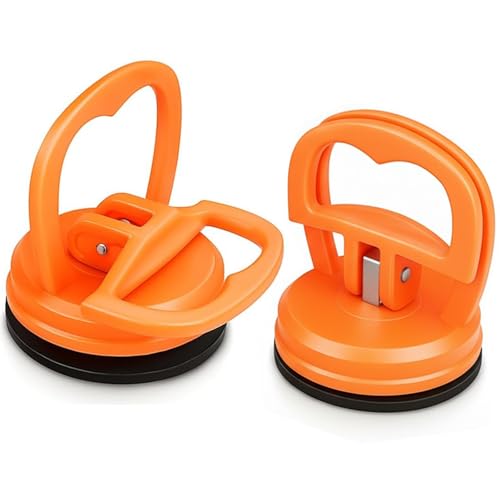
The compact two-puller set Compact 2-Pack Dent Puller is the most focused choice here for shallow dents and minor door dings. Its ABS handles and flexible rubber cups are intended for controlled pulling on smooth panels, and the maker claims up to 33 pounds of pulling force per puller under suitable conditions. That number is not a guarantee of dent removal: cup seal, panel shape and dent geometry all affect the result. The steps call for cleaning the area and pressing the cup firmly; this approach is less suitable for creases, edges or textured surfaces that prevent a seal.
Bottom line: Pick it for a small, shallow ding on a smooth, accessible panel.
9-Piece Dent Repair Suction Kit

The 9-piece kit 9-Piece Dent Repair Suction Kit is the only option here with specified cup diameters: two 4.5-inch pullers and one 2.2-inch puller. The maker claims up to 130 pounds of horizontal and 80 pounds of vertical suction, figures that describe the tool’s grip under suitable conditions rather than a guaranteed dent-pulling result. ABS housings, a metal core and rubber seals are paired with a rag, polishing pads and sandpaper. Choose it when you want more cup-size choice and finishing supplies; the larger cups need a broad, smooth area around the dent to seal.
Bottom line: Choose it when cup-size options and finishing accessories matter.
2-Pack Car Dent Puller

The three-piece set 2-Pack Car Dent Puller stands out for multipurpose lifting rather than dent-specific measurements: it includes one large puller and two small pullers, with rubber and a solid metal core. The maker describes a spring-lock handle and says the tools can also lift glass, steel, furniture, doors and other smooth objects. Suction cups need a clean, smooth, nonporous contact area; a curved or creased panel can defeat the seal.
Bottom line: Consider it for general smooth-surface lifting as well as small repair tasks.
How to choose a suction cup dent puller
A suction cup dent puller is most useful on a shallow dent with a smooth, broad surface where its rubber rim can seal. Dent shape matters more than the tool’s maximum pull-force claim: a pointed impact, sharp crease or dent close to a body-panel edge gives the cup little even area to grip. Match the cup diameter to the flatter area around the dent, not just to the visible depression. For a small ding with a smooth center, start with a compact cup; for a wider, flatter area, a larger cup may seal better. Stop if the cup slides or the panel flexes without lifting, since more force can worsen the damage.
Surface and dent fit for small car damage
Paintless suction pulling is intended for smooth, intact paint and accessible panel surfaces; chipped paint, textured trim and sharp folds are poor candidates. Clean away grit before attaching a rubber cup, because trapped dirt can weaken the seal and scuff the finish. A dent near a panel edge or body line usually needs a repair method that can reach behind or reshape the metal rather than a surface cup. Avoid pulling on thin plastic trim or glass unless the tool is made for that surface and the object is secure. These limits matter more than a high load rating, which measures suction grip rather than how a particular panel will respond.
What suction puller sizes and force claims mean
Cup diameter indicates the contact area needed for a seal, while pull-force figures are not a dent-removal rating. A larger cup requires a sufficiently flat patch; a small cup can fit a tighter area but may not bridge a broad dent. Force claims also depend on orientation and surface conditions, so horizontal and vertical ratings should not be treated as interchangeable. Compare kits by the sizes they provide and whether each cup can sit flat around the dent. This table summarizes the practical differences without treating claimed suction as a promise of repair.
| Need | Suitable option | Reason |
|---|---|---|
| Compact shallow ding | Two compact pullers | Made for minor dents; up to 33 lb claimed per tool |
| Choice of cup diameter | 9-piece kit | Includes 2.2-inch and 4.5-inch cups |
| Other smooth objects | Three-piece set | Also described for glass, steel and furniture |
Common mistakes when pulling a dent
The most common mistake is assuming any visible dent can be pulled from the outside. Suction needs a continuous, clean seal, so a body line, crease, perforation or sharp curve can stop the cup from gripping. Another mistake is interpreting a maximum suction figure as the force needed to reshape automotive metal; the cup’s hold and the panel’s response are different things. Work only where the paint is intact and the cup sits flat, and stop if the cup releases repeatedly.
Frequently Asked Questions
Can a suction cup puller fix a sharp dent crease?
Usually not reliably, because a crease leaves too little flat area for the cup to seal evenly. Suction cups work best on shallow dents with smooth, intact paint and room for the rim to sit flat.
Do suction dent pullers work on every car panel?
No; they need a smooth, nonporous surface and a dent away from sharp edges or body lines. Textured trim, chipped paint and sharply curved areas can prevent a seal.
Does a 33-pound rating mean the dent will come out?
No; a force rating describes the puller’s claimed holding force under suitable conditions, not a guaranteed repair force. Dent depth, panel shape and cup seal all affect the result.
How should I prepare a panel before pulling?
Clean and dry the contact area so dirt does not interfere with the rubber seal or scratch the finish. Confirm the cup can sit flat around the dent before applying force.
Can a suction dent puller be used on glass?
Some pullers are also intended for smooth glass, but safe lifting depends on the glass being intact and the cup making a full seal. Do not use a puller on cracked glass or an unstable pane.