
Tool to Remove Fuel Lines: 5 Options by Connector Type

The Lisle 37000 is the best starting point for fuel line quick connects because its six sizes cover common couplings from 5/16 to 7/8 inch. Choose a different tool if you need a smaller 1/4-inch opening or are removing a clamped hose rather than separating a quick-connect fitting.
Fuel line disconnect tools release quick-connect or spring-lock fittings; hose-removal pliers instead help loosen a hose from a tube.
We earn a commission if you buy through links on this page. As an Amazon Associate I earn from qualifying purchases. Products are compared on manufacturer specifications, not hands-on testing.
- Best overall: Lisle 37000 Disconnect Tool Set – Six sizes cover spring-lock and fuel quick-connect couplings from 5/16 to 7/8 inch.
- Best for narrow access: BFXM 7-Piece Disconnect Set – Seven opening sizes and an offset design are intended for one-handed use in tight spaces.
| Product | Best for | Sizes or fit range | Material | Tool type | Shop |
|---|---|---|---|---|---|
| Lisle 37000 Disconnect Tool Set | Common quick-connects | 5/16–7/8 in | — | Six-piece set | Check Price on Amazon |
| BFXM 7-Piece Disconnect Set | Tight access | 1/4–7/8 in | Plastic | Seven-piece set | Check Price on Amazon |
| Metal Scissor Fuel Line Tool | Metal construction | 5/16 and 3/8 in | Carbon steel | Scissor tool | Check Price on Amazon |
| 16-Piece Fuel Line Disconnect Set | Stored tool set | 1/4–7/8 in | Hard plastic | 16-piece set | Check Price on Amazon |
Tools to remove fuel lines
Match the tool to the connector or hose you need to separate, then compare size coverage and access.
Lisle 37000 Disconnect Tool Set

The Lisle 37000 is the clearest fit for common spring-lock and fuel quick-connect couplings, with six sizes from 5/16 to 7/8 inch. The set also includes a 5/16-inch tool for Ford push-lock radiator and transmission connectors. Its compact tools are intended for confined spaces, which can help when a fitting is hard to reach.
The maker says the set works on Ford and Chrysler A/C spring-lock couplings and GM, Ford, and Chrysler fuel quick connects. It does not include a 1/4-inch size, so buyers whose connector requires that opening should choose a set with smaller coverage.
Bottom line: Pick this set for the Ford, Chrysler, and GM connector types in its six sizes.
BFXM 7-Piece Disconnect Set

The BFXM set reaches down to 1/4 inch, the smallest opening among the exact-fit disconnect sets here, and its offset shape is designed for one-handed work in narrow spaces. Seven openings span 1/4, 5/16, 3/8, 1/2, 5/8, 3/4, and 7/8 inch, so the size range suits buyers who need more than the common larger couplings.
The maker says it is compatible with Ford, GM, Chrysler, and Mazda. Its plastic construction is a consideration for users who prefer metal tools; confirm the connector size and fitting style before selecting an opening.
Bottom line: Choose it when the fitting needs a 1/4-inch tool or access is restricted.
Metal Scissor Fuel Line Tool
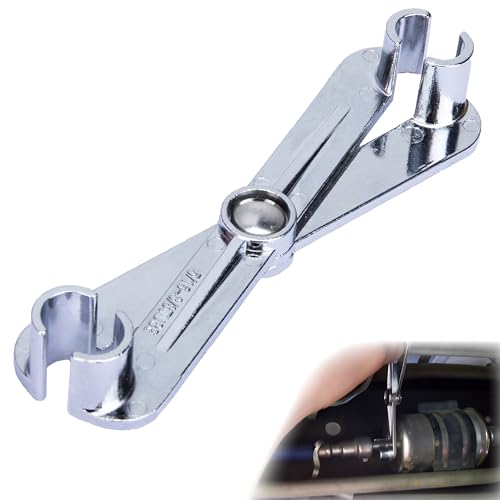
This scissor-style tool differs from the multi-piece sets by pairing a metal body with two listed working sizes: 5/16 and 3/8 inch. The carbon-steel construction is a useful distinction for buyers who want a metal tool for those specific fuel-filter couplings, rather than a plastic set covering a broader range.
The maker says the clamping structure separates couplers for fuel, heater, and A/C line service. The narrow size coverage limits its usefulness for other connectors; buyers should match the fitting to one of the two openings before choosing it, rather than assuming it handles every fuel line style.
Bottom line: Pick it for a 5/16- or 3/8-inch connection when a metal scissor tool suits the job.
16-Piece Fuel Line Disconnect Set

The 16-piece kit combines seven opening sizes with a storage box, making it the option here for buyers who want a grouped set kept together. The sizes listed for its disconnect tools run from 1/4 to 7/8 inch and cover the same broad range as the BFXM set.
The maker says the hard-plastic tools use engraved dimensions and an offset design for one-handed separation of fuel and A/C quick connects. The kit also names a valve-core remover, but its extra piece count does not mean broader disconnect sizing than the seven listed openings. Verify which fitting style the vehicle uses before selecting a tool.
Bottom line: Choose it if a storage box and broad quick-connect size coverage are priorities.
How to choose a fuel line disconnect tool
Start by identifying whether the joint is a quick-connect fitting or a hose pushed over a tube. Quick-connect tools depress or release a retaining mechanism; pliers can loosen a stuck hose without separating a connector. A common mistake is choosing by vehicle make alone: connector size and style decide fit. For these options, openings range from 1/4 to 7/8 inch, while hose-removal pliers cover 4 to 15 mm hose diameter. Measure or identify the fitting before selecting a tool, especially when the connector is tucked behind other components.
Use this guide to match the job type to the tool category.
| Job | Tool type | Fit check |
|---|---|---|
| Release a quick-connect coupling | Disconnect tool | Match opening and connector style |
| Loosen a hose on a tube | Hose-removal pliers | Hose diameter within 4–15 mm for the range |
Fuel line connector sizes and access
Disconnect tools in this group cover 1/4 to 7/8 inch, but a wide range does not guarantee every fitting style will work. The seven-size assortment includes 1/4, 5/16, 3/8, 1/2, 5/8, 3/4, and 7/8 inch; a six-tool set here starts at 5/16 inch. If a connector measures under 5/16 inch, select a tool whose range includes 1/4 inch. Offset and compact forms can help in restricted spaces, while the fitting still has to seat correctly in the tool.
Do not force an ill-fitting tool: it can damage a plastic connector or fail to release the retainer. Relieve fuel-system pressure using the vehicle service procedure before opening a fuel line, and keep ignition sources away from spilled fuel.
Fuel quick connects versus hose removal
A fuel quick connect is released at its coupling; a hose-removal tool addresses the hose-to-tube bond. Pushing a disconnect tool into a plain rubber hose will not release a clamp or loosen the hose, and prying a quick-connect can break its retainer. Hose-removal pliers are useful where a hose has adhered to a nipple, but only within their 4–15 mm diameter range for this option. The disconnect sets are for fittings matched to their openings.
Fuel can remain in a line after pressure is relieved. Work with the engine cool, catch residual fuel in an appropriate container, and avoid sparks, cigarettes, or hot work nearby. Replace damaged seals or retainers rather than relying on a loose connection.
Frequently Asked Questions
How do I know which fuel line tool size fits?
Match the tool opening to the fitting size and connector style; the sets here span 1/4 to 7/8 inch. If the fitting falls below 5/16 inch, choose a set that includes 1/4 inch rather than assuming the smaller size will fit.
Are fuel line disconnect tools and hose pliers interchangeable?
No. Disconnect tools release quick-connect couplings, while hose-removal pliers loosen a hose from a tube. The hose pliers in this group are intended for 4 to 15 mm hoses.
Should fuel pressure be relieved before disconnecting a line?
Yes, relieve fuel-system pressure using the vehicle service procedure before opening a fuel line. Residual fuel may remain, so work with the engine cool and keep ignition sources away.
What should I do if a fuel hose is stuck?
Use hose-removal pliers made for loosening a hose from its tube, not a quick-connect separator. For the pliers here, the hose diameter range is 4 to 15 mm; avoid prying against a connector retainer.
Can one disconnect tool work on every vehicle?
No, connector styles and sizes vary even among vehicles from the same maker. Match both the fitting style and opening size; the options here cover sizes from 1/4 to 7/8 inch.