
ANNKE Security Cameras: 5 Options Compared by Setup

For most homes needing several camera views and continuous local recording, ANNKE 3K Lite 8-Camera DVR System is the best fit because it includes eight cameras and a DVR with a 1TB hard drive. Choose a different option if you need one camera, solar charging, or wireless connectivity instead of a wired multi-camera setup.
We earn a commission if you buy through links on this page. As an Amazon Associate I earn from qualifying purchases. Products are compared on manufacturer specifications, not hands-on testing.
- Best overall: ANNKE 3K Lite 8-Camera DVR System – Eight wired cameras and a DVR with a preinstalled 1TB hard drive suit multi-view continuous recording.
- Best for solar coverage: ANNKE 4MP Dual-Lens Solar Camera – A 4MP dual-lens camera combines fixed and pan/tilt views with a 9000mAh battery and 4W panel.
- Best for two-way talk: ANNKE 3K Pan/Tilt Wi-Fi Camera – The plug-in camera offers 3K video, pan/tilt, motion tracking and two-way audio.
- Best for DVR upgrades: ANNKE E200 1080p 4-in-1 Bullet Camera – This single 1080p analog camera supports four signal formats but needs a compatible DVR and separate power adapter.
| Product | Best for | Camera count | Power / connection | Recording | Shop |
|---|---|---|---|---|---|
| ANNKE 3K Lite 8-Camera DVR System | Multi-camera recording | 8 cameras | Wired DVR system | 1TB HDD; 24/7 recording | Check Price on Amazon |
| ANNKE E200 1080p 4-in-1 Bullet Camera | Adding a DVR camera | 1 camera | Wired analog; DVR required | DVR recording | Check Price on Amazon |
| ANNKE 4MP Dual-Lens Solar Camera | Solar dual-view coverage | 1 camera; dual lens | Battery; 4W solar panel; Wi-Fi | App-based recording | Check Price on Amazon |
| ANNKE 3K Pan/Tilt Wi-Fi Camera | Two-way audio | 1 camera | Wi-Fi; plug-in power | Local recording | Check Price on Amazon |
| ANNKE Solar PT 4-Camera NVR System | Expandable solar system | 4 cameras; up to 10 | Solar; 2.4/5GHz Wi-Fi | 1TB HDD; local NVR | Check Price on Amazon |
ANNKE Security Cameras Compared
Start with the number of views and power arrangement you need, then compare recording and camera features.
ANNKE 3K Lite 8-Camera DVR System

For a multi-camera setup with continuous local recording, ANNKE 3K Lite 8-Camera DVR System combines eight 2MP cameras with an 8-channel DVR and a preinstalled 1TB hard drive. ANNKE says its AI can detect people and vehicles, and its H.265+ encoding saves storage. The DVR accepts TVI, AHD, CVI, CVBS and IP cameras; the kit cameras are 1080p. It can support 1080p at 30 fps or 3K/5MP at 20 fps with compatible cameras. The main limitation is the wired, multi-part installation, which is less suited to someone who only needs one wireless camera.
Bottom line: Choose this for several wired views and 24/7 local recording.
ANNKE E200 1080p 4-in-1 Bullet Camera
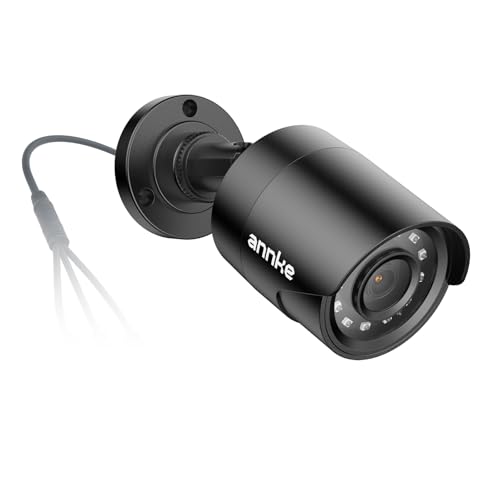
As a single add-on rather than a complete system, ANNKE E200 1080p 4-in-1 Bullet Camera is a 2MP, 1080p bullet camera with AHD, TVI, CVI and CVBS compatibility. Its infrared night vision is rated for up to 100 feet, according to ANNKE. This can suit someone expanding an existing compatible DVR installation without replacing the recorder. The important constraint is that the camera cannot work by itself: it needs a DVR connection, and a power adapter is not included. Check that your DVR supports one of its four signal formats before choosing it.
Bottom line: Pick this to add a compatible analog camera to an existing DVR setup.
ANNKE 4MP Dual-Lens Solar Camera

For a camera that pairs a fixed view with a remotely aimable view, ANNKE 4MP Dual-Lens Solar Camera has a 70-degree fixed lens and a second lens with 350-degree pan and 90-degree tilt. Its 9000mAh battery and included 4W solar panel make it distinct from plug-in models. ANNKE says its dual PIR sensors detect movement up to 26 feet away; the camera also supports 2.4GHz and 5GHz Wi-Fi. The limitation is that auto-tracking is not supported, so the movable lens does not automatically follow a subject. Solar performance also depends on usable daylight at the panel location.
Bottom line: Choose this when two lens views and solar charging suit the installation.
ANNKE 3K Pan/Tilt Wi-Fi Camera

For a single camera with remote conversation and automatic movement, ANNKE 3K Pan/Tilt Wi-Fi Camera provides 3K video, two-way audio, 350-degree pan and 90-degree tilt. ANNKE says its motion-tracking feature follows moving people, and the camera can trigger a light and sound alarm. Despite the wireless label, this model needs a power cable; wireless refers to its Wi-Fi or wireless-NVR connection. That makes it a better fit near an outlet than at a location where running power is difficult. Choose another model if solar power or a multi-camera kit is the priority.
Bottom line: Pick this for a powered Wi-Fi camera with talk and motion tracking.
ANNKE Solar PT 4-Camera NVR System
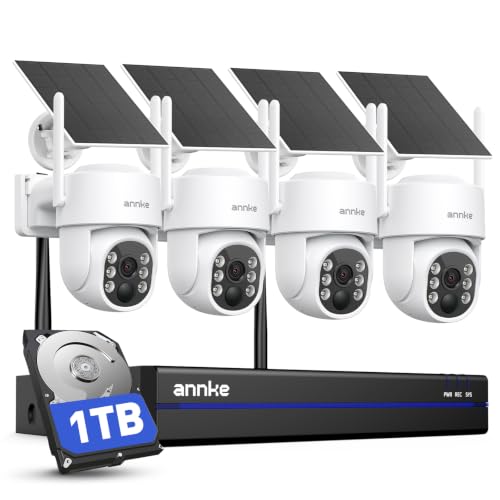
For several solar cameras managed together, ANNKE Solar PT 4-Camera NVR System starts with four 4MP cameras and a 10-channel NVR with a 1TB hard drive. The system can expand to 10 cameras, and ANNKE says footage stays on the local NVR without a cloud subscription. Its cameras support pan and tilt, human detection and two-way audio. Compared with ANNKE 4MP Dual-Lens Solar Camera, this is a multi-camera recorder system rather than a single dual-lens camera. Its trade-off is the larger setup: choose it for multiple views and local NVR storage, not for a simple one-camera installation.
Bottom line: Choose this for a multi-camera solar system with expandable local recording.
How to choose an ANNKE security camera setup
Choose first between a recorder-based system and a single camera, then match power and placement. A DVR or NVR centralizes recordings from multiple cameras; a single camera is simpler when only one view is needed. Wired analog cameras typically use coaxial video plus a separate power connection, while Wi-Fi cameras still need either a power cable or a battery/solar arrangement. For properties with several entry points, favor a recorder system with enough channels for planned expansion. For one view near an outlet, a plug-in Wi-Fi camera can avoid a recorder installation. Solar models need a location with adequate daylight on the panel; shade and seasonal sun angle affect charging. Before buying, map each camera’s view and confirm the recorder and camera connection types match.
Camera coverage, pan and tilt
Pan-and-tilt cameras can reposition a view, but their quoted movement range is not the same as simultaneous coverage in every direction. A fixed lens keeps one view pointed at a set area; a movable lens can turn toward another direction when controlled or, on some models, when tracking is enabled. A dual-lens design can retain a fixed view while providing a movable second view. Measure the scene and prioritize doors, gates and walkways rather than trying to cover every corner with one camera. Night vision also has limits: infrared footage is generally monochrome, while color night vision requires visible light or an illuminated scene. Camera resolution alone does not guarantee readable faces at a distance; lens angle and subject distance matter too.
Use this comparison to match a setup type to a practical need.
| Setup type | Good fit | Key constraint |
|---|---|---|
| Wired DVR kit | Several camera views and recorder storage | Route camera cabling |
| Single wired add-on | Expanding an existing DVR | Match signal format and provide power |
| Plug-in Wi-Fi PT camera | One outlet-accessible view | Power cable required |
| Solar camera or system | Locations where power wiring is difficult | Panel needs useful daylight |
Local recording and storage capacity
Local recorder storage keeps video on a drive rather than requiring a cloud account, but retention depends on camera count, resolution, frame rate, motion activity and compression. Continuous recording uses more space than event-triggered recording because footage is saved throughout the day. H.265-family compression can reduce storage use compared with older encoding, though the exact retention period still changes with settings and activity. A useful planning rule is to decide how many days of footage you want before selecting drive capacity; a busier scene or more cameras requires more space. Recorder channel count is also a hard limit on expansion, so leave spare channels if you expect to add cameras. Do not assume an NVR and DVR accept interchangeable camera signals.
Outdoor placement and safe installation
Install outdoor cameras where the intended scene is visible without placing the unit within easy reach. Check the mounting surface and keep cables protected from abrasion, water entry and trip hazards. IP ratings use two digits: the first rates dust protection and the second water protection under standardized conditions, but an outdoor rating does not make connectors or power supplies waterproof unless they are similarly protected. Avoid aiming directly at bright lights, which can wash out nighttime images, and test the view after mounting. Solar panels work best with sustained sun exposure and should not be hidden under eaves or dense shade. For powered models, use the compatible power equipment and keep mains connections dry; do not improvise outdoor electrical splices.
Frequently Asked Questions
Do ANNKE wireless cameras need a power cable?
Some do: the 3K pan/tilt model requires plug-in power even though its camera connection is wireless. Solar models use a battery and panel instead, so choose based on outlet access and sunlight at the mounting point.
Can an ANNKE 4-in-1 camera work without a DVR?
No, the E200 camera requires a DVR and a separate power adapter. Confirm the recorder supports AHD, TVI, CVI or CVBS before connecting it.
How much video can a 1TB security camera drive hold?
There is no fixed retention period because camera count, resolution, frame rate, motion and compression all change storage use. Continuous recording fills a drive faster than motion-triggered recording, so estimate retention using the settings you plan to run.
What does 360-degree camera coverage mean?
A pan-and-tilt camera can rotate to different directions, but a single movable lens does not record every direction simultaneously. A dual-lens camera can maintain a fixed view while its second lens moves, depending on its design.
Where should I place a solar security camera panel?
Place the panel where it receives sustained daylight rather than under an eaves shadow or dense tree cover. In the Northern Hemisphere, a south-facing position often receives more sun, but local obstructions and seasonal angle affect charging.