
Muslin Cloth for Cooking: 5 Options Compared

For most cooking tasks, Organic Cheese Cloth, 36-Inch Grade 100 is the most versatile choice because its 36-inch square Grade 100 weave is designed to strain with one layer. Choose smaller precut squares if compact pieces fit your recipe better, or an extra-fine sheet if repeated use and finished edges matter.
Muslin cooking cloth is a cotton fabric used to strain liquids, bundle ingredients, or wrap foods; its weave and size determine how it handles each job.
We earn a commission if you buy through links on this page. As an Amazon Associate I earn from qualifying purchases. Products are compared on manufacturer specifications, not hands-on testing.
- Best overall: Organic Cheese Cloth, 36-Inch Grade 100 – Its 36-inch square Grade 100 weave is specified at 56 × 41 threads per inch and is designed for one-layer straining.
- Best for fine straining: Cotton Farm Grade 100 XL, 36-Inch – This 36-inch Grade 100 sheet has a 46 × 54 thread-per-inch weave and overlocked edges.
- Best for batch prep: Six-Pack Grade 100, 20-Inch Squares – Six precut 20-inch squares provide multiple pieces for separate kitchen tasks.
| Product | Best for | Size | Pack count | Weave | Shop |
|---|---|---|---|---|---|
| Organic Cheese Cloth, 36-Inch Grade 100 | Versatile straining | 36 × 36 in | 1 | 56 × 41 threads/in | Check Price on Amazon |
| Cotton Farm Grade 100 XL, 36-Inch | Finished edges | 36 × 36 in | 1 | 46 × 54 threads/in | Check Price on Amazon |
| Six-Pack Grade 100, 20-Inch Squares | Multiple tasks | 20 × 20 in | 6 | Grade 100 | Check Price on Amazon |
| Precut Grade 100, 15-Inch Four-Pack | Compact portions | 15 × 15 in | 4 | Grade 100 | Check Price on Amazon |
| XelNaga Unbleached Cotton, 19.7-Inch Five-Pack | Everyday squares | 19.7 × 19.7 in | 5 | — | Check Price on Amazon |
Muslin Cloth for Cooking Options
Compare each cloth’s dimensions, count, and weave to match the fabric to your recipe and straining needs.
Organic Cheese Cloth, 36-Inch Grade 100
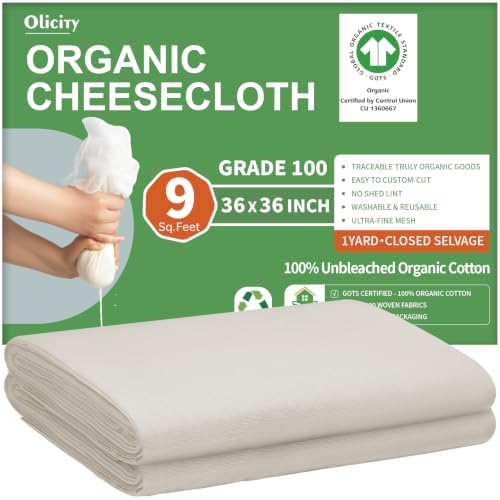
The 36-inch square format and Grade 100 weave distinguish this cloth: the maker gives a 56 × 41 thread count and says the tighter weave allows one layer for straining. Made from 100% organic cotton, it has closed edges and can be cut to a desired size. That combination suits cooks who want a large sheet for straining, spice bundles, or poultry wrapping. Its single-piece pack is less useful when you need several ready-to-use portions without cutting.
Bottom line: Choose this when a large sheet and one-layer straining are priorities.
Cotton Farm Grade 100 XL, 36-Inch

Overlocked edges set this 36-inch square apart, with stitching intended to resist fraying during repeated washing. The maker specifies an ultra-dense Grade 100 weave of 46 × 54 threads per inch and says the sheet is pre-washed. Its single-sheet size suits cooks who want a ready-to-use cloth for fine straining and repeated kitchen use. One sheet may be inconvenient when different jobs need separate cloths or when you need a smaller precut piece.
Bottom line: Pick this if edge finishing and a single large sheet suit your routine.
Six-Pack Grade 100, 20-Inch Squares

Six separate 20-inch squares make this pack the choice for cooks who want multiple cloths rather than one large sheet. Each piece is unbleached cotton with a Grade 100 fine mesh, and the maker identifies uses including juicing, nut milk, cooking, and baking. The precut size avoids trimming and makes it easier to reserve cloths for different jobs. The 20-inch square is smaller than the 36-inch options, so it offers less fabric for wrapping a large item or lining a broad vessel.
Bottom line: Choose the multipack when several medium-size cloths are more useful than one large sheet.
Precut Grade 100, 15-Inch Four-Pack

At 15 inches square, these four precut Grade 100 cloths are the most compact format here. The maker says the tighter weave is intended to catch fine particles during straining and that reinforced stitching helps limit shedding. Their smaller size suits individual portions, small bowls, or tasks where a broad sheet would be awkward. A 15-inch square gives less coverage than the 20- and 36-inch options, so it is not the natural pick for large batches or wrapping larger foods.
Bottom line: Pick these for compact straining jobs that do not need broad coverage.
XelNaga Unbleached Cotton, 19.7-Inch Five-Pack
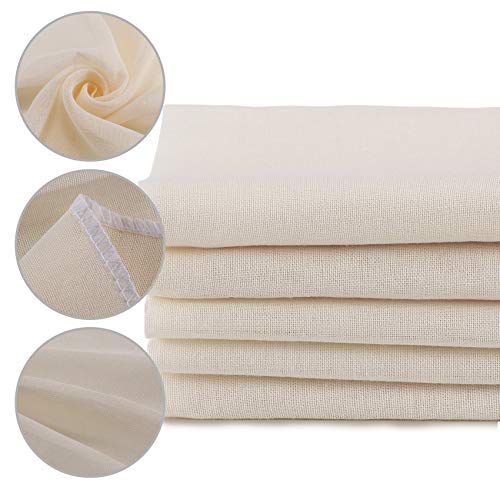
Five 19.7-inch squares offer a middle ground between compact pieces and large sheets. The cloths are 100% unbleached cotton, and the maker says the fabric is SGS-tested for food contact; the pack is intended for repeated washing and reuse. Their near-20-inch size suits everyday straining and kitchen prep when a few separate pieces are useful. The weave grade is not given, so cooks who need a defined fine-mesh specification should compare the Grade 100 options instead.
Bottom line: Choose this pack for reusable everyday squares when a specified weave grade is not essential.
How to choose muslin cloth for cooking
Choose by weave first for fine straining, then by sheet size and pack count. Grade 100 is a commonly used fine cheesecloth grade; the products here include maker-specified thread counts of 56 × 41 and 46 × 54 threads per inch. A tighter weave can retain finer particles but also slows liquid flow, so it may take longer to drain thick mixtures than a more open fabric. For a large batch or a wide bowl, a 36-inch square gives more coverage; for individual jobs, precut squares from 15 to about 20 inches are easier to handle. If your recipe calls for one layer, select a cloth whose maker identifies it for that use rather than assuming every muslin has the same weave.
Muslin cloth sizes and coverage
Size determines whether a cloth can line a vessel, hold a bundle, or cover a large food item. A 15-inch square is suited to small portions, while a 20-inch square gives more fabric for draining a bowl or forming a pouch; a 36-inch square is useful for broad coverage or trimming into smaller pieces. Leave enough cloth beyond the rim to grip and gather it without the food touching the outside edge. For a recipe needing a bundle, allow extra fabric above the ingredients so it can be tied securely. Washable cotton can shrink, so prewashing a new cloth before measuring or cutting helps avoid a poor fit.
Weave grades and straining speed
Weave openness controls both particle retention and drainage speed: finer fabric catches smaller solids but passes liquid more slowly. Grade 100 is the fine-weave designation on several options here, but the actual thread counts differ, so the grade alone does not establish an identical texture. Cheesecloth grades are not a universal substitute for a recipe’s specified straining method; compare the fabric description and use the layer count the recipe calls for. A practical rule is to use a fine single layer for small particles when the cloth is specifically described for that job, and avoid doubling it unless the recipe needs more filtration. Thicker mixtures may drain faster through a more open cloth.
| Task | Useful cloth format | Trade-off |
|---|---|---|
| Small portions | 15-inch square | Less coverage |
| Several separate jobs | Multiple 20-inch squares | Smaller than a large sheet |
| Broad coverage or trimming | 36-inch square | More fabric to handle |
Cleaning and safe handling
Rinse food residue from cotton straining cloth promptly, then wash thoroughly and dry it fully before storage; damp fabric can develop musty odors. Avoid leaving a used cloth bunched up overnight, especially after dairy or other perishable foods. Cotton can scorch or burn, so keep muslin away from open flames, heating elements, and direct contact with a hot burner. For poultry or other foods, use the cloth only as the recipe directs and prevent raw-food contact from spreading to ready-to-eat ingredients; wash hands and surfaces after handling. Retire fabric that is fraying, stained with persistent residue, or no longer cleans well, since loose threads and trapped food can undermine clean straining.
Frequently Asked Questions
Should cooking muslin be washed before first use?
Yes, wash and fully dry cotton muslin before using it with food. Prewashing can remove handling residue and lets you account for any shrinkage before cutting a large sheet.
Does a finer muslin cloth drain more slowly?
Usually, yes: a tighter weave retains smaller particles but reduces liquid flow. Thick mixtures also drain more slowly than thin liquids, so allow extra time rather than pressing hard and forcing solids through.
How large should a cloth be for straining?
A 15-inch square can handle small portions, while a 20-inch square gives more room to gather fabric around a bowl. For broad coverage or trimming to fit, a 36-inch square gives more working area.
Can cotton muslin go near a stove flame?
No, keep cotton muslin away from open flames and hot burners because cotton can scorch or catch fire. When using it to bundle herbs or spices, keep the cloth fully inside the pot and away from the heating element.
How should reusable cooking muslin be stored?
Store muslin only after washing and drying it completely. Keep it in a clean, dry place rather than leaving damp fabric folded, which can encourage musty odors.