
Manual Tire Changers for 20-Inch Rims: 4 Models

16–21-Inch Gear-Drive Tire Changer suits most buyers changing 20-inch rims because its 16- to 21-inch range includes that diameter and excludes smaller wheels. Choose a wider-range model if you also work on motorcycle or other small wheels; confirm that the changer’s mounting points suit your wheel design before buying.
We earn a commission if you buy through links on this page. As an Amazon Associate I earn from qualifying purchases. Products are compared on manufacturer specifications, not hands-on testing.
- Best overall: 16–21-Inch Gear-Drive Tire Changer – Its 16- to 21-inch range is centered on the requested 20-inch rim size.
- Best for broad wheel range: 4–21-Inch Steel Portable Tire Changer – Its 4- to 21-inch range covers both small wheels and 20-inch rims.
- Best for home garages: PreAsion 4–21-Inch Manual Changer – It covers 4- to 21-inch vacuum tires and uses a four-end lock for fixation.
| Product | Best for | Wheel diameter range | Weight | Shop |
|---|---|---|---|---|
| 16–21-Inch Gear-Drive Tire Changer | 20-inch wheels | 16–21 in | — | Check Price on Amazon |
| 4–21-Inch Steel Portable Tire Changer | Mixed wheel sizes | 4–21 in | 35 lb | Check Price on Amazon |
| PreAsion 4–21-Inch Manual Changer | Garage versatility | 4–21 in | — | Check Price on Amazon |
| YUQIPEILEI 4–21-Inch Steel Tire Changer | Frequent garage use | 4–21 in | 34 lb | Check Price on Amazon |
Manual Tire Changers for 20-Inch Rims
Compare the wheel ranges and construction details to choose a manual changer that fits your rims and workspace.
16–21-Inch Gear-Drive Tire Changer

16–21-Inch Gear-Drive Tire Changer is the focused choice for 20-inch rims, with a 16- to 21-inch capacity and a manual gear transmission that multiplies input force. Its wrench-style adjustment lets the operator change tightness with a lift-and-twist motion, and its use includes car, truck, trailer, SUV, and RV wheels. The gear mechanism is the distinguishing feature for buyers who want more leverage than a lever-only design. Its fit begins at 16 inches, so it is not the choice for smaller motorcycle or bicycle wheels.
Bottom line: Choose this if your work centers on 20-inch rims and larger wheels.
4–21-Inch Steel Portable Tire Changer

4–21-Inch Steel Portable Tire Changer combines a 4- to 21-inch wheel range with an integrated bead-breaker arm, making it the broadest documented fit for buyers who may switch between small wheels and 20-inch rims. The steel frame has a rust-resistant coating, and rounded contact surfaces are intended to reduce rim contact damage. Tire lubricant can reduce friction during the work. Its 35-pound weight is worth considering if the tool must be moved often; the wide size range alone does not guarantee fit for every wheel profile.
Bottom line: Pick this for varied wheel diameters when portability matters.
PreAsion 4–21-Inch Manual Changer

PreAsion 4–21-Inch Manual Changer covers 4- to 21-inch vacuum tires and uses a four-end lock to hold a tire in place. Its steel construction has a red coating intended to resist rust and corrosion, while the lever principle provides the mechanical force for manual operation. This broad range makes it a possible match for a garage handling both small tires and 20-inch rims. The base must be fixed during use, so buyers without a secure mounting surface should account for that setup requirement.
Bottom line: Choose this if you can secure the base and need a wide wheel range.
YUQIPEILEI 4–21-Inch Steel Tire Changer
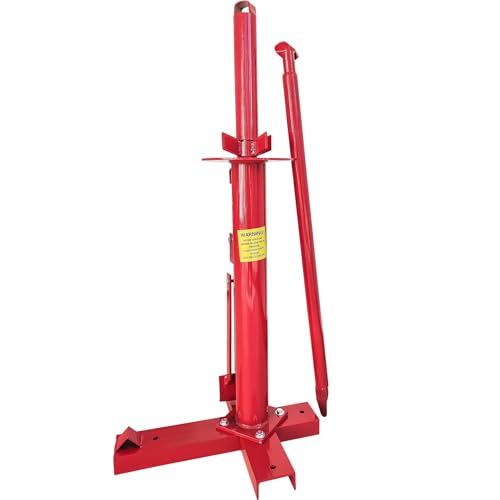
YUQIPEILEI 4–21-Inch Steel Tire Changer pairs a 4- to 21-inch range with a reinforced bead-breaker arm, so it covers 20-inch rims while also accommodating smaller wheels within its range. Its thickened steel construction and rust-resistant coating are intended for repeated garage or small-shop work, and rounded contact surfaces help limit direct rim and tire contact. The 34-pound weight makes moving it a consideration when the workspace is shared. A broad diameter range does not establish compatibility with every rim shape or mounting arrangement.
Bottom line: Pick this for a broad-size garage tool with a reinforced bead breaker.
How to Choose a Manual Tire Changer for 20-Inch Rims
Start with the wheel diameter range: a upper limit of 20 inches includes the target size, while a range ending at 16 inches does not. The wheel’s nominal diameter is the number after the R in a tire size such as 245/45R20; it refers to the rim’s bead-seat diameter, not the outside edge of the mounted tire. Also compare the changer’s contact and clamping arrangement with the wheel design, since diameter alone cannot establish fit. Manual tools use leverage or gearing rather than a motor, so a gear-driven mechanism can change the force applied without changing the wheel-size range. If you need one tool for several vehicle types, choose a range that includes every wheel diameter you plan to service.
What 20-Inch Rim Compatibility Means
A 20-inch wheel needs a changer whose specified wheel range includes 20 inches, but the number does not describe tire width or sidewall height. A tire marked 275/40R20 and one marked 245/45R20 share a 20-inch rim diameter while differing in width and sidewall proportions. Confirm the tire and wheel size markings before setup, and check how the tool secures the wheel rather than assuming every 20-inch rim has the same profile. A manual changer also does not balance the wheel; balancing is a separate operation performed after mounting. Avoid forcing a wheel into a tool whose adjustment or contact points do not align, because leverage can damage the tire bead or wheel finish.
Manual Tire Changer Types and Setup
Lever-only changers rely on the operator’s force through a handle, while a gear-drive changer adds mechanical advantage through gears. Either type still depends on stable anchoring and correct positioning: a moving base makes bead work harder to control. Secure the base to an appropriate firm surface where the model requires it, and use tire lubricant on bead-contact areas to reduce friction during mounting and removal. Keep the tool’s contact points aligned with the rim and tire bead; prying against the rim edge can mar the finish or pinch the tire. Manual tire changers are not inflation or wheel-balancing equipment, so plan those operations separately.
Safe Use and Common Tire-Changing Mistakes
Keep hands clear of pinch points between the lever, tire, and rim, and stop if the changer or wheel shifts under load. Do not assume that a wheel-size range guarantees compatibility with every wheel construction; unusual profiles and mounting arrangements can require a different tool. Use suitable tire lubricant rather than forcing a dry bead over the rim, since excess friction raises the chance of damage. Inflate a mounted tire only with a proper inflation setup and suitable restraints; tire beads can release suddenly during inflation. Never exceed the tire or wheel maker’s inflation limits, and do not use a manual changer as a substitute for balancing after installation.
Frequently Asked Questions
How do I tell whether a tire fits a 20-inch rim?
Read the tire-size marking: the number after R gives the rim diameter in inches, so R20 indicates a 20-inch rim. The other numbers describe tire width and sidewall proportion, not the rim diameter.
Does a manual tire changer balance a wheel?
No, mounting and balancing are separate jobs. After installing a tire, balancing equipment is used to identify and correct wheel-and-tire imbalance.
Why should I lubricate a tire bead during mounting?
Lubricant reduces friction as the bead moves over the rim, helping avoid forceful prying. Use lubricant intended for tire mounting, not oil or grease that may affect rubber.
Is it safe to inflate a tire while it is on a manual changer?
A tire changer is not an inflation restraint. Inflate with suitable equipment and keep clear of the tire’s path because a bead can release suddenly; stay within the tire and wheel makers’ pressure limits.