
Best Waterproof Bandages for Swimming: 4 Options Compared

Nexcare Waterproof Clear Bandages, Assorted is the best fit for most swimmers because its 360-degree seal protects minor wounds and the assorted sizes suit different locations. Choose Nexcare Waterproof Clear Bandages, Knee and Elbow instead for a larger knee or elbow cover, or Transparent Film Dressing, 4 x 4.75 in for a broad transparent film dressing.
Waterproof bandages are adhesive covers intended to seal around minor wounds during water exposure; they are not a substitute for avoiding swimming when a wound cannot stay fully covered.
We earn a commission if you buy through links on this page. As an Amazon Associate I earn from qualifying purchases. Products are compared on manufacturer specifications, not hands-on testing.
- Best overall: Nexcare Waterproof Clear Bandages, Assorted – Its 360-degree seal and assorted sizes work across several minor-wound locations.
- Best for knees and elbows: Nexcare Waterproof Clear Bandages, Knee and Elbow – The 2.38-by-3.5-inch cover is sized for larger joints.
- Best for flexible areas: Nexcare Max Hold Waterproof Bandages, 60 Count – The maker says it stays on for 48 hours and is designed for fingers, knees and heels.
| Product | Best for | Size | Count | Design | Shop |
|---|---|---|---|---|---|
| Nexcare Waterproof Clear Bandages, Assorted | Mixed wound sizes | Assorted sizes | 100 | Clear backing, nonstick pad | Check Price on Amazon |
| Nexcare Waterproof Clear Bandages, Knee and Elbow | Large joints | 2.38 x 3.5 in | 30 | Clear, 360-degree seal | Check Price on Amazon |
| Nexcare Max Hold Waterproof Bandages, 60 Count | Flexible locations | — | 60 | Flexible, clear | Check Price on Amazon |
| Transparent Film Dressing, 4 x 4.75 in | Broad transparent cover | 4 x 4.75 in | 30 | Transparent polyurethane film | Check Price on Amazon |
Waterproof Bandages for Swimming
Compare coverage shape and seal before choosing a bandage for a minor wound near the water.
Nexcare Waterproof Clear Bandages, Assorted

For a mix of minor wound locations, Nexcare Waterproof Clear Bandages, Assorted combines assorted sizes with a clear flexible backing and nonstick pad. The maker says its 360-degree seal protects against water, dirt and germs, and that the bandages conform to fingers, elbows and knees. The 100-count pack suits households that want several sizes on hand. Its limitation is that the package size range is not broken out here, so choose another option if a specific cover dimension is essential.
Bottom line: Choose this if you want assorted coverage sizes and a sealed pad.
Nexcare Waterproof Clear Bandages, Knee and Elbow

Unlike the assorted-size pack, Nexcare Waterproof Clear Bandages, Knee and Elbow specifies a 2.38-by-3.5-inch cover intended for knees and elbows. Its clear design and 360-degree seal are meant to protect cuts, scrapes and blisters from water, dirt and germs; the maker says it stays on in a bath, shower or pool. The 30-count pack is useful when larger joint coverage is the priority. Because it comes in one stated size, it may be too large for a small finger cut or too small for a broad scrape.
Bottom line: Pick this for a minor wound on a knee or elbow that needs a larger pad.
Nexcare Max Hold Waterproof Bandages, 60 Count
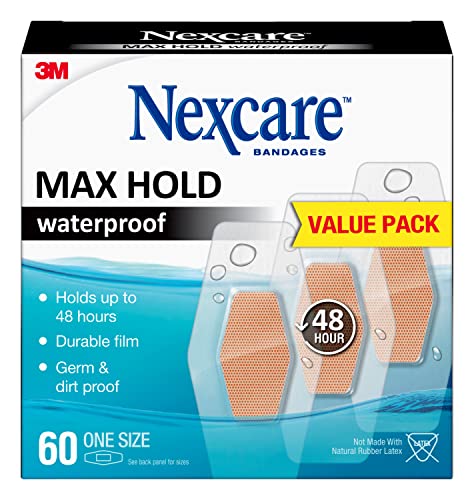
For fingers, knees and heels, Nexcare Max Hold Waterproof Bandages, 60 Count emphasizes flexibility rather than a wound-cover dimension. The maker says the bandages stay on for 48 hours; they are sterile and contain no natural rubber latex. The 60-count clear pack suits buyers who want a flexible option for areas that bend or rub. However, without a cover measurement in the specifications, this is less predictable for a wound that needs a particular pad size; match the bandage to the whole wound with a margin around it.
Bottom line: Choose this for flexible placement when its actual pad size suits the wound.
Transparent Film Dressing, 4 x 4.75 in

For broad, see-through coverage rather than a conventional small adhesive strip, Transparent Film Dressing, 4 x 4.75 in is a 4-by-4.75-inch transparent film dressing sold in a 30-count box. The maker describes the polyurethane film as breathable and waterproof for bathing, showering and swimming, and says the transparent design lets the covered area remain visible. That larger format may suit a broad area or secured equipment, but it can be awkward on a small finger or a curved joint. Make sure the wound is fully covered and the film seals to dry, intact surrounding skin.
Bottom line: Pick this when a broad transparent film cover fits the area.
How to choose waterproof bandages for swimming
Choose by wound area first, then by how completely the adhesive can seal around it. A waterproof cover needs to extend beyond the wound onto clean, dry, intact skin; a seal that crosses a crease or lands on damp skin is more likely to lift. For a small cut, a pad-style bandage is usually easier to position than a large film sheet, while a broad scrape may need a larger cover. Keep swimming to minor wounds that can be fully covered, and skip the water if the cover will not stay sealed. Pools use disinfectants, but pool water is not sterile, and a waterproof label is not a guarantee against leakage.
Replace a bandage if an edge lifts, water gets underneath, or the dressing becomes dirty. Clean the wound and dry the surrounding skin before applying a fresh cover; do not trap moisture or debris beneath adhesive.
Match bandage size to the wound location
A cover should extend beyond the wound on every side so adhesive can attach to unbroken skin. For a joint, place the pad over the injury with the joint relaxed, then check that bending does not pull the seal loose. A flat film dressing offers a larger area of coverage, but corners and folds can catch and peel. For fingers, heels and knees, flexible shapes can be easier to keep in place than a broad flat sheet.
The chart below connects common needs with the product formats; fit still depends on the actual wound dimensions and surrounding skin.
| Need | Format to consider | Fit check |
|---|---|---|
| Several wound locations | Assorted-size pad bandages | Confirm a size covers the entire wound |
| Knee or elbow | 2.38 x 3.5 in cover | Check seal while joint bends |
| Broad area | 4 x 4.75 in film dressing | Keep all edges on dry, intact skin |
Swimming with a covered minor wound
A waterproof bandage can reduce water contact, but no adhesive cover makes an open wound risk-free in a pool, lake or ocean. Do not swim if the wound cannot be completely covered or if the cover loosens. Natural water can contain germs, and pool disinfectant does not make water sterile. After swimming, remove a wet or lifted cover, rinse the wound with clean water, and apply a clean dressing if needed.
Do not use swimming as a reason to ignore worsening wound symptoms. Increasing redness, swelling, warmth, drainage or pain warrants medical advice, especially for a deep wound, bite, or wound that will not stop bleeding.
Frequently Asked Questions
Can waterproof bandages come off while swimming?
Yes, an edge can lift if the surrounding skin is damp, oily, hairy or curved. Apply the cover to clean, dry skin and leave a margin of adhesive around the wound; get out and replace it if water enters underneath.
Should I change a bandage after swimming?
Change it if it is wet underneath, dirty or peeling. Dry the skin and use a clean cover rather than sealing moisture under the adhesive.
Can I swim with a cut covered by a bandage?
Only consider swimming for a minor wound that can be completely covered and whose seal stays intact. Skip swimming if any part of the wound remains exposed or the bandage will not adhere securely.
How large should a waterproof bandage be?
The adhesive should reach intact skin around the entire wound, not just cover the injured center. A joint or broad scrape needs enough extra area to keep the seal from crossing the wound edge or a moving crease.
Are film dressings the same as bandages?
Film dressings are thin adhesive sheets that cover a larger area, while pad-style bandages combine a wound pad with adhesive around it. A large film can suit a broad flat area, but may be harder to seal over a small curved finger.