
Urea 40 Cream With Salicylic Acid: 4 Formulas Compared

For a 40% urea cream with 2% salicylic acid, VREKEF Urea Cream 40% is a focused foot-care option with glycerin and aloe, while Urea 40% Cream with 2% Salicylic Acid adds coconut oil and shea butter for broader dry-area use.
Choose OUKEYA Urea Cream 42% instead if you prefer 42% urea, or NUVADERMIS Urea Cream 40% if you want a cream also aimed at elbows, knees, and body areas.
We earn a commission if you buy through links on this page. As an Amazon Associate I earn from qualifying purchases. Products are compared on manufacturer specifications, not hands-on testing.
- Best overall: VREKEF Urea Cream 40% – Combines 40% urea and 2% salicylic acid with glycerin and aloe in a foot-focused formula.
- Best for hands and elbows: Urea 40% Cream with 2% Salicylic Acid – Targets hands, feet, and elbows and includes coconut oil and shea butter.
- Best for higher urea strength: OUKEYA Urea Cream 42% – Uses 42% urea with the same 2% salicylic acid concentration.
| Product | Best for | Urea | Notable ingredients | Shop |
|---|---|---|---|---|
| VREKEF Urea Cream 40% | Foot care | 40% | Glycerin, aloe, sucrose | Check Price on Amazon |
| Urea 40% Cream with 2% Salicylic Acid | Broad dry areas | 40% | Coconut oil, shea butter, aloe | Check Price on Amazon |
| NUVADERMIS Urea Cream 40% | Body and joints | 40% | Moisturizing ingredients | Check Price on Amazon |
| OUKEYA Urea Cream 42% | Higher urea level | 42% | Glycerin, camellia, peppermint, aloe | Check Price on Amazon |
Urea 40 Cream With Salicylic Acid Options
Compare the urea concentration, added ingredients, and intended use before choosing a formula for rough or dry areas.
VREKEF Urea Cream 40%

VREKEF Urea Cream 40% pairs 40% urea with 2% salicylic acid in a cream positioned for feet, including dry, cracked heels and calluses. The formula also includes glycerin, aloe vera, and sucrose, and the container holds 5.29 oz.
This choice suits someone looking mainly for a foot-care cream rather than a formula framed for several body areas. The product claims dermatologist testing, but the fields do not give a study protocol; buyers who need a specific testing standard should verify it before ordering. Urea and salicylic acid can irritate sensitive skin, so start with a small area.
Bottom line: Pick this if feet and rough heels are your main focus.
Urea 40% Cream with 2% Salicylic Acid

Urea 40% Cream with 2% Salicylic Acid stands out for naming hands, feet, knees, and elbows as its intended areas and including coconut oil and shea butter alongside aloe vera. The formula contains 40% urea and 2% salicylic acid in a 5.29 oz container, with a fast-absorbing, non-greasy feel claimed by the maker.
Choose it when you want one cream framed for several rough or dry areas, not just feet. Apply only as directed on the package, especially on irritated or broken skin.
Bottom line: Choose this for a multi-area routine with added oils.
NUVADERMIS Urea Cream 40%
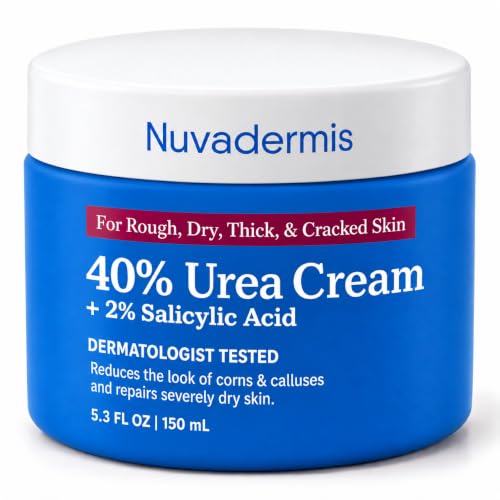
NUVADERMIS Urea Cream 40% combines 40% urea and 2% salicylic acid and names feet, hands, elbows, knees, body, and keratosis pilaris among its target uses. That broader range makes it distinct from the more foot-centered option, while its 5.3 oz size is slightly larger than the 5.29 oz containers in this group.
This is a better match for someone seeking a general rough-skin cream than a buyer who wants a clearly named botanical or oil blend. Avoid assuming the product is suitable for every body area; follow its package directions.
Bottom line: Pick this if you want a 40% formula for several body areas.
OUKEYA Urea Cream 42%

OUKEYA Urea Cream 42% is the only formula here with 42% urea; it also contains 2% salicylic acid and lists glycerin, camellia, peppermint, and aloe vera. The 5.29 oz cream is intended for areas including heels, hands, elbows, and knees, and the maker claims quick absorption without a greasy or sticky feel.
This suits shoppers specifically seeking a higher urea concentration than 40%. The difference is two percentage points, not a different salicylic acid strength. Peppermint extract may be unsuitable for some sensitive users, so check the ingredient label and test a small patch before broader use.
Bottom line: Choose this if 42% urea is your priority.
How to choose a urea cream with salicylic acid
For a 40% urea cream, first decide whether you need a foot-focused formula or one described for several dry areas. Urea is a humectant that attracts water and, at higher concentrations, also softens thickened outer skin; salicylic acid is a keratolytic that helps loosen scale. The 2% salicylic acid concentration is the same in all four options here, so compare urea percentage and added ingredients instead. With particularly sensitive skin, start with a small patch and stop if irritation develops. Do not apply keratolytic creams to open cracks, inflamed skin, or large areas without clinician guidance, as irritation and absorption can increase.
A useful decision rule is to choose 42% only if you specifically want the higher urea concentration; for a formula at exactly 40%, select among the three 40% options based on their ingredients and intended areas.
What 40% urea and 2% salicylic acid do
At 40% concentration, urea functions as both a moisture-binding ingredient and a strong softener for thick, rough skin; 2% salicylic acid helps loosen dead surface cells. These ingredients do not make a cream interchangeable with a moisturizer for everyday whole-body use. Concentrated keratolytics can sting or irritate, especially around cracks, cuts, or sensitive skin.
Use a small amount on a limited patch first, and keep the cream away from eyes and mucous membranes. People with diabetes, reduced sensation, or circulation problems should ask a clinician before self-treating thick foot skin: unnoticed irritation or injury can become serious. Do not scrape softened calluses aggressively, since removing too much skin can cause bleeding or infection.
Where to apply concentrated urea cream
Apply concentrated urea cream to the dry, thickened patch rather than spreading it over unaffected skin. A thin layer after washing and drying the area can reduce mess; avoid applying between toes, where trapped moisture can soften skin excessively. The products differ in the areas their makers emphasize, so use the intended areas as a guide and check the package directions.
For heels, close-fitting socks after application can help keep cream in place, but do not cover irritated skin or use occlusion unless the package permits it. If a crack is open, painful, or bleeding, do not put salicylic acid cream into it. Persistent pain, redness, swelling, or drainage merits medical attention rather than more exfoliating product.
Common mistakes with urea and salicylic acid
The most common mistake is treating a high-strength cream like an all-over daily lotion. Strong urea and salicylic acid are intended to soften rough patches, and more frequent or broader application can provoke burning, redness, or peeling. Follow the container directions and avoid layering it on the same patch with other exfoliants unless a clinician advises it.
Another mistake is using a blade or sharp tool after skin softens. A pumice stone used gently on intact skin is less risky, but stop if the skin becomes sore. A product marketed for calluses does not mean every thick spot is a callus; a new, changing, or painful lesion should be assessed instead of repeatedly treated at home.
Frequently Asked Questions
Can I use 40% urea cream every day?
Use frequency depends on the product directions and how your skin tolerates the formula. Because 40% urea with 2% salicylic acid can irritate, begin on a small rough patch and reduce or stop use if burning or redness appears.
Can I put urea cream on cracked heels?
Use it only on intact, dry skin around a heel crack, not inside an open or bleeding fissure. Deep or painful cracks may need clinician care rather than a salicylic acid cream.
How long does urea cream take to soften calluses?
Softening varies with callus thickness and how often the cream is used. Give a small area a few applications according to package directions, and do not cut or shave softened skin.
Is 42% urea much stronger than 40%?
The 42% formula has two percentage points more urea than a 40% formula, while the salicylic acid concentration here remains 2%. Choose based on the desired concentration and your skin’s tolerance, not the small numerical gap alone.
Can I use urea cream between my toes?
Avoid applying a concentrated cream between toes, where moisture can accumulate and soften skin too much. Keep application to dry, thickened areas such as intact heel or sole skin, following the package directions.