
Sound and Heat Insulation for Cars: 3 Mats Compared

For sound and heat insulation for cars, 394-Mil Closed-Cell Foam Mat is the closest match because it combines 394-mil thickness with a closed-cell foam thermal barrier. Choose KILMAT 80-Mil Butyl Mat instead when you mainly need a butyl sound-deadening layer, or Siless Liner 4 mm Foam for wider foam coverage.
We earn a commission if you buy through links on this page. As an Amazon Associate I earn from qualifying purchases. Products are compared on manufacturer specifications, not hands-on testing.
- Best overall: 394-Mil Closed-Cell Foam Mat – 394-mil closed-cell foam with a 10.8-square-foot sheet combines sound and heat insulation.
- Best for broad coverage: Siless Liner 4 mm Foam – Closed-cell foam comes in 36 square feet for larger-area thermal insulation.
- Best for sound deadening: KILMAT 80-Mil Butyl Mat – 80-mil butyl material is aimed at automotive sound and vibration damping.
| Product | Best for | Material | Thickness | Coverage | Shop |
|---|---|---|---|---|---|
| 394-Mil Closed-Cell Foam Mat | Combined insulation | Closed-cell foam | 394 mil | 10.8 sq ft | Check Price on Amazon |
| KILMAT 80-Mil Butyl Mat | Sound damping | Butyl and foil | 80 mil | 36 sq ft | Check Price on Amazon |
| Siless Liner 4 mm Foam | Large-area heat barrier | Closed-cell PE foam | 4 mm | 36 sq ft | Check Price on Amazon |
Sound and Heat Insulation Mats for Cars
Compare the insulation material, thickness and coverage to match a mat to your vehicle project.
394-Mil Closed-Cell Foam Mat

394-Mil Closed-Cell Foam Mat combines a thick closed-cell foam layer with an aluminum foil finish, making it the most direct fit here for someone seeking both sound and heat insulation. The 40-by-40-inch sheet covers 10.8 square feet, and the maker gives a working temperature range of -40°F to 300°F and claims it blocks 98% of radiant heat transfer. Its self-adhesive, waterproof construction suits targeted areas such as a hood or trunk. The main limitation is coverage: larger projects may need more material than this single sheet provides.
Bottom line: Choose this for a thick foam barrier on a limited area.
KILMAT 80-Mil Butyl Mat

KILMAT 80-Mil Butyl Mat is the butyl-based option, a different approach from the closed-cell foam mats: its purpose centers on sound deadening and audio noise insulation. The 80-mil material comes in 36 square feet and weighs 0.5 pound per square foot, so its coverage is suited to projects spanning multiple vehicle panels. The adhesive-backed sheets are intended for DIY installation and include an indicator to help judge application. It is thinner than the 394-mil foam options, so choose it for vibration and noise damping rather than as the thickest thermal layer.
Bottom line: Pick this when butyl sound damping and broad panel coverage matter most.
Siless Liner 4 mm Foam
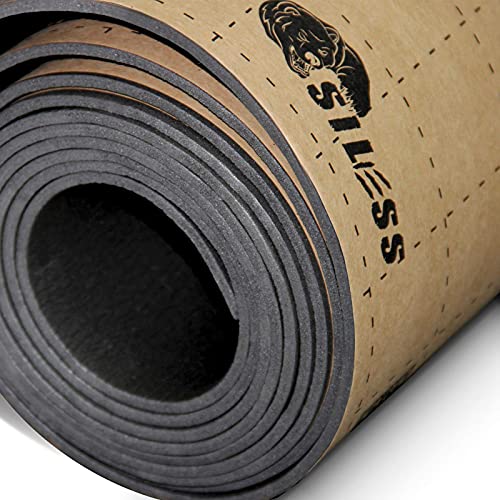
Siless Liner 4 mm Foam offers 36 square feet of closed-cell polyethylene foam, three times the coverage of 394-Mil Closed-Cell Foam Mat, for projects where a thermal liner needs to span more area. Its maker says the waterproof, oil-resistant foam blocks 98% of radiant heat transfer. The adhesive layer makes it a fit for insulating vehicle surfaces, and the weight is 2.6 pounds for the 36-square-foot amount. At 4 mm thick, this is a foam liner rather than a thick 394-mil mat, so it is less suited to buyers prioritizing substantial thickness.
Bottom line: Choose this for wide foam coverage when 4 mm thickness suits the job.
How to choose sound and heat insulation for cars
Start with the main job: butyl mats damp panel vibration, while closed-cell foam is commonly used as a thermal liner. A practical approach is to use a vibration-damping layer on resonant metal panels, then add a foam barrier where heat transfer is the concern. Coverage matters as much as material: measure each planned surface and add the areas before choosing a sheet, since the options here span 10.8 to 36 square feet. For broad vehicle projects, favor a package with more coverage; for a small targeted area, avoid paying in material weight and trimming waste for surface you will not cover.
Keep the install away from moving parts, wiring, airbag deployment paths, pedals, and latches. Do not cover drains or service access, and avoid material near exhaust or other hot components unless its temperature rating suits that location.
Where car insulation mats fit best
Car insulation mats are commonly placed on doors, floors, roofs, trunks, and firewall areas, but the substrate and nearby components decide what is appropriate. Metal panels that flex and resonate benefit most from damping; broad areas exposed to radiant heat may call for a separate thermal barrier. Hood installations need particular attention to temperature: engine-bay surfaces can get much hotter near exhaust parts than cabin-facing panels. Match the product’s temperature range to the actual location rather than assuming one mat suits every surface.
Measure usable flat areas rather than the outside dimensions of a panel. Cut templates from paper or cardboard around ribs and hardware, and leave clearance for clips, drains, and mechanisms. A smooth, clean, dry surface generally helps adhesive-backed material bond; oil, dust, and loose coatings can weaken adhesion.
Sound damping and thermal foam compared
Butyl sound-deadening sheets and closed-cell foam solve related but distinct problems. Butyl adds mass and helps reduce vibration in sheet metal; foam’s closed cells slow heat transfer and can also provide a barrier between surfaces. A single mat may not provide the same result as a layered system designed for both tasks. Material thickness alone is not a reliable comparison across different materials because composition and density affect how each behaves.
Use this need-to-material guide to narrow the choice before measuring coverage.
| Primary need | Material to consider | Planning point |
|---|---|---|
| Panel vibration | Butyl damping mat | Target resonant metal panels |
| Radiant heat barrier | Closed-cell foam | Confirm temperature suitability |
| Both goals | Layered approach | Keep fit and clearances intact |
Installation and safety checks for car insulation
Clean and dry the surface before applying adhesive-backed insulation, then press the material firmly into contact without trapping large air pockets. A hand roller can help conform a mat to shallow contours, but do not force thick material across sharp folds or over fasteners. Test-fit each cut piece first and keep seams and edges from interfering with trim, seat mounts, belt hardware, or door operation.
Before ordering, confirm the planned location’s temperature exposure and available clearance. Never install insulation where it can obstruct airbags, wiring access, drainage, controls, or ventilation, and do not bridge a gap that exists to prevent heat from reaching cabin materials. A mat is not a substitute for repairing a noisy, damaged exhaust or a failed weather seal.
Frequently Asked Questions
Does car sound insulation block engine heat?
Some closed-cell foam mats are intended to reduce radiant heat transfer, while butyl damping mats primarily address panel vibration and noise. Choose material according to the surface and its temperature exposure.
How much insulation do I need for a car?
Measure the usable surface areas in square feet and total them before selecting coverage. Add allowance for cutouts and mistakes, especially on contoured panels that require several smaller pieces.
Can I put insulation under a car hood?
Only use a material rated for the temperature at the intended location. Hood areas near exhaust components face more heat than cabin-facing panels, so check the product’s temperature range against that exposure.
How thick should car sound deadening be?
Thickness is only one part of sound damping; material composition and mass also matter. Use a butyl mat on resonant metal panels when vibration control is the priority, rather than choosing by thickness alone.
Can car insulation cover airbag areas?
No. Keep insulation clear of airbag deployment paths, wiring, controls, drains, and moving parts, since obstruction can interfere with safe operation.