
Element Fire Extinguisher: Safety Tools Compared

For a compact Element fire safety tool, Element E50 Safety Stick suits buyers who want a portable stick with extended discharge; Element CAL50-FST is the alternative when a 50-second discharge is the deciding factor.
Choose a conventional extinguisher instead if you need a clearly marked UL fire-class rating for a specific hazard; AmzBoom 3-Pack Spray is a spray alternative, not an Element product.
We earn a commission if you buy through links on this page. As an Amazon Associate I earn from qualifying purchases. Products are compared on manufacturer specifications, not hands-on testing.
- Best overall: Element E50 Safety Stick – The compact stick design and extended-discharge positioning suit general portable preparedness.
- Best for stated duration: Element CAL50-FST – Its product name gives a specific 50-second discharge claim.
- Best for multiple locations: AmzBoom 3-Pack Spray – The pack contains three sprays and mounting brackets.
| Product | Best for | Discharge claim | Package count | Format | Shop |
|---|---|---|---|---|---|
| Element E50 Safety Stick | Portable preparedness | Extended; no duration given | 1 pack | Solid-state stick | Check Price on Amazon |
| Element CAL50-FST | Longer stated discharge | 50 seconds | — | Safety tool | Check Price on Amazon |
| AmzBoom 3-Pack Spray | Multi-spot access | — | 3 sprays | Aerosol spray | Check Price on Amazon |
Element Fire Extinguisher Tools Compared
Compare the product formats and stated discharge claims before choosing a tool for a specific fire risk.
Element E50 Safety Stick

Unlike the aerosol spray and the model with a specific duration claim, this Element option is a slim, solid-state stick. The maker says it offers extended discharge compared with compact models, but gives no number here, so buyers who need a timed discharge should compare that claim carefully. The maker also says it has no pressurized canister and is intended for storage in places such as vehicles, workshops, boats, garages, and homes. Its compact form may suit general preparedness; buyers who need a marked fire-class rating for a particular hazard should verify the tool’s rating before choosing.
Bottom line: Choose this for a portable, solid-state safety stick when a specific discharge time is not essential.
Element CAL50-FST
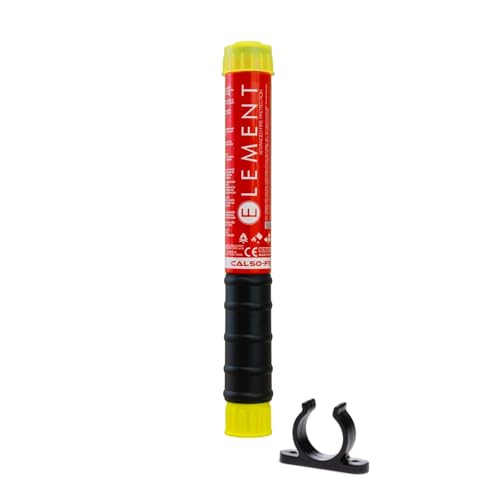
The CAL50-FST stands apart with a specific 50-second discharge claim, unlike the other Element stick’s unquantified extended-discharge positioning. The maker says it is a clean-agent tool for common household and vehicle risks, including cooking oil, grease, electrical, and liquid-based emergencies, and claims it leaves no residue and needs no maintenance or inspections. Its dimensions are 10.75 × 0.6 × 0.6 inches and its weight is about 0.51 lb. The small size suits compact storage, but buyers who need a conventional extinguisher with a defined UL class rating should confirm that rating before selecting it.
Bottom line: Choose this when the 50-second discharge is the key distinction you want.
AmzBoom 3-Pack Spray

Unlike the two Element sticks, this is a three-canister aerosol set with mounting brackets. The maker says the water-based formula is intended for kitchen grease, wood, gasoline, and lithium-ion battery fires, and describes it as residue-free; those are maker claims, not a substitute for checking the fire class and instructions on the actual unit. Three sprays can support placement in separate locations, while the included brackets are useful where fixed access matters. This is a partial match for someone seeking an Element tool, and anyone choosing by fire class should verify the label for the specific hazard.
Bottom line: Choose this only if a three-spray set with brackets fits your needs better than an Element stick.
How to choose a fire extinguisher tool
Choose by the fuel involved and the tool’s marked fire-class rating, not by compactness alone. In the US, Class A covers ordinary materials such as wood and paper, Class B covers flammable liquids, and Class C applies to energized electrical equipment; Class C does not identify a separate fuel. A multipurpose ABC extinguisher is a common household choice, while cooking oils and fats call for Class K equipment in commercial kitchens. A small portable tool may fit a glovebox or drawer, but check whether its label covers the hazard you face. If the fire is spreading, the room is filling with smoke, or your exit is threatened, leave and call emergency services rather than attempting suppression.
What fire classes mean for home and vehicle use
Fire classes describe the material burning, so one tool is not automatically suitable for every fire. Class A is for ordinary combustibles, Class B for flammable liquids, and Class C for energized electrical equipment; once power is disconnected, the remaining fuel determines the class. Class K equipment is designed for cooking oils and fats, and a grease fire should never be doused with water because splashing can spread burning oil. Lithium-ion battery fires present a special hazard: a small device can reignite after flames are knocked down, so evacuate and call emergency services if a battery is smoking, swelling, or burning. Use a product’s specific label to confirm coverage rather than relying on broad wording.
How to use a portable extinguisher safely
Use PASS—Pull the pin, Aim at the base, Squeeze the handle, and Sweep side to side—only on a small, contained fire with a clear exit behind you. Keep several feet between yourself and the flames as you start, then move closer only if the fire is shrinking. Smoke can disable a person quickly, so do not enter a smoke-filled room or turn your back on an active fire to retrieve equipment. An extinguisher can run out before a fire is controlled; stop if the flames grow, spread, or block the exit. For a kitchen grease flare-up, turn off the heat only if safe, cover a pan with a metal lid, and never carry a burning pan.
How to store and maintain fire equipment
Store a fire tool where it can be reached quickly and where heat, impact, or corrosion are unlikely to damage it. Conventional pressurized extinguishers should be checked regularly for a readable label, damage, leakage, and pressure-gauge position; follow the inspection and servicing schedule on the unit, since service requirements depend on its type and jurisdiction. Keep the path to the tool clear, and make sure household members know the exit route as well as the tool’s location. A claim such as no maintenance or no expiry is specific to a product; do not apply it to other extinguisher types. Replace or service conventional equipment after discharge, even if only a small amount was used.
Frequently Asked Questions
What does an ABC extinguisher cover?
An ABC extinguisher is rated for ordinary combustibles, flammable liquids, and energized electrical equipment. It is not a Class K rating for commercial cooking oils, so kitchens with deep fryers need equipment selected for that hazard.
Can a fire extinguisher stop a lithium-ion battery fire?
A portable extinguisher may knock down visible flames, but a lithium-ion battery can reignite as damaged cells continue to heat. If a battery smokes, swells, or burns, evacuate and call emergency services rather than staying to fight it.
How far away should I stand when using an extinguisher?
Start several feet from a small fire and aim at its base, keeping a clear exit behind you. Move closer only if flames are shrinking; retreat immediately if heat, smoke, or spreading fire makes the exit uncertain.
What does Class C mean on an extinguisher?
Class C means the extinguisher is suitable for energized electrical equipment. It is not a fuel category; after power is disconnected, the burning material determines whether another class applies.
Should I use water on a grease fire?
No: water can spread burning cooking oil through splashing. If a pan fire is small and safe to approach, turn off the heat if possible and cover it with a metal lid; otherwise leave and call emergency services.