
Hemming Foot for Sewing Machine: 4 Sets Compared

For most lightweight rolled hems, ZXIIXZ 3-Size Rolled Hem Foot Kit is a practical starting choice because it includes three narrow sizes: 3, 4, and 6 mm. Choose a different set if you need wider hems, a broader size range, or extra needles.
A rolled hem foot curls the fabric edge as you sew, helping form a narrow finished edge without folding the full hem by hand.
We earn a commission if you buy through links on this page. As an Amazon Associate I earn from qualifying purchases. Products are compared on manufacturer specifications, not hands-on testing.
- Best overall: ZXIIXZ 3-Size Rolled Hem Foot Kit – Three narrow sizes—3, 4, and 6 mm—cover common lightweight rolled hem widths.
- Best for wide hems: Six-Size Wide and Narrow Hem Foot Set – Includes three wide sizes from 1/2 to 1 inch alongside three narrow sizes.
- Best with needles: Lunarm 6-Foot Set with 30 Needles – Combines six narrow and wide hem feet with 30 universal needles.
| Product | Best for | Hem sizes | Compatibility | Material | Shop |
|---|---|---|---|---|---|
| ZXIIXZ 3-Size Rolled Hem Foot Kit | Lightweight narrow hems | 3, 4, 6 mm | Household low-handle machines | Stainless steel | Check Price on Amazon |
| Six-Size Wide and Narrow Hem Foot Set | Wide hem options | 3–6 mm; 1/2–1 in | Low-shank; Brother, Singer, Janome | — | Check Price on Amazon |
| Five-Size 6–10 mm Rolled Hem Foot Set | Medium-width hems | 6, 7, 8, 9, 10 mm | Most home and industrial machines claimed | Stainless steel | Check Price on Amazon |
| Lunarm 6-Foot Set with 30 Needles | Feet plus needles | 3, 4, 6 mm; 4, 6, 8 mm | Household low-shank machines | Stainless steel | Check Price on Amazon |
Hemming Feet for Sewing Machines
Compare hem widths and attachment fit before choosing a presser-foot set.
ZXIIXZ 3-Size Rolled Hem Foot Kit
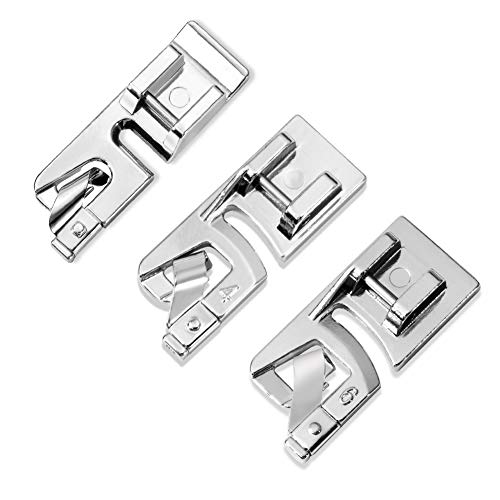
Three narrow widths make this set a straightforward choice for lightweight fabric edges that call for small rolled hems. The feet are stainless steel, and the set is intended for household machines with a low-handle attachment. It suits projects where a narrow finish matters more than a wide hem range. The use is thin fabric, so choose another option if your work needs wider hems or heavier material; matching the foot to the machine’s attachment style is also important before sewing.
Bottom line: Pick this set for lightweight fabric and narrow 3–6 mm rolled hems.
Six-Size Wide and Narrow Hem Foot Set

This set is the one to consider when a narrow hemmer alone will not cover the project: it pairs 3, 4, and 6 mm narrow feet with wide feet measuring 1/2, 3/4, and 1 inch. The maker says the feet suit low-shank domestic machines, including Brother, Singer, and Janome models, and help keep the hem in place while sewing. That range supports more hem widths than the narrower kits. Its compatibility claim is for low-shank machines, so owners of another attachment type should confirm the fit before ordering.
Bottom line: Choose this set when you need both narrow and wide rolled hem widths.
Five-Size 6–10 mm Rolled Hem Foot Set

Unlike the smaller-width kits, this set covers five sizes from 6 through 10 mm, making it relevant when a 3 or 4 mm hem would be too narrow. The maker describes it as stainless steel and says it fits most home and industrial sewing machines when the needle plate has one mounting-screw hole; the mounting screw is not included. That attachment condition is a key limitation: do not assume the broad compatibility wording means it fits every machine. Verify the plate and screw arrangement before choosing this set.
Bottom line: Pick this set if your project needs a 6–10 mm hem and its mounting arrangement matches.
Lunarm 6-Foot Set with 30 Needles

This bundle adds 30 universal needles to six rolled hem feet, so it differs from foot-only sets by including replacement needles in sizes 75/11, 90/14, and 100/16. Its feet span narrow sizes of 3, 4, and 6 mm and wide sizes of 4, 6, and 8 mm. The maker says the feet suit household low-shank machines, and the feet are stainless steel. The range tops out at 8 mm, so it does not cover the 1-inch wide hem option found in another set.
Bottom line: Choose this bundle if you want a mixed-width foot set and universal needles.
How to Choose a Hemming Foot Size
Choose a rolled hem foot by the finished hem width, not just by the word “universal.” Narrow sizes such as 3, 4, and 6 mm suit small rolled edges; wider options measured in fractions of an inch make a broader finish. Match the foot opening to the fabric and the look you want: a foot that is too small can crowd thicker fabric, while a wide hemmer can make a delicate edge look bulky. For lightweight fabric and a hem under 6 mm, start with a narrow foot; for a finish of 1/2 inch or more, choose a set that includes wide sizes. Test the fold on a fabric scrap before sewing the finished piece.
Check Sewing Machine Foot Compatibility
Presser-foot attachment style determines whether a hemmer will mount securely, so confirm the machine’s shank or mounting arrangement before choosing. Low-shank household feet are common, but a low-shank claim does not establish fit for every machine model. Some feet use a screw-mounted arrangement; the five-size set here calls for a single hole in the needle plate and does not include its mounting screw. Compare the attachment point on your machine with the foot’s fit, then install it with the needle raised and the machine off. If the needle does not clear the foot opening when turned by hand, stop rather than stitching; needle-to-foot contact can break a needle.
Narrow and Wide Rolled Hemmers Compared
Narrow and wide hemmers both curl an edge, but their intended finished widths differ. Narrow feet in the 3–6 mm range are aimed at delicate, lightweight edges; wide feet in 1/2–1 inch sizes are for noticeably broader finishes. Intermediate sizes such as 6–10 mm fill the space between. The right size depends on fabric weight, edge shape, and the finished look, not on the machine brand alone. Use this guide to match the width you want to the kind of foot supplied.
| Need | Foot size to consider | Fit check |
|---|---|---|
| Very narrow edge | 3–4 mm | Confirm attachment style |
| Narrow-to-medium edge | 6–10 mm | Check foot opening and mounting |
| Broad edge | 1/2–1 inch | Confirm low-shank fit if specified |
Prepare Fabric for a Rolled Hem
Rolled hem feet work most predictably on lightweight fabric with an even, clean edge. Thick seams, bulky layers, and abrupt curves can resist feeding through the curl, so avoid placing a seam allowance directly inside the foot’s forming channel. Start with a straight edge and test on a scrap cut from the project fabric; adjust the fabric feed gently rather than pulling from behind the needle. These feet form the edge as the machine sews, but a scrap test still helps reveal whether the fabric thickness and selected width produce a smooth roll. Keep fingers clear of the needle and turn the handwheel manually when checking clearance.
Frequently Asked Questions
What fabric works best with a rolled hem foot?
Lightweight fabric is the intended use for the narrow feet in these sets. Test a scrap first, especially where the fabric has a thick seam or several layers, because bulk can prevent the edge from feeding smoothly.
Can a rolled hem foot sew curved edges?
A gentle curve may feed through, but tight curves are harder because the foot curls the edge as it advances. Use short, controlled sections on a scrap and avoid pulling the fabric sideways near the needle.
How do I know if a hemmer fits my machine?
Check the machine’s presser-foot attachment style against the set’s fit claim; low-shank feet do not automatically fit every machine. For a screw-mounted design, confirm the plate and mounting arrangement and that the required screw is available.
Should I use a rolled hem foot on thick fabric?
Narrow rolled hem feet in these sets are intended for lightweight fabric, so thick layers may not pass cleanly through the curl. Test the exact fabric and seam bulk on a scrap before sewing the garment.
Why does fabric bunch under a rolled hem foot?
Bunching can happen when the edge is too bulky, uneven, or not feeding into the foot’s curl. Begin with a clean edge, test on a scrap, and guide the fabric without pulling it from behind the needle.