
A8 Original Sound Transmitter: Guitar System Alternatives

The WENTELMUSIC A8 is the closest match for an A8 original sound transmitter, with a 2.4GHz guitar system, under-4ms latency, and up to 100 feet of range.
We earn a commission if you buy through links on this page. As an Amazon Associate I earn from qualifying purchases. Products are compared on manufacturer specifications, not hands-on testing.
- Best overall: WENTELMUSIC A8 Guitar System – A2.4GHz A8 system for electric guitar and bass with under-4ms latency and up to 100 feet of range.
- Best for pickup modes: INGPARTNER A8 UHF Guitar System – Offers active and passive pickup modes and up to four hours of playtime.
- Best for a rotating plug: A9 2.4GHz Guitar System – The A9 model has a 270-degree rotatable plug for instrument connections.
| Product | Best for | Instrument fit | Wireless band | Maximum range | Shop |
|---|---|---|---|---|---|
| WENTELMUSIC A8 Guitar System | A8 guitar match | Electric guitar, bass | 2.4GHz | 100 ft (open area) | Check Price on Amazon |
| INGPARTNER A8 UHF Guitar System | Pickup mode choice | Guitar, bass, violin, keyboard | UHF | 100 ft | Check Price on Amazon |
| A9 2.4GHz Guitar System | Rotatable plug | Electric/acoustic guitar, bass | 2.4GHz | 100 ft (open area) | Check Price on Amazon |
A8 original sound transmitter options
Compare these transmitters by intended source, wireless band, and range before choosing for your setup.
WENTELMUSIC A8 Guitar System
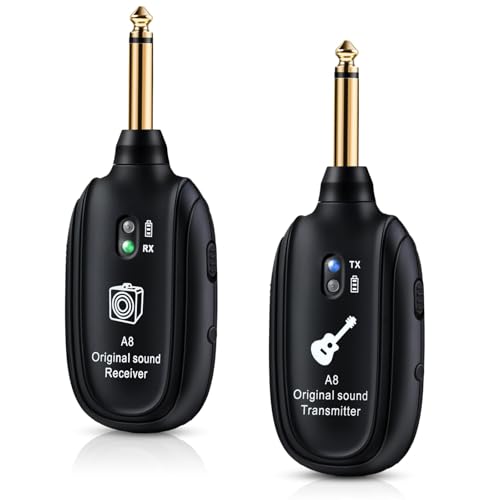
The WENTELMUSIC A8 is the closest match for an A8 guitar transmitter and receiver set, with a 2.4GHz band, 24-bit/48kHz audio, and latency under 4ms. Its 1TX+1RX setup is intended for electric guitar and bass, and the maximum range is 100 feet. Choose it when an A8 label and guitar/bass use matter more than alternate pickup modes. The range is a maximum, not a guarantee through walls or in crowded wireless environments, so it is a less suitable choice when the signal path is congested.
Bottom line: Pick this for an A8-branded system for electric guitar or bass.
INGPARTNER A8 UHF Guitar System

The INGPartNER A8 separates itself with selectable active and passive pickup modes, alongside a UHF wireless system for guitar, bass, violin, keyboard, and other electric instruments. Its 1TX+1RX pair auto-pairs, has a range of 100 feet, and provides up to four hours of playtime on a 1.5-hour charge. This is a practical match if pickup mode selection and broader instrument use are central to the setup. The runtime is shorter than a long session, so players expecting more than four hours between charges should plan a recharge.
Bottom line: Choose this when pickup-mode switching is important.
A9 2.4GHz Guitar System

The A9 is a related model rather than an A8, and its distinguishing feature is a 270-degree rotatable plug. It uses 2.4GHz transmission, has under-4ms latency, and reaches a maximum of 100 feet in open areas; the rechargeable battery provides up to four hours of use. Its instrument range includes electric and acoustic guitar and bass. Choose it if plug angle matters more than matching the A8 model name. The manufacturer advises against use on large stages or amid heavy Wi-Fi/Bluetooth congestion, limiting its fit for those environments.
Bottom line: Pick this when a rotatable connector matters more than the A8 name.
How to choose an A8 guitar transmitter
Start by matching the transmitter to the instrument and its output jack, then compare band, range, latency, and runtime. Guitar systems plug directly into the instrument and pair a transmitter with a receiver; they are not interchangeable with TV Bluetooth adapters. The two A8 systems here differ in band and pickup-mode options, while the related A9 adds a rotating connector. A 100-foot maximum generally describes open-area conditions, not a reliable indoor distance through walls. For practice or a small room, prioritize the instrument fit and connection layout; for a busy wireless venue, confirm the operating band and local signal conditions before relying on a 2.4GHz system.
UHF and 2.4GHz guitar systems
UHF and 2.4GHz identify different radio bands, but neither alone guarantees a cleaner signal in every room. 2.4GHz shares spectrum with common Wi-Fi and Bluetooth devices, so congestion can reduce reliability; UHF systems also depend on local radio conditions and compatible equipment. A guitar wireless set needs both a transmitter at the instrument and a receiver at the amp or other audio input. Compare the actual system features—such as pickup modes, frequency band, latency, and stated range—rather than choosing by the band label alone. A product’s claimed maximum range is best treated as an open-space ceiling; walls, bodies, and nearby radio activity can shorten usable distance.
Use this distinction to eliminate a wrong-purpose device before comparing guitar features.
| System type | Typical source | Destination |
|---|---|---|
| Instrument transmitter/receiver | Electric instrument output | Amplifier or audio input |
| TV Bluetooth transmitter | TV audio output | Bluetooth headphones or speakers |
Check instrument fit and connector layout
Instrument compatibility comes first because wireless guitar systems connect at the instrument’s output jack, not through a generic Bluetooth pairing process. Check that the plug shape and orientation clear the instrument body, strap, and nearby controls; a rotatable plug can help where a straight connection crowds the surface. The A8 options are described for guitar and bass, while the INGPartNER model also names violin and keyboard. Acoustic instruments need a compatible pickup or output to feed a wireless set; a wireless system does not create an instrument signal on its own. Confirm the jack and pickup setup before ordering if your instrument uses an unusual connector or active electronics.
Plan runtime and radio conditions
Battery runtime affects whether a compact wireless set can cover a rehearsal or performance without interruption. One system here states up to four hours of operation, so a session longer than four hours requires a charging break or another charged option. Radio range is also conditional: the A9’s manufacturer cautions against large stages and heavy Wi-Fi/Bluetooth congestion, and open-area maximums should not be treated as indoor guarantees. Keep the transmitter and receiver within a clear path when possible, and avoid placing the receiver behind dense obstacles. Before a live set, check the connection in the actual room and allow time to address interference or a depleted battery.
Frequently Asked Questions
Can a guitar wireless transmitter connect to a TV?
A guitar transmitter/receiver system is designed to carry an instrument output to an audio input, not to send TV audio to Bluetooth headphones. TV transmitters use TV audio connections and Bluetooth output instead. Match the device type to the source and destination.
Does a 100-foot range work through walls?
A 100-foot maximum is an open-area figure and does not guarantee the same distance indoors. Walls, people, and wireless congestion can reduce the usable range, so test the path with the receiver in its intended position.
What does under 4ms latency mean for guitar?
Latency is the delay between playing a note and hearing its transmitted signal; under 4ms is a short delay specification. Monitoring through additional digital effects or equipment can add delay beyond the wireless link itself.
How long should a rechargeable guitar system last per charge?
The A8 and A9 systems here state up to four hours of operation. Plan for charging before longer sessions, since actual use time can depend on operating conditions.
Can a wireless guitar system work with an acoustic guitar?
An acoustic guitar needs an output signal, usually from a pickup, for a transmitter to carry. The A9 is described for acoustic guitar, but confirm your instrument has a compatible output jack before choosing a system.