
Wireless Solar Cab Lights for Trucks Compared

For wireless solar cab lights for trucks, choose Solar RGB Strobe Cab Lights, 5-Piece if remote and app controls matter most alongside solar and USB-C charging. Choose a different set if you want a nighttime runtime or a specific LED count; these roof marker lights mount without wiring, but adhesive fit depends on a clean, flat surface.
We earn a commission if you buy through links on this page. As an Amazon Associate I earn from qualifying purchases. Products are compared on manufacturer specifications, not hands-on testing.
- Best overall: Solar RGB Strobe Cab Lights, 5-Piece – Combines solar and USB-C charging with remote and app controls.
- Best for stated runtime: Solar Roof Markers, 12 Amber LEDs – Claims up to 9 hours of nighttime illumination and specifies 12 amber LEDs.
- Best for repositioning: Solar RGB Strobe Signal Lamps, 5-Piece – Its maker describes a detachable base for repositioning.
| Product | Best for | Set size | Charging | Notable feature | Shop |
|---|---|---|---|---|---|
| Solar RGB Strobe Cab Lights, 5-Piece | App and remote control | 5 lights | Solar, USB-C | Remote and app control | Check Price on Amazon |
| Solar RGB Strobe Signal Lamps, 5-Piece | Repositionable base | 5 lights | Solar, USB-C | Motion sensor | Check Price on Amazon |
| Solar Roof Markers, 12 Amber LEDs | Amber LED output | — | Solar, backup battery | 12 amber LEDs | Check Price on Amazon |
Wireless Solar Cab Lights for Trucks
Compare the charging options and distinguishing features before choosing a roof marker set.
Solar RGB Strobe Cab Lights, 5-Piece

Remote and app control set this five-piece RGB strobe kit apart from the other choices. The maker says it charges by solar panel or USB-C and includes a motion vibration sensor and an IP67 waterproof rating. Its lights measure 4.12 inches long, 2.12 inches wide and 1.57 inches high. The adhesive-and-detachable-base setup is intended for a no-drill install, which suits buyers who want to avoid wiring or roof holes. Its RGB strobe style may not suit someone seeking conventional amber marker lamps, and adhesive mounting requires a suitable clean, flat surface.
Bottom line: Pick this set if app and remote control are priorities and RGB styling suits your truck.
Solar RGB Strobe Signal Lamps, 5-Piece

A detachable base that can be repositioned is the distinguishing feature of this five-piece RGB strobe set. The maker says the lights use solar charging with USB-C backup, have a motion vibration sensor and carry an IP67 waterproof rating. Remote and app controls are also included. Each lamp measures 4.13 inches long, 2.16 inches wide and 1.57 inches high. This set suits buyers who want wireless installation and the option to reposition the base; its RGB strobe appearance is not the conventional amber look used for many marker lamps. Check that the roof surface supports adhesive mounting before choosing it.
Bottom line: Choose this set if repositioning the base matters more than having a runtime or LED count.
Solar Roof Markers, 12 Amber LEDs
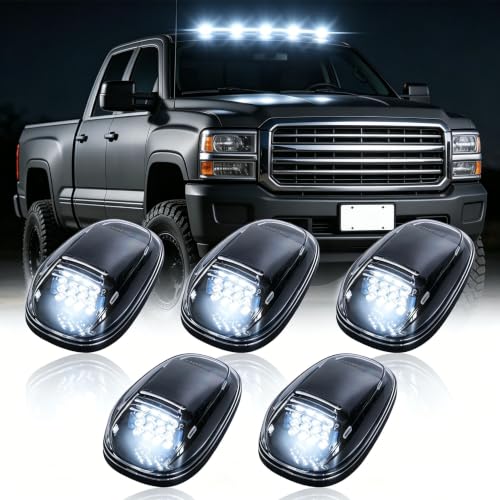
Twelve amber LEDs and a maker-claimed runtime of up to 9 hours at night distinguish this roof marker set. The maker says a built-in backup battery supplies nighttime illumination and a vibration sensor turns the lights on with movement, then shuts them off 2–5 minutes after stopping. The product is described as a no-drill adhesive mount for flat roof surfaces. It suits buyers seeking amber light rather than RGB strobes. Unlike the other two sets, its maker does not describe USB-C charging or remote and app controls, so those seeking either should consider a different option.
Bottom line: Pick this set if amber LEDs and a nighttime runtime are the deciding features.
How to Choose Wireless Solar Cab Lights
Choose by light purpose first: decorative RGB strobes and amber marker lamps are not interchangeable for compliance. For a truck at least 80 inches wide, federal lighting rules generally call for front clearance lamps and three front identification lamps, with amber at the front; a decorative solar set should not be assumed to satisfy those requirements. Compare the charging method, controls, color and mounting approach, then verify whether the lamps are approved for the intended road use. Solar charging also depends on direct sunlight and roof exposure, so a shaded parking spot can make a solar-only setup less convenient. If you need regulated marker or identification lighting, select equipment specifically compliant for that use rather than relying on appearance alone.
Roof Fit and Adhesive Mounting
Adhesive roof lights need a flat, clean, dry mounting area and enough clearance from roof seams, antennas and accessories. A curved or textured surface reduces the contact area, while dirt or wax can weaken adhesion; clean and dry the target area before applying tape. These sets are described as no-drill, but that does not establish a fit for every truck roof. Measure the available area against each lamp’s dimensions and leave room for any base. For a vehicle that must meet lighting rules, placement matters as much as fit: clearance and identification lamps have prescribed positions and colors. Do not substitute a convenient roof location for a required lamp position.
Solar Charging, Runtime and Controls
Solar roof lights work best when their panels receive direct daylight, while USB-C or a backup battery can help when sunlight is limited. The first two sets specify USB-C backup charging; the third claims up to 9 hours of nighttime illumination from its built-in battery. That runtime is a maker claim, not a guarantee for every charge condition. Motion sensors can reduce time spent lit while parked, but they may activate when the vehicle vibrates or moves. Before installation, decide whether automatic activation, remote access or app control is useful for your routine. Avoid assuming a solar panel will recharge adequately through shade, a covered parking space or frequent nighttime use.
Road-Legal Marker Lights and Safety
Road lighting has specific color and placement rules, so decorative cab lights should not replace required vehicle lamps. Federal standards generally specify amber for front clearance and identification lamps and red for rear lamps; trucks 80 inches or wider have additional front identification-lamp requirements. Required lights must be positioned and visible as the applicable rules prescribe, not merely mounted somewhere on the roof. Solar or adhesive mounting describes power and installation, not regulatory approval. If a truck is used on public roads, verify the lamp’s intended road-use status and your state requirements before relying on it as required lighting. Keep wiring-free decorative lights separate from any lighting needed for safe signaling or legal compliance.
Frequently Asked Questions
Do solar cab lights need direct sunlight to work?
Solar panels need daylight exposure to recharge effectively, and shade or covered parking can limit charging. A USB-C backup or built-in battery can help, depending on the set.
How long do solar truck cab lights stay on at night?
Runtime depends on the charge and operating conditions. One of these sets claims up to 9 hours at night, but that is a maker-stated figure rather than a guaranteed runtime.
Can adhesive cab lights fit a curved truck roof?
Adhesive mounting works best on a clean, dry, flat surface with broad contact. If the roof is curved or textured, check the lamp base against the mounting area before installation.
Are decorative solar cab lights road legal?
Not automatically; wireless power and adhesive mounting do not establish regulatory compliance. Trucks 80 inches or wider generally need specific front clearance and identification lamps, including amber front lighting, in required positions.