
Best Dog Water Bowls for Sloppy Drinkers Compared

Patidofy 7L Splash-Guard Bowl is the strongest fit for most sloppy drinkers because its 7-liter bowl pairs a floating disk with a 3-inch splash-guard. Dogs that need a simpler, smaller bowl can choose a lower-capacity option; households with several pets may prefer more capacity.
These bowls use a floating disk or barrier to limit water movement as a dog drinks, helping contain splashes rather than catching every stray drip.
We earn a commission if you buy through links on this page. As an Amazon Associate I earn from qualifying purchases. Products are compared on manufacturer specifications, not hands-on testing.
- Best overall: Patidofy 7L Splash-Guard Bowl – A 7-liter stainless steel bowl combines a floating disk with a 3-inch splash-guard.
- Best for long ears: Heouvo 1-Gallon Lid Bowl – A hollow lid and floating disk are designed to help keep ears and snouts dry.
- Best for multi-pet homes: Decflow 10L Bowl with Silicone Mat – Its 10-liter capacity is the largest among these options, with an extended silicone mat.
| Product | Best for | Capacity | Bowl material | Dimensions (L × W × H) | Shop |
|---|---|---|---|---|---|
| Patidofy 7L Splash-Guard Bowl | Messy large dogs | 7 L | Stainless steel | 12.5 × 8.5 × 6.5 in | Check Price on Amazon |
| Heouvo 1-Gallon Lid Bowl | Long-eared dogs | 3.8 L | Stainless steel | 8.7 × 8.7 × 4.9 in | Check Price on Amazon |
| Kactoily 3L Stainless Steel Bowl | Steel disk preference | 3 L | Stainless steel | — | Check Price on Amazon |
| AONKEY 3L Clear Acrylic Bowl | Visible water level | 3 L | Acrylic | 9 × 7.2 × 4 in | Check Price on Amazon |
| Decflow 10L Bowl with Silicone Mat | Several large dogs | 10 L | Stainless steel | 14.5 × 10.7 × 6.2 in | Check Price on Amazon |
Dog water bowls for sloppy drinkers
Compare the capacity, materials and splash-control parts to find a bowl that suits your dog and feeding area.
Patidofy 7L Splash-Guard Bowl

Patidofy 7L Splash-Guard Bowl stands apart with a 3-inch splash-guard around its floating disk, giving messy drinkers an added barrier above the water surface. The stainless steel bowl holds 7 liters and measures 12.5 by 8.5 by 6.5 inches, a substantial footprint for a feeding area. The maker says the disk and guard reduce splashing and dribbles, and the bowl is intended for large dogs or multi-dog use. Its size may be cumbersome in a narrow space, so measure the spot before choosing it.
Bottom line: Choose it for a large dog or multi-dog area where the raised splash-guard and 7-liter capacity suit the available space.
Heouvo 1-Gallon Lid Bowl

Heouvo 1-Gallon Lid Bowl is the only option here with a hollow lid over the floating disk, a useful difference for dogs that nose at bowl parts or have long ears. The bowl holds 3.8 liters and measures about 8.7 inches across and 4.9 inches high. The maker says the lid helps limit digging and splashes, while the disk slows drinking and keeps debris from falling into the water. The smaller capacity means larger dogs may need more frequent refills than with the 7- or 10-liter choices.
Bottom line: Pick it when a lid over the disk matters more than maximum capacity.
Kactoily 3L Stainless Steel Bowl

Kactoily 3L Stainless Steel Bowl differs by using stainless steel for both the bowl and its self-adjusting disk. It holds 3 liters, and the maker says the buoyant disk slows drinking and that the bowl is dishwasher safe. That combination suits buyers who want the disk itself to be metal rather than a clear acrylic bowl or a lid-covered design. Its capacity is less than half that of the 7-liter option, so it is a less convenient choice when a large dog or several pets share one water station.
Bottom line: Choose it if an all-stainless steel bowl and disk matter more than a larger reservoir.
AONKEY 3L Clear Acrylic Bowl
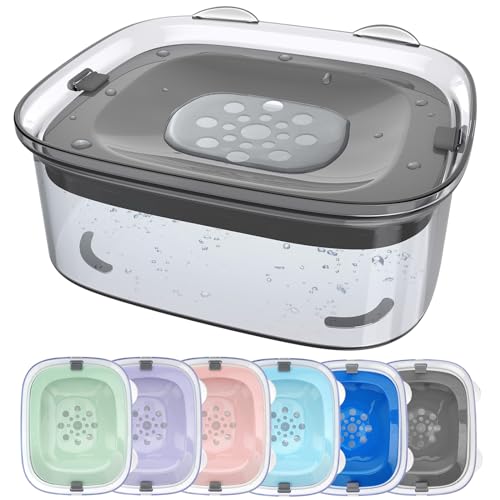
AONKEY 3L Clear Acrylic Bowl is the clear-bowl option, making the water level visible without lifting the bowl. It holds 3 liters and has a floating disk with silicone plugs; the maker says the one-piece disk does not need to be pried open for cleaning. Its 9-by-7.2-inch footprint is more compact than the larger-capacity choices. Acrylic differs from the stainless steel bowls, so buyers specifically seeking a steel drinking surface should choose another option; this design instead prioritizes visibility and a small footprint.
Bottom line: Pick it when seeing the water level at a glance is your priority.
Decflow 10L Bowl with Silicone Mat
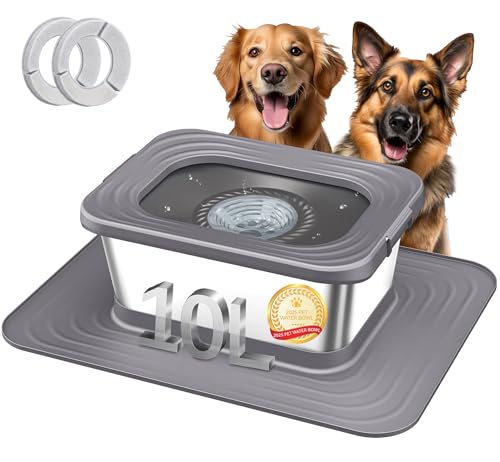
Decflow 10L Bowl with Silicone Mat has the largest capacity here at 10 liters, and its separate 20-by-15-inch silicone mat extends well beyond the bowl’s 14.5-by-10.7-inch footprint. The stainless steel bowl uses a floating board; the maker says it slows drinking and helps keep debris out. That capacity can reduce refill frequency for large dogs or a shared water station, but the wide mat needs more floor area than the compact choices. Its 6.2-inch height is also worth checking against your dog’s comfortable drinking posture.
Bottom line: Choose it for a shared station with room for the extended mat and the largest capacity.
How to choose a water bowl for a sloppy drinker
Choose the bowl by matching capacity, splash control and floor space to your dog’s habits. A floating disk limits how much water is exposed at once; a lid or raised guard adds a physical barrier around the drinking area. Those parts can contain splashes, but they do not guarantee a dry floor, especially when a dog carries water away on its muzzle.
As a rough daily water-intake guide, dogs often drink about 1 ounce per pound of body weight, with needs rising in heat, after exercise or on dry food. Use that estimate to judge refill frequency, not to restrict access: dogs should have free access to fresh water. For a 60-pound dog, a 3-liter bowl may need refilling during the day, while a larger bowl offers more reserve. Choose a footprint that fits the spot without blocking walkways.
Floating disks, lids and splash guards compared
A floating disk is the basic slow-flow design; a lid or raised splash-guard adds another layer of containment. The disk rises and falls with the water and exposes water through an opening, so the dog drinks from a smaller accessible area. A lid can help keep a dog from pushing or removing the disk, while a raised guard can catch splashes near the rim. Neither design replaces supervision or guarantees that every dog will drink comfortably from it.
Use this comparison to match the design feature to the mess you are trying to control.
| Design | Useful when | Trade-off |
|---|---|---|
| Floating disk | Dog splashes or drinks quickly | Dog must adapt to drinking through the opening |
| Hollow lid | Dog paws at or removes bowl parts | More parts to keep clean |
| Raised splash-guard | Water spills over the rim | Taller bowl needs suitable access and space |
Capacity and placement for shared water stations
Capacity helps determine how often a bowl needs refilling, but it does not determine whether each dog can reach the water comfortably. A 3-liter bowl suits a smaller or single-dog station more readily than a 7- or 10-liter bowl; multiple pets or a large dog may use a smaller reserve quickly. Keep bowls in a quiet, accessible spot, away from narrow traffic paths where people or pets can bump them.
Measure the floor area, including any mat, before selecting a large bowl. For the 10-liter option, the silicone mat extends to 20 by 15 inches. In a multi-pet home, offer enough separate water access that one dog cannot block another; provide another bowl if guarding or crowding makes access difficult.
Cleaning and safe use of slow-drink bowls
Wash a dog’s water bowl daily and refresh the water at least once a day; biofilm and saliva can collect on both the bowl and moving parts. Disassemble or lift the disk as its design allows, then clean the opening and underside instead of washing only the visible rim. Dishwasher-safe claims apply only to the product parts identified by the maker, so check before putting a disk, lid or mat in the dishwasher.
Do not use a slow-flow bowl to limit a dog’s water intake. Dogs need continuous access to fresh water, and an unfamiliar disk can make some dogs hesitant; introduce the bowl while supervising and keep a familiar water source available until the dog drinks comfortably. Seek veterinary advice for a sudden change in drinking rather than trying to solve it with bowl design.
Frequently Asked Questions
How often should I refill a dog water bowl?
Check and refresh a dog’s water at least daily, and refill sooner whenever the level gets low or the water becomes dirty. A rough intake guide is about 1 ounce per pound of body weight per day, with heat and activity increasing demand.
Do floating-disk bowls stop all water spills?
No bowl design can guarantee a spill-free floor because dogs may drip water after drinking or bump the bowl. A floating disk controls exposed water, while a lid or raised guard adds a barrier around the drinking area.
How do I clean a bowl with a floating disk?
Wash the bowl and disk daily, including the underside and the opening where water passes. Only put parts in a dishwasher when the maker identifies those parts as dishwasher safe.
Can I use a slow-drink bowl for a puppy?
A puppy can use one only if it can comfortably reach the water and readily drink through the disk opening. Supervise the first uses and keep another accessible source of fresh water available while the puppy adjusts.
How much water should a dog drink each day?
A common rough guide is about 1 ounce of water per pound of body weight per day. Heat, exercise, diet and health can change that need, so keep fresh water freely available and ask a veterinarian about a sudden change.