
PA66 GF30 Coolant Connectors: Fit and Design Compared

NW8 PA66 GF30 90° Coolant Connector is the closest match for a PA66 GF30 coolant connector because it names the reinforced nylon material and has a 90-degree NW8 elbow for tight routing. Choose another connector when your hose size, angle or vehicle application calls for a different configuration; the other options are not identified as PA66 GF30.
We earn a commission if you buy through links on this page. As an Amazon Associate I earn from qualifying purchases. Products are compared on manufacturer specifications, not hands-on testing.
- Best overall: NW8 PA66 GF30 90° Coolant Connector – The NW8 elbow is the only option that explicitly identifies PA66 GF30 construction.
- Best for straight runs: NW14 3/4-Inch Straight Connector – Its 3/4-inch connection and straight configuration suit a direct hose path.
- Best for NW16 routing: 6207721 NW16 90° Connector – The 90-degree fitting is identified as NW16 and includes OE code 6207721.
| Product | Best for | Connection size | Angle | Dimensions (L × W × H) | Shop |
|---|---|---|---|---|---|
| NW8 PA66 GF30 90° Coolant Connector | Tight-space elbows | NW8 | 90° | 1.73 × 1.46 × 0.87 in | Check Price on Amazon |
| NW14 3/4-Inch Straight Connector | Straight hose runs | 3/4 in | Straight 0° | 2.29 × 1.29 × 1.15 in | Check Price on Amazon |
| 6207721 NW16 90° Connector | NW16 elbows | NW16 (16 mm) | 90° | 2.09 × 1.27 × 2.02 in | Check Price on Amazon |
| Dorman 627-000 Radiator Hose Connector | Select Audi-VW fits | — | — | 5.5 × 3.7 × 3.5 in | Check Price on Amazon |
PA66 GF30 Coolant Connectors Compared
Compare connection size, routing angle and stated dimensions, then verify the exact application before choosing a replacement.
NW8 PA66 GF30 90° Coolant Connector
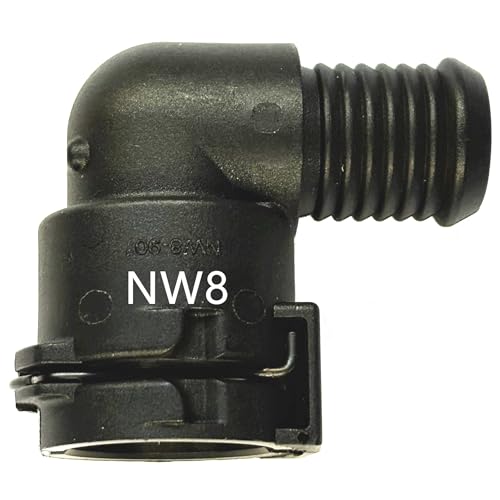
NW8 PA66 GF30 90° Coolant Connector stands apart by explicitly naming PA66-GF30, a 30% glass-fiber-reinforced nylon, in a compact 90-degree NW8 connector. Its maker gives a heat-resistance range of -40°F to 275°F and describes the fitting as threaded and barbed for BMW B38, B48 and B58 applications. The 1.73-inch length and 1.46-inch width may help when planning a tight coolant-line bend. This option suits a repair that calls for the same NW8 elbow arrangement; it is not a universal substitute for connectors with larger or straight hose connections, so confirm the vehicle application and hose fit.
Bottom line: Choose this when the application calls for an NW8, 90-degree PA66-GF30 connector.
NW14 3/4-Inch Straight Connector

NW14 3/4-Inch Straight Connector is the straight-run alternative, with a 3/4-inch hose connection rather than the NW8 elbow configuration. The connector measures 2.29 inches long, 1.29 inches wide and 1.15 inches high, and its vehicle range spans several European and American makes. Those make names alone do not establish fit for every engine or trim, so match the hose diameter and connector shape against the original part. Its 0-degree layout also will not replace a bent fitting when the hose must turn immediately.
Bottom line: Choose this for a compatible 3/4-inch hose that needs a straight connector.
6207721 NW16 90° Connector

6207721 NW16 90° Connector provides a larger NW16 (16 mm) 90-degree connection and identifies OE code 6207721, making it a distinct alternative to the smaller NW8 fitting. Its dimensions are 2.09 inches long, 1.27 inches wide and 2.02 inches high. The maker describes compatibility with selected BMW applications and says the connector includes reinforced O-rings and pre-attached stainless-steel clamps. Those sealing and installation features are maker claims, not a substitute for matching the original part.
Bottom line: Choose this when the vehicle calls for OE code 6207721 and an NW16 elbow.
Dorman 627-000 Radiator Hose Connector

Dorman 627-000 Radiator Hose Connector differs from the dimensioned hose fittings by being identified as a direct replacement for select Audi and Volkswagen models rather than by a named connection size or bend angle. Its overall dimensions are 5.5 inches long, 3.7 inches wide and 3.5 inches high, which describe the part envelope but do not establish hose compatibility. Dorman describes it as a replacement for original hardware that is missing or has failed from fatigue and recommends checking the exact make, model and trim.
Bottom line: Choose this for an exact select Audi or Volkswagen application match.
How to choose a coolant hose connector
Match the connector’s hose size, angle and mating style to the original part before considering material. A straight connector keeps a hose run in line, while a 90-degree elbow redirects it; even a small change in bend location can affect clearance around nearby engine components. Measure the hose’s inside diameter rather than estimating from its outside, since the hose wall adds thickness. Match any threaded end, barb pattern, retaining clip or groove to the removed connector. With less than 1 inch of clearance in the direction the hose must turn, compare the fitting’s full dimensions and elbow orientation before ordering. A vehicle make alone is not enough to confirm fit; engine and trim can change coolant-line connections.
What PA66 GF30 means for coolant fittings
PA66 GF30 means polyamide 66 reinforced with 30% glass fiber; the fiber changes stiffness and dimensional behavior compared with unreinforced nylon. A coolant fitting still has to match the vehicle’s original shape and connection, because a reinforced material does not make different sizes interchangeable. Heat exposure and repeated hot-cold cycles can stress plastic components over time, so inspect a removed fitting for cracks, distortion and damaged sealing surfaces. The NW8 option’s maker states a -40°F to 275°F heat-resistance range; that claim applies to that product, not every PA66 GF30 fitting. Do not substitute a generic temperature rating for the vehicle maker’s required connector material or application.
Coolant connector replacement and safety
Coolant systems are pressurized when hot, so never remove a connector or open the reservoir cap until the engine is fully cool. Many passenger vehicles use a 50/50 mixture of coolant and water, but the correct chemistry and concentration depend on the vehicle; mixing incompatible coolant types can cause deposits or corrosion. Drain coolant below the connection before separating a hose, then check the hose end for splits and the sealing area for residue or damage. A replacement connector cannot correct a cracked hose or a failed clamp. Refill and bleed the system using the vehicle procedure, then monitor the level after the first complete cool-down. Collect drained coolant securely because it is toxic to people and animals.
Frequently Asked Questions
How do I measure a coolant hose for a connector?
Measure the hose’s inside diameter with calipers or compare it against the original connector’s barb size. A 3/4-inch connection is not interchangeable with an NW8 or NW16 fitting just because the hose can be forced over it.
Can a 90-degree coolant connector replace a straight one?
Only when the vehicle’s hose route and available clearance allow the same connection points. A 90-degree elbow changes the direction immediately at the fitting, while a straight connector keeps the run aligned.
When is it safe to replace a coolant connector?
Wait until the engine and cooling system are fully cool before opening or draining anything. A hot system is pressurized, and escaping coolant can cause severe burns.
What coolant mixture should I use after replacing a connector?
Use the coolant chemistry and concentration specified for the vehicle; many passenger vehicles use a 50/50 coolant-water mix. Do not assume every coolant color or formulation is compatible with the system.
How can I tell if a plastic coolant connector needs replacement?
Look for visible cracks, distortion, coolant residue or a damaged sealing surface when the system is cold. Heat cycling can stress plastic fittings, and a sound-looking connector should still be checked for a secure hose and clamp fit.