
LED Lights for Terrarium: Reptile and Plant Options

For a 12- to 18-inch reptile terrarium, Pawfly 11 W Terrarium Light is the closest match because it has extendable sizing and separate day and night modes. Choose Hygger Zoo 12W LED UVB Light instead when UVB and adjustable UVI modes are a priority; plant grow lights serve planted setups, not reptile UVB needs.
We earn a commission if you buy through links on this page. As an Amazon Associate I earn from qualifying purchases. Products are compared on manufacturer specifications, not hands-on testing.
- Best overall: Pawfly 11 W Terrarium Light – Extendable 12- to 18-inch fit and two modes with six intensity levels.
- Best for UVB modes: Hygger Zoo 12W LED UVB Light – Includes five UVI modes and an extendable reptile-tank design.
- Best for small plants: Kullsinss 3.5-Inch Plant Grow Light – A standalone plant light with timer settings and 10 dimmable levels.
| Product | Best for | Fit or size | Lighting modes | Brightness control | Shop |
|---|---|---|---|---|---|
| Pawfly 11 W Terrarium Light | Flexible reptile fit | 12–18 in. | Day and night | 6 levels | Check Price on Amazon |
| Hygger Zoo 12W LED UVB Light | UVI mode choices | 14 in. | 5 UVI modes | Dimming | Check Price on Amazon |
| AQUANEAT 18–24-Inch Aquarium Light | Freshwater tanks | 18–24 in. | On or off | Not adjustable | Check Price on Amazon |
| Kullsinss 3.5-Inch Plant Grow Light | Small planted displays | 3.5 in. light | 3 spectra modes | 10 levels | Check Price on Amazon |
| Barrina T5 1-Foot Grow Lights | Plant strip setups | 1 ft. strips | Full spectrum | — | Check Price on Amazon |
LED Lights for Terrarium
Match the light to its job first: reptile lighting, freshwater aquarium lighting, and plant growth lighting are not interchangeable.
Pawfly 11 W Terrarium Light

Pawfly 11 W Terrarium Light is the direct terrarium option for tanks 12 to 18 inches long, with a 11 W rating and an extendable design. Its full-spectrum output combines 6500 K white, 450 nm blue, and 660 nm red light. Day mode uses all lights, while night mode uses blue light only; the controls provide six intensity levels. This suits buyers who want visible day-and-night modes in one fixture. The main limitation is that the maker does not identify UVB output, so buyers whose reptile needs UVB should select a fixture with verified UVB performance instead.
Bottom line: Pick this for a 12- to 18-inch terrarium when day-and-night visible lighting is the goal.
Hygger Zoo 12W LED UVB Light

Unlike a visible-light-only terrarium fixture, Hygger Zoo 12W LED UVB Light is identified as a 12 W LED UVB light and offers five UVI modes, from 2.0 through 15.0, plus dimming. The maker says its UVA and UVB lighting supports reptile activity and vitamin D3 synthesis; those are product claims, not a substitute for matching light exposure to the animal. Its 14-inch size makes it a distinct choice for buyers prioritizing UVB features. The limitation is fit: the size is fixed at 14 inches, so confirm that it can be positioned over the intended enclosure.
Bottom line: Choose this when a 14-inch fixture and selectable UVI modes suit the reptile setup.
AQUANEAT 18–24-Inch Aquarium Light
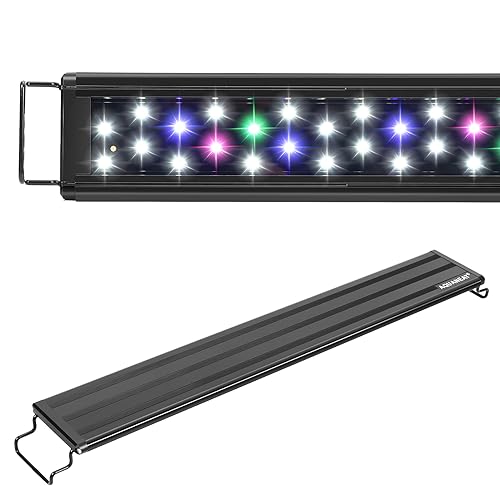
AQUANEAT 18–24-Inch Aquarium Light is an aquarium fixture rather than a reptile terrarium light, with extendable brackets for 18- to 24-inch freshwater tanks and 42 LEDs. Its controls switch all lights on or off; there is no timer or brightness adjustment. That simpler aquarium role makes it relevant only when the enclosure is an aquatic setup designed for this type of light, not when a reptile requires species-specific UVB. The maker cautions that the fixture is not waterproof and should be kept away from splashing water, which is an important constraint around aquatic habitats.
Bottom line: Consider it only for a freshwater aquarium-style enclosure where its splash limitation can be respected.
Kullsinss 3.5-Inch Plant Grow Light

Kullsinss 3.5-Inch Plant Grow Light is a small plant grow light, not a reptile lamp; its base or soil-insertion setup is intended for potted plants and shelves. The 48 LEDs cover a 380–760 nm range, with white, warm-white-and-red, and all-light-on modes. A timer offers 3-, 9-, or 12-hour settings, and brightness has 10 levels. This suits a terrarium focused on small plants when the light can be positioned for the plant arrangement.
Bottom line: Pick it for small plants in a display, not as a reptile UVB source.
Barrina T5 1-Foot Grow Lights

Barrina T5 1-Foot Grow Lights differs from the compact plant lamp by using four 1-foot grow light strips in a linkable format. Each is a 5000 K full-spectrum plant light, with magnetic installation and three mounting modes; up to 16 lights can be linked in series. That arrangement suits a plant-heavy terrarium or shelf where strip coverage and installation options matter more than a single standalone fixture.
Bottom line: Choose these strips for plant lighting when linkable mounting is more useful than reptile UVB.
How to choose LED lights for terrarium use
Start by deciding whether the light is for an animal, plants, or both, because visible LEDs and UVB serve different roles. Reptile lighting must match the species and its required exposure; a lamp advertised as full spectrum is not automatically a UVB source. For a planted enclosure, consider coverage, mounting distance, and photoperiod rather than assuming a household LED will support plant growth. A useful decision rule is to choose a fixture explicitly identified as UVB when the animal’s care needs call for UVB, and use plant lights only for the plants. For lighting modes, a timer can help maintain a regular schedule; manually operated modes require the user to manage the on/off routine.
Terrarium light fit and placement
Measure the enclosure’s usable top length before choosing a fixture, and compare that measurement with the fixture’s range rather than the outside tank dimensions alone. An extendable 12- to 18-inch light and a fixed 14-inch fixture solve different fit problems. For UVB, distance and barriers matter: glass and most plastic block UVB, so a lamp shining through a closed glass lid may not deliver the intended exposure. Follow the reptile species’ care guidance for target placement and exposure, and avoid assuming that greater intensity is safer. Keep electrical fixtures away from water and splashes, and secure cords so animals cannot pull or chew them.
Reptile, aquarium, and plant lights compared
Reptile lights are selected around the animal’s lighting requirements, aquarium fixtures around aquatic tank coverage, and grow lights around plant growth. A device’s LED label alone does not establish that it has the right spectrum for another purpose. The table gives a quick way to sort these categories before checking size and placement.
| Lighting purpose | First thing to match | Common mismatch |
|---|---|---|
| Reptile enclosure | Species-specific UVB and exposure need | Assuming visible full-spectrum means UVB |
| Aquatic enclosure | Tank length and water-safe placement | Allowing a non-waterproof light to get splashed |
| Terrarium plants | Plant coverage and mounting position | Expecting plant LEDs to satisfy reptile UVB needs |
Safe lighting habits for reptiles
UVB exposure is a husbandry requirement for many reptiles, but the needed level depends on species, enclosure layout, and the animal’s access to shade. Use a UV meter when setting a UVB gradient; a UVI reading is more useful than judging brightness by eye. Provide a shaded retreat so an animal can move out of direct exposure, and never treat a high selectable UVI mode as universally appropriate. Replace or measure UVB sources according to their manufacturer’s service guidance, since visible light can remain bright even as UVB output changes. Keep lighting cables and fixtures out of reach and away from wet surfaces.
Frequently Asked Questions
Does full-spectrum LED mean a terrarium light has UVB?
No; full-spectrum wording alone does not confirm UVB output. Check for an explicit UVB specification, and match the source to the reptile’s species-specific needs.
Can aquarium LED lights be used in terrariums?
Only when the enclosure’s needs and fixture placement are compatible; an aquarium light does not automatically provide reptile UVB. Keep non-waterproof fixtures away from splashes, and verify dimensions before mounting.
How long should terrarium lights stay on each day?
A common starting schedule for many reptiles is about 12 hours of light and 12 hours of darkness, adjusted for species and seasonal needs. A timer helps keep that schedule consistent.
Does glass block UVB from a terrarium lamp?
Yes, ordinary glass and most clear plastics block much of the useful UVB. Place the UVB source so it is not shining through a glass or plastic barrier, while preserving a shaded retreat.
How do I measure UVB exposure for a reptile?
Use a UV index meter at the animal’s basking position and at the height where it can reach the lamp. Compare readings with care guidance for that species rather than choosing a setting based on visible brightness.